


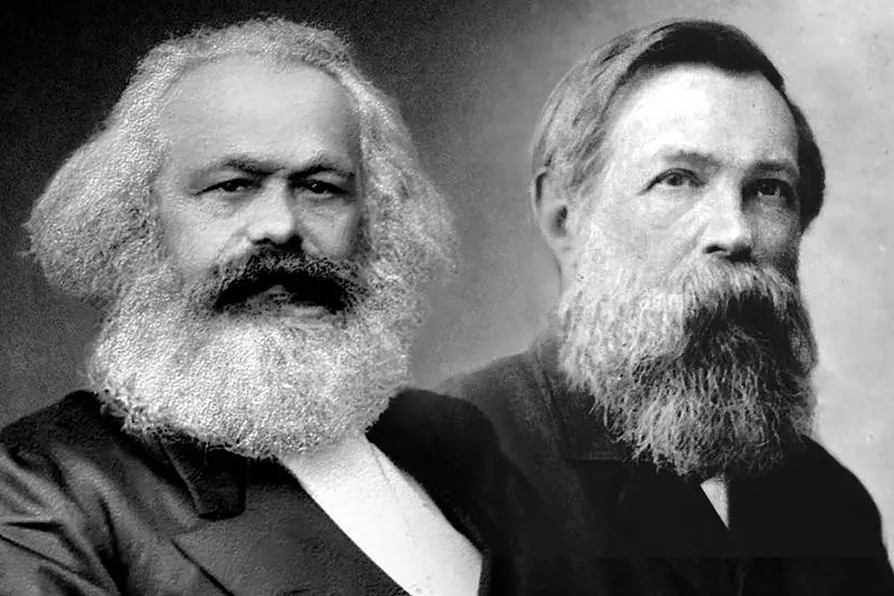
 Editorial webpic.jpgKarl Marx and Friedrich Engels / Pic: Wikipedia/CC






TOMORROW, Saturday February 21 is the anniversary of the 1848 publication of The Manifesto of the Communist Party drafted by Karl Marx and Friedrich Engels and adopted by the International Working Man’s Association in 1864.
We mark this event each year with Red Books Day in which we celebrate the present day explosion in revolutionary writing with readings of contemporary texts which have a profound meaning for us and, of course, of the revolutionary prose of the two 19th-century giants of revolutionary thought and action.
In the manifesto the authors move from a profound and detailed analysis of the capitalist formation and the philosophical basis of revolutionary ideas to a direct address to working men and women.
The authors present a series of direct demands which challenge the material basis of existing society and the ideas which arise on the basis of private property Marx and Engels present a political platform which remains surprisingly relevant today.
They propose the abolition of private property in land and inheritance. Just how this touches the nerve of the property-owning class today is revealed by the proposal to tax agricultural inheritance at the same rate as other inheritance.
We can see that the demand for a progressive inheritance tax has today a special relevance when wealth — itself drawn from the unpaid wages of workers, from rents extorted from that part of the labourers’ wages they actually receive, and of the interest paid on loans — is taxed at a much lower rate than wages.
Sir Jim Ratcliffe’s careful squirrelling of his four billion unpaid tax pounds in his Monaco hideaway would be compensated for by the proposal of Marx and Engels to confiscate the property of rebels against the communist order and those who flee the new dispensation.
The revolutionary duo propose that the workers international advocate the nationalisation of credit, communications and transport, a principle these two visionaries would undoubtedly extent to todays’ public utilities, the NHS, mail, rail and energy.
Their prospectus includes the expansion and integration of industry and agriculture — a policy impossible without public ownership — the enforcement of universal obligation of labour; the provision of universal education and the elimination of child labour.
These almost prosaic demands presented a challenge to capitalist relations of production in 1848 — the Year of Revolutions which saw in Britain a mass, almost insurrectionary, gathering of working people under the republican colours of the People’s Charter — and today they remain even more relevant.
Addressing conventional wisdom, Marx and Engels say: “You are horrified at our intending to do away with private property.”
They point out that: “But in your existing society, private property is already done away with for nine-tenths of the population; its existence for the few is solely due to its non-existence in the hands of those nine-tenths.”
Today the Office of National Statistics (ONS) report that wealth inequality in Britain is much more severe than income inequality, with the top 20 per cent of the population taking more than a third of the country’s income and nearly two-thirds of the wealth while the bottom fifth have just 8 per cent of the income and 0.5 per cent of the wealth.
Britain’s 50 richest families have more wealth than 50 per cent of the population while property, inheritance and finance account for over half of total billionaire wealth.
We celebrate the Manifesto not just for the quality of the writing, not just for the clarity of vision and analyis but because it is a call to action to end exploitation and oppression and establish the communist order.
And we can judge how relevant the 1848 text is by noting that an absolute majority of British people, including Tory and Reform UK, voters favour nationalisation of utilities and greater taxes on the rich.
