Britain funds the policing of black culture 16 times better than the culture itself. The Diamond Jubilee is the moment to end that, argues CLAUDIA WEBBE


 Latest editorial

A journey of solidarity – from Britain to Havana
GEOFF BOTTOMS recalls meeting Fidel Castro in the ’90s after joining a Pastors for Peace caravan to Cuba, and reflects on how international support is still vital to help the island withstand economic warfare
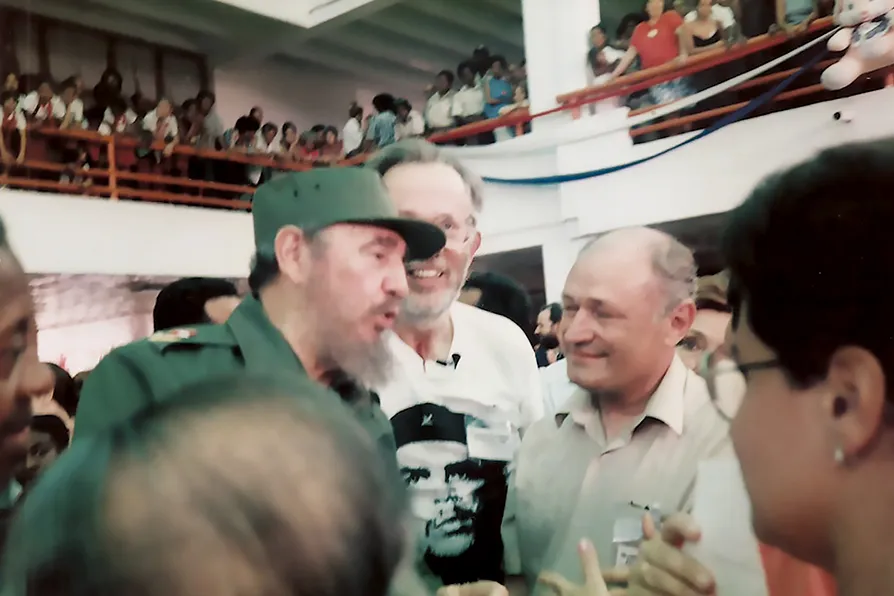 Geoff Bottoms meets President Fidel Castro in Havana in 2000 / Pic: Author supplied
Growing instability in the US economy and financial markets could have serious consequences worldwide because of the central role of the US dollar and financial system, argues MICHAEL BURKE
Despite Andy Burnham’s declaration defending the continued partition of the island, all major international and internal trends are converging to make Irish reunification inevitable
Humans are part of the ‘animal kingdom’ – and of nature in general – but also distinct from it and labour (work) is part of what makes us unique, declared Engels. His insights 150 years ago into how our species came to be and how we differ from the rest of nature, are as important today as they were then, says the MARX MEMORIAL LIBRARY
Growing instability in the US economy and financial markets could have serious consequences worldwide because of the central role of the US dollar and financial system, argues MICHAEL BURKE
From Margate to Deal, mining memories are being kept alive. National co-ordinator for General Strike 100, HENRY FOWLER continued his nationwide tour of partner organisations in the Garden of England





PASTORS for Peace is a project of the Interreligious Foundation for Community Organisation, founded by the late Rev Lucius Walker in 1992, which organises annual caravans across the US delivering medicine, equipment and educational materials to Cuba via neighbouring countries in defiance of the US blockade.
A small group of Cuba Solidarity Campaign activists from Britain joined the convoy in May 1997, knowing that they could be detained at the Canadian border, fined, or even imprisoned for violating US embargo regulations.
This included Tony Caccavone, a London cabbie who took his taxi proudly displaying the colours of the Cuban flag, and myself as a Catholic priest, who were filmed throughout the trip for a BBC2 documentary series directed by Katherine Walker called Picture This, which was shown in September 2000.
This was at the height of the Special Period, which was an extended economic crisis in Cuba that began in 1991 following the collapse of the Soviet Union, when the country lost around 85 per cent of its foreign trade and its gross domestic product (GDP) plunged by 35 per cent within four years, triggering acute shortages of food, medicine and fuel.
Seeing an opportunity for regime change, the US had also passed the Torricelli Act in 1992 to penalise foreign subsidiaries trading with Cuba, severely restricting alternative possibilities for trade.
In response Cuba had taken several measures in order to survive as well as to develop.
Holding foreign currency was legalised in 1993, creating a dual-currency system which allowed families receiving foreign remittances to buy goods at state-run dollar stores.
Cuba was also opening its doors to foreign investment with luxury beach resorts being built as joint ventures with European and Canadian firms to bring in vital cash reserves.
Together with farmers’ and artisans’ markets, the government had even permitted limited self-employment such as private family restaurants and guest houses.
Solidarity was vital then just as it is now, but little did we know that towards the end of the blockade-busting journey, which took us through New York State and successfully across the border into Canada before flying on to Cuba for a programme of activities, we would end up meeting the President Fidel Castro for the official handing over of the solidarity aid.
The event took place in the Pioneers Palace in Lenin Park, 20km south of central Havana, when in the midst of a series of speeches a fleet of official black cars appeared, and in walked Fidel to great applause and cheering.
He didn’t make a speech on this occasion, but at the close of the meeting the Rev Lucius Walker called me and Tony Caccavone over to meet the man himself.
Tony handed him a photo of his taxi decorated in the Cuban flag, while Fidel spoke to me for about five minutes about ecological issues and the need to protect our planet, which was months ahead of the landmark Kyoto Protocol.
At the time, Cuba was being transformed into a global pioneer of organic farming, with city lots converted into community urban gardens to feed local populations, as a result of the Special Period.
Gently towering over me Fidel reinforced the points he was making with gentle taps on my shoulder and spoke with a soft voice in contrast to his passionate public speeches.
Overawed, I remember saying to him before the final hug that he was an inspiration and that I stood in solidarity with him.
And now in the face of a cruel, criminal and escalating US energy blockade, together with the ramping up of sanctions and aggressive threats against Cuba, including the indictment of former president Raul Castro as a pretext for further intervention, Cuba is experiencing another existential crisis that demands urgent action and solidarity.
China is providing massive support to Cuba’s energy sector, helping to alleviate critical power shortages and reduce dependence on fossil fuel imports through solar expansion. By May 2026, Chinese assistance has fuelled a surge in solar power, with over 50 solar parks completed out of 92 pledged by 2028, and more than 10,000 panel systems installed for homes, farms, and critical infrastructure.
This partnership, which includes technical assistance and training, has made China the key player in Cuba’s attempt to remodel its ageing energy infrastructure, and is crucial for Cuba’s plan to transition completely to renewable energy by 2050.
It is also helping to mitigate the impact of the US oil siege, while representing a substantial boost for defending the country’s sovereignty and its socialist development path.
If Cuba sustains the present pace of installation with continuing Chinese support, and achieves adequate battery storage, it could reach energy independence that renders oil blockades economically irrelevant.
This is what international solidarity looks like, together with political campaigning calling on governments, trade unions, parliamentarians and supporters of peace to reject Washington’s escalating campaign of economic warfare, destabilisation and manufacturing of pretexts for further aggression, as well as practical relief in the form of solidarity aid such as CSC’s Cuba Vive appeal, Pastors for Peace Friendshipment Caravans, and the recent Nuestra America Convoy.
In this centenary year of the birth of Fidel Castro the words of his grandson, Fidel Antonio Castro Smirnov, during his recent national tour, remind us that “the legacy of Fidel Castro is not a debate about the past, it is a debate about the future.
“While they attack, we plan vaccines, while they build walls, we train doctors, while others try to break us, without any fear we continue the work of my father and my grandfather. There will be no blockades nor imperial pressures that can change our march towards a sovereign, independent, prosperous and sustainable socialism.”
This message of defiance and resistance to the imperialist arrogance and aggression of the US is Fidel’s legacy, not only to the Cuban revolution, but to humanity in general.
If “our homeland is humanity,” according to Cuba’s national hero, Jose Marti, then “the homeland must be defended,” to quote the current revolutionary slogan.
Today that defence begins with Cuba.
