Latest editorial

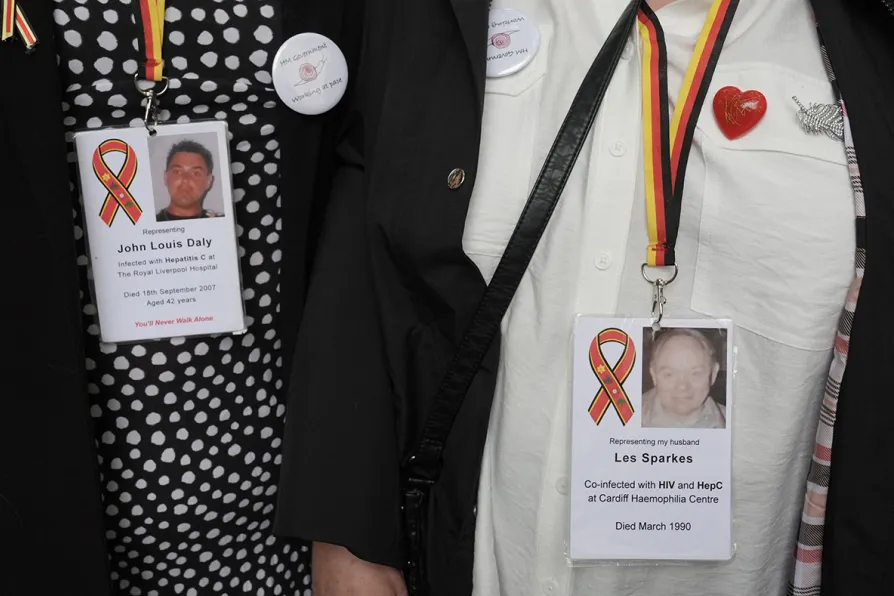 Family members wearing tributes to victims whilst attending a service of recognition, remembrance and reflection for members of the infected blood community, at St Paul's Cathedral, London, May 19, 2026






VICTIMS of the infected blood scandal held a protest outside Downing Street calling on Prime Minister Andy Burnham to resolve “injustices” in the compensation scheme today.
Campaigners delivered handwritten letters to No 10 warning victims are facing “unreasonably high standards of evidence” and urged him to take action to speed up payments.
The Infected Blood Inquiry closed this year after examining what has been dubbed the worst treatment disaster in the history of the NHS.
A compensation scheme for victims was announced in 2024 with £11.8 billion allocated to compensate victims, administered by the Infected Blood Compensation Authority (IBCA).
Mr Burnham was praised as a long-standing supporter of contaminated blood victims before becoming PM.
Figures from the IBCA show that to August 27, some 3,512 have had their compensation paid, with the combined payments totalling more than £2.2 billion.
But campaigners have said that only 17 per cent of victims have been compensated, with mothers being asked to prove they lived with their children who died in order to start their claim.
Contaminated Blood Campaign founder Glenn Wilkinson, who organised the protest, said: “Our community expected, and deserved, a compensation scheme that was straightforward to deliver and simple to understand.
“Instead, hepatitis victims in particular have been left with an unnecessarily complex scheme that requires an unreasonable level of mental gymnastics simply to navigate and process.
“[Chairman of the inquiry] Sir Brian Langstaff made clear that ‘people affected by decisions need to be involved in them.’
“Yet, despite this fundamental principle, the government deliberately excluded our community from engaging with its experts before the compensation scheme was designed and established.
“The result is a failing scheme that has imposed unnecessary complexity, distress and ongoing retraumatisation on the very people it was intended to compensate.”
More than 30,000 people in Britain were infected with HIV and hepatitis C after they were given contaminated blood and blood products in the 1970s and early 1990s.
An IBCA spokesperson said: “We understand that records, particularly for events that happened decades ago, can be difficult to access or no longer exist.”
A government spokesperson said: “We have listened and learned through constant engagement with the community to make changes to the scheme, while recognising the resolve of victims in their fight for justice.”




Social Housing Action Campaign blasts PM’s decision to break commitment to allocate 100% of Affordable Homes Programme to social rents