


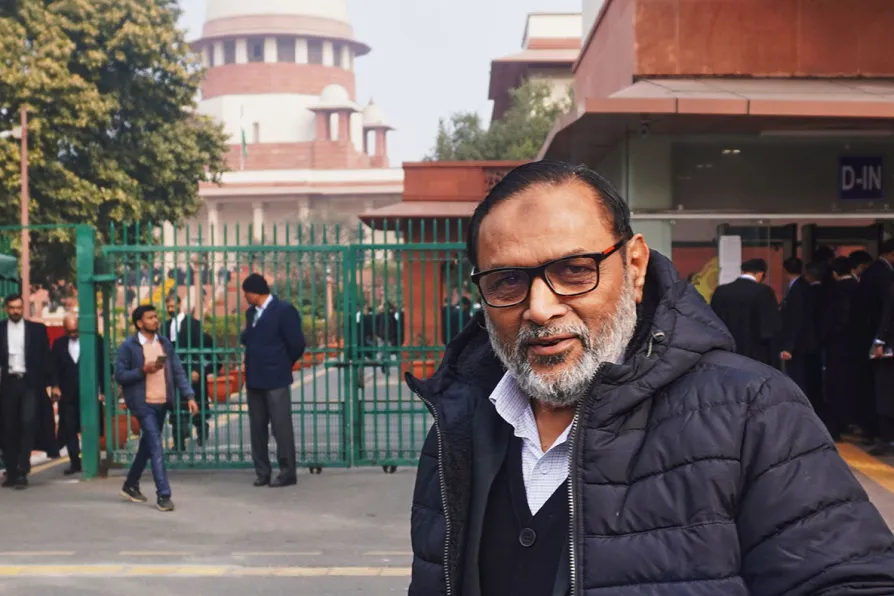
 Qasim Rasool, father of Umar Khalid, arrives at the Supreme Court for the hearing of the bail plea of his son in New Delhi, India, January 5, 2026





INDIA’S Supreme Court denied bail to two Muslim student activists today who have spent years in detention without trial over a case linked to one of the country’s deadliest outbreaks of religious violence.
Umar Khalid and Sharjeel Imam were arrested five years ago under India’s harsh state security law and accused of conspiring to incite the communal violence that swept parts of Delhi in February 2020.
The riots left 53 people dead, most of them Muslims, and took place amid massive, prolonged protests against a controversial 2019 citizenship law that discriminates against Muslims.
While bail was granted to the other five accused in the same case, the court noted that Mr Khalid and Mr Imam had a “central role in the conspiracy.” It also said that the delay in their trial was not a sufficient ground for granting them bail.
“Umar Khalid and Sharjeel Imam stand on a qualitatively different footing as compared to other accused,” the Supreme Court said in its verdict, according to Bar and Bench, a legal news website.
The two student activists were a leading voice in nationwide protests against the citizenship law, which marked one of the most significant challenges to Prime Minister Narendra Modi’s far-right Hindu nationalist government.
Their detention has been widely seen as emblematic of a broader crackdown on dissent under Mr Modi, drawing criticism from rights groups over the use of anti-terror laws against activists and student leaders.
In the months following the riots, police charged several other activists and organisers, under the Unlawful Activities (Prevention) Act, that in the past was used only to quell violent insurgencies but under Mr Modi has been largely used to silence political opposition.
Activists and other dissenters targeted under the law can be held in pretrial detention almost indefinitely, often resulting in years of detention until the completion of trial.
Mr Khalid and Mr Imam’s lawyers argue that there is no evidence linking them to the violence and deny the charges against them.
Dozens of other Muslims were also charged in similar cases related to the riots and held under prolonged detention. Some of those cases later unravelled because police were unable to provide evidence linking many detainees to the riots.
International human rights groups have also repeatedly urged Mr Khalid and Mr Imam’s release, saying their detention suppresses dissent and breaches fundamental legal protections.
Amnesty International in a statement last year said Mr Khalid’s “imprisonment without trial exemplifies derailment of justice” and is “emblematic of a broader pattern of repression faced by those who dare to exercise their rights to freedom of expression.”
