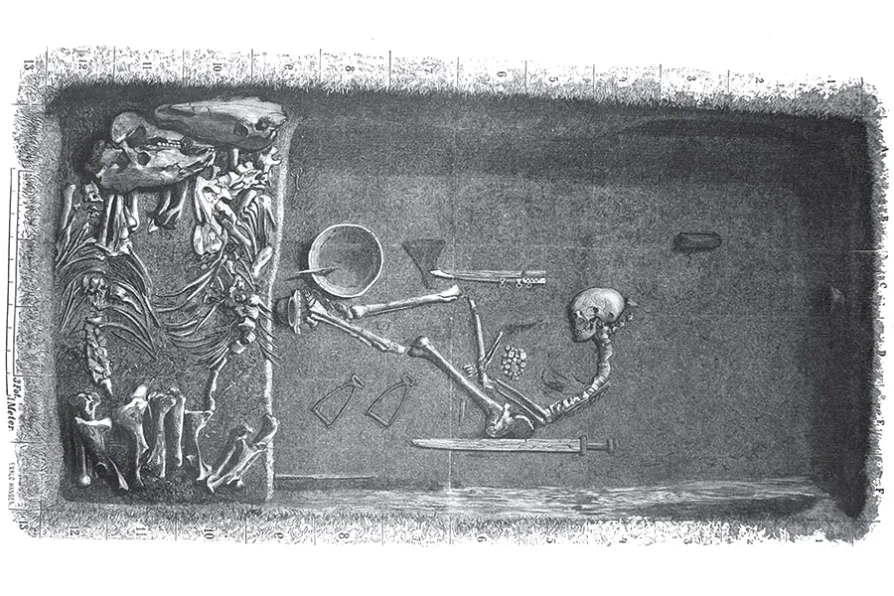
Reducing historical lives to ‘male’ and ‘female’ roles, we lose the nuance of those lives and a clearer understanding of past societies, suggests CLAIRE ISABELLA GILMOUR


 Latest editorial

‘I wanted the freedom to play simple melodies again’
Chris Searle speaks to saxophonist LARRY STABBINS
 Larry Stabbins on Sax and Mark Sanders on percussion at the 100 Club, London [Pic: Courtesy of Pete Woodman]
CHRIS SEARLE relishes the genius of pianist Alexander Hawkins, his many ensembles, and his new album
New releases from The Mountains Goats, Ed O’Brien, and YHWH Nailgun
ANGUS REID, ANDY HEDGECOCK and MARIA DUARTE review On The Sea, A Useful Ghost, Brunello: The Gracious Visionary, and Pinocchio Unstrung
RON JACOBS enjoys a great tale, told by a US communist, of the lives of working-class New Yorkers
BRENT CUTLER searches a new history of contemporary Iran for an understanding of the Islamic Republic, finding both interesting detail and glaring omissions
MARIA DUARTE recommends the true story of the remarkable woman who sued Donald Trump for sexual assault not once, but twice





“I PLAYED in a local dance band in my early teens, but got thrown out for trying to sound like John Coltrane. I played a solo and thought it sounded great, but the bandleader said: ‘Don’t you ever do anything like that again’!”
The insurgent saxophone sound of Larry Stabbins, born in Bristol in 1949, has marked his life in music.
“My mother was a primary schoolteacher from the Welsh Valleys, and my dad worked in the Filton Aerospace factory, although he’d been a percussionist in silent picture houses before the war and carried on playing drums until well into his ’70s.
“On my 12th birthday I bought Coltrane’s Africa Brass and that blew me away. The bass player in our school jazz club played me Ornette Coleman, then from the mid-60s it was mainly Archie Shepp and Albert Ayler — Junior Walker too. I left school at 17 and went straight into a Mecca dancehall band for six months then went off to London to join a soul band.
“By 1978 I was playing more and more free music, inspired by drummer John Stevens. I decided no more commercial music for me, no more London nightclubs. So I moved back to Bristol to concentrate on free music, paying my rent by repairing instruments.”
Fellow Bristolian, pianist Keith Tippett brought him into both his large-scale orchestral recordings of Septober Energy (1971) and Frames (1978), and he made a key album with Tippett and South African drummer Louis Moholo-Moholo in 1982. Between 1985-89 he made five albums as the co-leader of Working Week (formerly Weekend) with guitarist Simon Booth, playing a fusion of Latin, dance rhythms, soul, jazz and funk.
Now he has two albums simultaneously released: a duo album, Cup and Ring, with drummer Mark Sanders, and a trio album Aurora with Sanders and bassist Paul Rogers. Throughout both records, the spontaneous melodies teem from his saxophone, and in Cup and Ring, his flutes too.
“I was musically brought up playing melodies, so a lot of them must be stored somewhere inside me. When I started writing for Working Week I realised I had a flair for it and I was getting fed up with that type of improvisation where anything resembling melody or rhythm is beyond the pale. I wanted the freedom to play simple melodies again.”
I asked him about the special musical qualities of Rogers and Sanders.
“Our music just happens naturally. They both have experience of playing a vast range of music and wonderful creative imaginations. Paul supplies an endless stream of melodic and textual ideas to inspire me. Apart from being a whole string section on his seven-string bass, he brings both references to contemporary chamber music and folk music. Virginia Woolf called it ‘thickening the soup.’ I also think we absorbed a lot of influence from Keith Tippett in our many (overlapping) years of playing with him.
“Mark has a particularly fine sense of sound and texture. He really listens and responds — not all drummers do that. That’s why he’s in demand in so many situations. And if you want driving power, he has loads of it. But above all, I love the way he can play so much rhythm, layers of overlapping rhythmic patterns without overtly stating time.
“In Cup and Ring I wanted to do something with more space. With the duo there’s nowhere to hide — I have to come up with more melodic dimensions and make a break and do something new with flutes, rather than recreate the past.”
How does he think his music can seek to challenge and change the violent and disruptive times we are living through?
“It serves as a focal point to bring people together with similar views of the world and how we’d like to change it. There’s a quote I like and I don’t know where it comes from: ‘We make art to know we are not alone’.”
Listening to both these musical outings and their three brilliant creators, you feel my local sage William Morris’s words certainly: “Fellowship is life.” But hearing them again, you want to add: “Art is fellowship, for all of us.”
Aurora is released by Sarost (Jazz in Britain); Cup and Ring is released by Discus Records.
