


From ground-sharing and ownership battles to a return to the Premier League, the Sky Blues’ rise reflects the spirit of the city itself, writes DAVID CONWAY
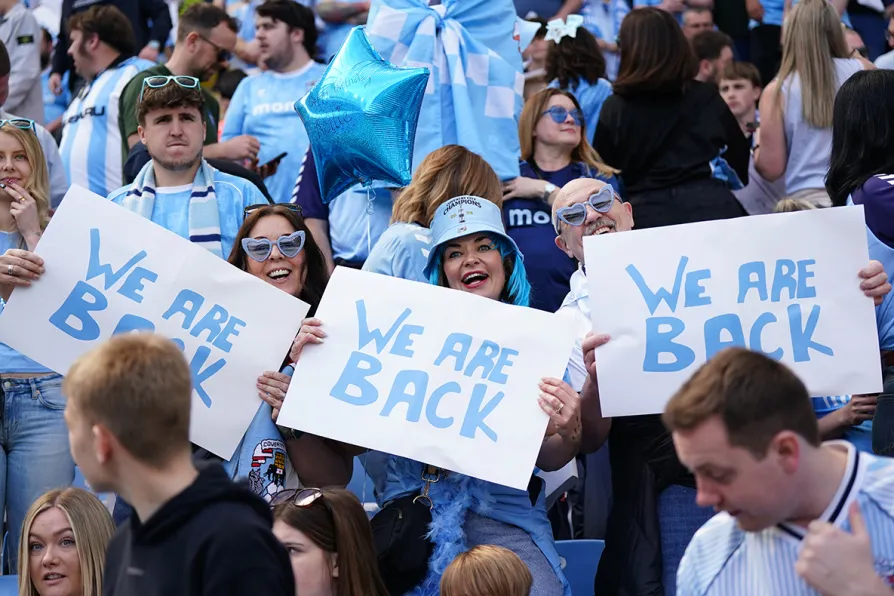
 Coventry City fans ahead of the Championship match at the Coventry Building Society Arena, Coventry, April 26, 2026
One of Britain’s longest-serving NFL fans is calling time after 18 years: “It’s priced me out”





COVENTRY is a city no stranger to suffering, resilience and renewal, and the recent history of Coventry City FC reflects that same spirit. Since relegation from the Premier League in 2001, the club has endured a prolonged period of decline. Yet Coventry’s recent success is not simply the result of improved performances on the pitch, but the culmination of years of collective hardship that forged an unusually resilient bond between club and supporters.
Years of Decline and Displacement
Following the sale of Highfield Road in 1999, Coventry City’s financial difficulties after relegation meant the club was unable to finance or retain ownership of its new stadium. The arena was instead developed and owned by Arena Coventry Ltd, backed by Coventry City Council and the Alan Edward Higgs Charity, leaving Coventry City as tenants when it opened in 2005.
Relegation to League Two in 2017 marked the lowest point in the club’s modern history. By that stage, supporters had already weathered years of instability: chronic underfunding, administration, points deductions, and the bitter experience of “home” matches being played in Northampton following a rent dispute with the stadium’s owners. Uncertainty intensified when Wasps RFC acquired a controlling stake in the arena, further distancing the club from its own home. Subsequent spells ground-sharing in Birmingham and Burton only deepened that sense of dislocation, while protests against the ownership of SISU Capital became a regular feature of supporter life.
Rebuilding Under Robins
Amid this turmoil, manager Mark Robins led Coventry to the 2017 EFL Trophy, promotion via the League Two play-offs, the League One title, and within touching distance of both promotion to the Premier League and an FA Cup final following the dramatic semi-final defeat to Manchester United in 2024.
Off the pitch, Doug King began the process of acquiring Coventry City in November 2022, agreeing to purchase a controlling stake from SISU before completing a full takeover and becoming sole owner in January 2023, much to the joy of supporters.
In a bold move that upset fans following a poor start to the 2024/25 season, King dismissed Robins and appointed Frank Lampard. Lampard inherited a squad with strong foundations and continued the club’s upward trajectory. Shrewd additions such as Matt Grimes brought control and composure in midfield, while players including Ephron Mason-Clarke and Jay Dasilva reached new levels of consistency.
Although Coventry were narrowly beaten by Sunderland in the play-off semi-finals, the disappointment proved a turning point rather than a setback. During the 2025/26 season, the club performed to a consistently high level, winning the Championship title and securing promotion to the Premier League.
Reuniting Club and City
Progress on the pitch was matched by consolidation off it, with King securing a controlling stake in the arena and finally reuniting the club with its home in August 2025. He has also committed to funding the season tickets of 5,000 supporters who backed the club through its “Premier Package” next season.
However, Coventry’s revival has been about far more than footballing or financial success. It has been built on the resilience of a supporter base that endured years of hurt.
The Supporters as a Driving Force
Time and again, the unrelenting backing of the fans has become a force in its own right, helping the team grind out results. The away match at Blackburn in 2023 stands as a powerful example: the 95th-minute equaliser, ricocheting in off goalkeeper Ben Wilson after he had gone up for a corner, felt less like chance and more like inevitability — as though the ball had been willed into the goal by the travelling supporters.
Playing away from Coventry amid protests against SISU can be regarded as one of the darkest periods in the club’s history. However, the anger generated during that time arguably galvanised supporter mobilisation and forged a stronger bond between players and fans, rooted in shared adversity.
The first game back at the arena following exile to Northampton, against Gillingham in 2014, was attended by 27,306 fans. Following League Two play-off final success, Robins said: “It’s about the players, the supporters and uniting a club.” His words emphasised how unity had become central to Coventry’s recovery.
After the 2023 Championship play-off final, King said: “We could all see the pride that fans and the whole city feels in their football club and we want to capture that at the [Coventry Arena], which is becoming a fortress for us.” Since then, the club has only lost 13 league games at home and King describes the club’s relationship with the fans as “a partnership”.
The manager and players openly acknowledge that performances are driven by the club’s fans. Shortly after joining, Lampard said: “I was surprised when I got here in terms of the fan base and what we’ve managed to get rolling… The fan base has been here long before me and will be here after me.” Speaking to the BBC after receiving his Championship winner’s medal Brandon Thomas-Asante said “moments like this aren’t just out of nowhere, they are built up of a year, over a year, decades. It is a journey”.
These sentiments reveal that the club’s success has been driven not only by recruitment and tactics, but by a collective emotional energy created by the supporters.
Reflecting the City
Coventry has a long history of welcoming people from different backgrounds and that tradition is reflected in the identity of Coventry City. Reform UK rhetoric centred on division, hostility to migration and opposition to inclusion feels far removed from the lived reality of a city built on its diversity.
Indeed, Gael Bigirimana would not have scored the decisive goal in the 2017 EFL Trophy final if Coventry had not welcomed him as a refugee in 2004 after he fled civil war in Burundi, before later joining the club’s academy at the age of 11.
The city’s identity has translated into a deeper culture of inclusion, one that is felt personally by both the club and its supporters. Lewis Wale, founder of Proud Sky Blues, has described how homophobic attitudes in football once drove him away from Coventry City, before the club’s growing commitment to inclusion gave him the confidence to return.
Proud Sky Blues was established in 2023 — now with over 100 members and actively collaborating with the club — has helped create what Wale describes as an environment where LGBT+ fans can “feel wanted and accepted.” Reflecting on the group’s connection with the club, Lewis feels Proud Sky Blues have been part of the club’s journey to the Premier League, stating “I’d say we’re certainly part of the club’s success.”
Creator of Sky Blues Against Racism, Guy MacGregor, explained that “Coventry is the city of anti-racism — The Specials, 2Tone, Pauline Black.” However, he said he felt compelled to start the group after noticing a rise in, and the growing normalisation of, racist behaviour in society, including stickers at the football ground stating “Stop the boats.”
Guy is now beginning to work more closely with the club and hopes this will provide the group with a “platform to denounce racism” that is embedded in the matchday experience, rather than a bolt-on, as diversity and inclusion initiatives can sometimes appear to be.
Lewis and Guy said that, despite the club becoming more welcoming, there is still much work to be done, and groups like theirs are crucial to making Coventry City increasingly inclusive. As supporter pride and diversity continue to grow, the club has become more than just a football team, serving as a reflection of the values and positivity within the city itself.
Champions Together
While the contributions of Robins, Lampard, King and players such as Jamie Allen and Liam Kelly cannot be underestimated, Coventry’s rise through the divisions has been built on the unwavering support of its fans, who will continue to be essential to sustaining success in the years ahead.
Coventry City’s return to the Premier League is more than a sporting achievement; it reflects a club reborn through collective resilience, where success has been built not only on results, but on unity, belonging and shared identity.
