

 Latest editorial

Iran and US agree two-week ceasefire as Israel launches new strikes on Lebanon
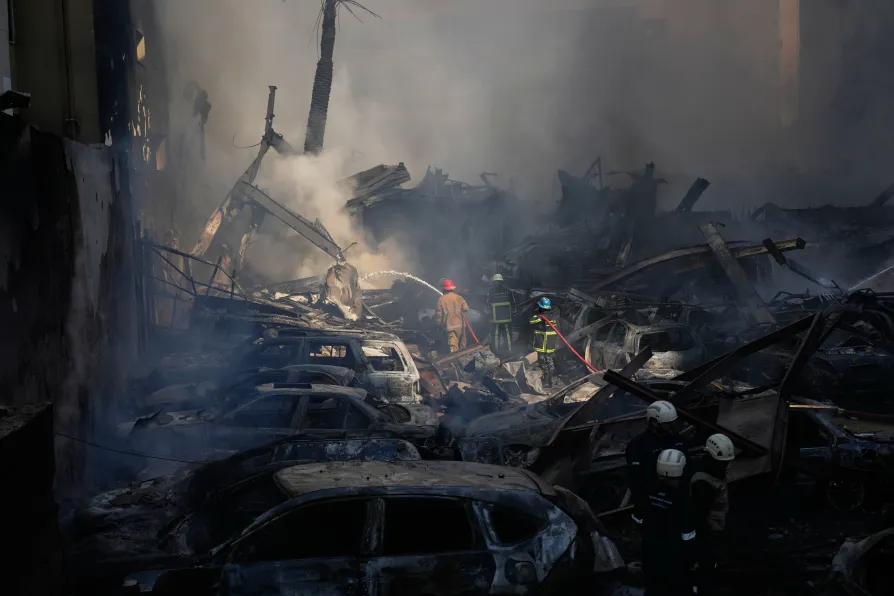 Firefighters spray smoldering debris at the site of an Israeli airstrike that struck a building in Beirut, Lebanon, April 8, 2026





ISRAEL launched new devastating strikes on Lebanon today, killing at least 87 people, as Iran and the US agreed to a two-week ceasefire.
World leaders rushed to celebrate news that their nations would find some relief from the oil crisis from the announcement, which followed the US President Donald Trump’s threat to unleash a bombing campaign to destroy the whole of Iran’s civilisation.
But the terms of the deal were unclear, with Iran saying it would allow it to formalise the new practice of charging ships passing through the Strait of Hormuz.
Mr Trump said that the US would also be working with Tehran to remove buried enriched uranium as part of its attempts to curb Iran’s missile and nuclear programmes, though Iran’s own version of the agreement in Farsi said it will be allowed to continue enrichment.
Pakistan, which helped to mediate the deal, said fighting would also pause in Lebanon, where Israel has launched a ground invasion.
But Israel denied this, striking more than 100 targets within 10 minutes across the country, the largest wave of attacks in over a month.
Lebanon’s National News Agency reported that the air strikes had hit at least five different neighbourhoods in Beirut’s central and coastal areas.
The Lebanese Ministry of Health said its initial toll showed that at least 87 people had been killed and more than 700 others wounded.
Hours after the ceasefire announcement, Iran and the Gulf nations reported new attacks.
An oil refinery on Iran’s Lavan Island came under attack, according to Iranian state television. Its report said that firefighters were working to contain the blaze, but no-one had been hurt. It did not say who launched the attack.
The island is home to one of the terminals that Iran uses to export oil and gas.
Bahrain, Israel, Kuwait, Saudi Arabia and the United Arab Emirates all issued warnings about incoming missiles from Iran.
British Prime Minister Sir Keir Starmer said there was a “sense of real relief” at the ceasefire, but that more work was needed to make the peace deal last and restore oil and gas supplies.
Sir Keir, who was visiting an air base in Saudi Arabia, said he wanted to ensure the economic impact of the war was minimised by getting the strait open again.
But End Fuel Poverty Coalition co-ordinator Simon Francis said that the “damage had already been done” to energy bills, saying: “The surges in oil and gas costs have already hurt household finances and will continue to have an impact on energy bills for months to come.
“Oil, LPG and gas costs have remained elevated for over five weeks, immediately impacting many households.
“All households will feel the pain from 1 July when the next Ofgem price cap period starts.”
Mr Francis said that as long as the energy system is “hooked on oil and gas prices, history will keep repeating itself and our bills will be at the mercy of decisions taken by Trump, Putin and Gulf States.”
A Stop the War statement said: “We regard Trump as a dangerous war criminal and have no illusions that this ceasefire will hold.
“We are committed to opposing any further attacks, and those of Netanyahu’s Israel on Lebanon and on the Palestinian people.
“Keir Starmer has been complicit in this illegal war, and we demand he stops allowing US planes to use British bases.
“The so-called ‘special relationship’ is finished, and the British government must break with Trump and his warmongering policies.”
Norwegian Refugee Council lead Jan Egeland said that while the ceasefire deal offers “a welcome reprieve for civilians across Iran, the Gulf and beyond,” it must not “be a short-lived window of hope before renewed violence.”
“All parties must commit to ending hostilities across the region beyond this two-week agreement. Lebanon must also be included.”
He said his colleagues are “reporting horrifying scenes of so much destruction and many casualties” amid Israel’s intensified bombardment of Lebanon.
“Israel and Hezbollah must commit to stopping their attacks, and Israel must withdraw from the Lebanese villages and territory it currently occupies,” he wrote on X.
Lebanon’s Minister of Social Affairs, Haneed Sayed, condemned Israel’s wide range of strikes, calling it a “very dangerous turning point.”
“These hits are now at the heart of Beirut,” she said.
“Half of the sheltered [internally displaced persons] are in Beirut in this area.”
She said Lebanon’s government is ready to enter negotiations with Israel for an end to the violence, and that an offer that was previously made, but Israel had not responded.
Israel’s military said it had targeted missile launchers, command centres and intelligence infrastructure and accused Hezbollah of using civilians as human shields.
Residents and local officials have denied that the buildings hit were military sites.
Before the wave of new strikes, a Hezbollah official said that the group was giving a chance for mediators to secure a ceasefire in Lebanon, but “we have not announced our adherence to the ceasefire since the Israelis are not adhering to it.”
The official said the group would not accept a return to the pre-March 2 status quo, when Israel carried out near-daily strikes in Lebanon despite a ceasefire being nominally in place since the last full-blown Israel-Hezbollah war ended in November 2024.
At a displacement camp on Beirut’s waterfront, 35-year-old Fadi Zaydan said: “We can’t take this anymore, sleeping in a tent, not showering, the uncertainty.
“But we’ll be targeted if we go home.”
UN secretary-general Antonio Guterres’s personal envoy arrived in Iran today as part of a regional tour aimed at supporting efforts to resolve the ongoing Iranian conflict.
Jeanine Hennis, the UN’s special co-ordinator for Lebanon, called for an end to the deadly violence, writing on X: “Today’s wave of [Israeli military] strikes came just as hopes for an end to violence and destruction were rising.
“This cannot go on. Neither side can shoot or strike their way to victory.”
