

 Latest editorial
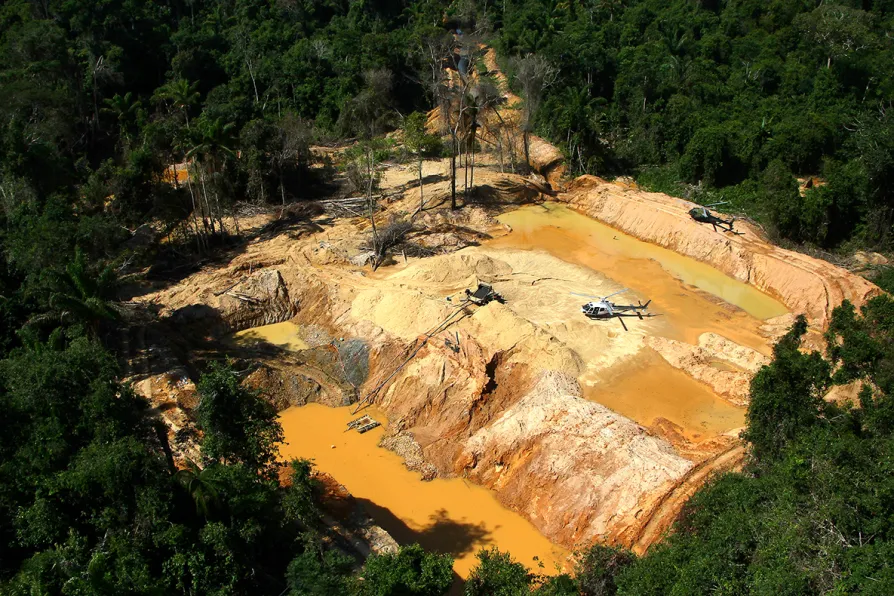 An illegal mining camp is visible from a Brazil Environmental Agency helicopter during an operation to try to contain illegal mining in Yanomami Indigenous territory, Roraima state, Brazil, February 11, 2023





A RENEWED mining rush in Brazil’s Amazon rainforest has been driven by surging gold prices in recent years, officials and experts say, with accelerating deforestation in protected areas and mercury contamination reaching hazardous levels.
According to a study published on Tuesday by non-governmental organisation Amazon Conservation in partnership with the Socio-Environmental Institute, illegal mining sites drove tree clearance inside three conservation areas in the Xingu region, spanning the states of Para and Mato Grosso.
The Terra do Meio Ecological Station recorded its first cases of illegal mining in September 2024. By the end of last year, mining-related deforestation there had spread to 74 acres.
In the Altamira national forest, illegal mining caused 2,056 acres of deforestation between 2016 and September 2025. A new mining front that opened in 2024 expanded to 89 acres by October 2025.
Satellite monitoring also detected a clandestine airstrip used by illegal miners at the Nascentes da Serra do Cachimbo biological reserve last year. Illegal mining in the reserve grew from five acres to at least 66 acres in 2025.
In 2023, Amazon Conservation teamed up with Earth Genome and the Pulitzer Centre to develop the Amazon Mining Watch, a platform that uses satellite imagery to track mining across the Amazon since 2018.
About 1,225,500 acres of rainforest have been cleared for mining since then, including approximately 551,000 acres in Brazil.
Amazon Conservation estimates that 80 per cent of mining-related deforestation in Brazil is very probably illegal.
Mining remains a relatively small driver of deforestation in Brazil, where forest loss is largely linked to agribusiness expansion.
However, “what makes mining particularly problematic is that it targets protected areas and indigenous territories,” said Matt Finer, director of Amazon Conservation’s Monitoring of the Andes Amazon programme.
Researchers warn that continued tree loss in the Amazon could accelerate the global climate emergency.
Federal prosecutor Andre Luiz Porreca said illegal gold mining is financed by Brazil’s largest criminal organisations.
Record-breaking gold prices, driven largely by investor demand for safe assets amid rising global risks, have provided a strong incentive for illegal mining.
As well as causing deforestation, illegal mining operations dump mercury into rivers, which contaminates waterways and accumulates in fish consumed by riverside and indigenous communities.
The Ministry of Indigenous Peoples said in a statement that combating illegal mining was a priority for the government.
However, when authorities destroy dredges and equipment in one region, miners often relocate or resume operations once officials have left.
