
PETER MASON applauds the revival, 39 years later with the same team and cast, of Manfred Karge’s version of Brecht’s 100-year-old play, Mann Ist Mann

‘Hallo! Greenham Common Peace Camp speaking’
MALC McGOOKIN appreciates a graphic novel that records the history of the legendary peace camp and surveys the state of the right to protest in contemporary Britain
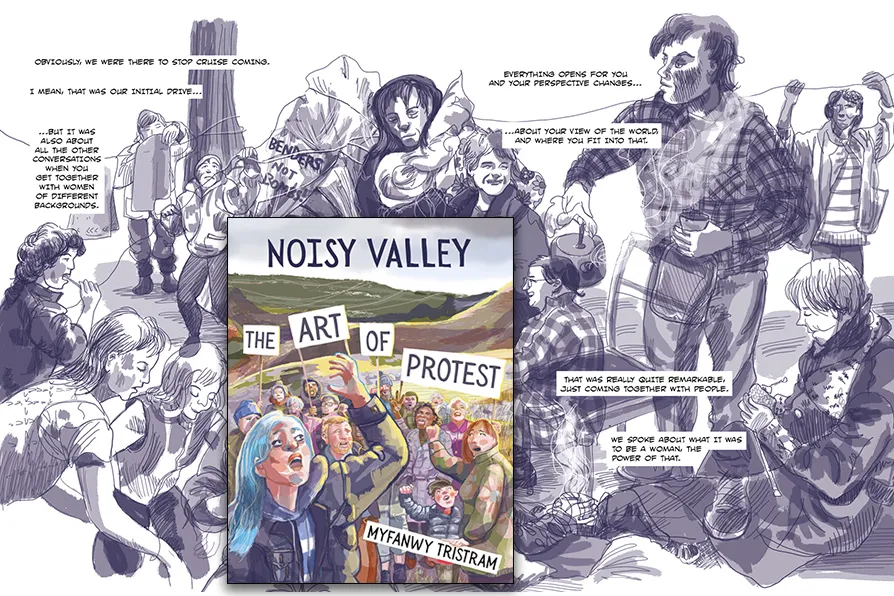
 Noisy Valley - The Art Of Protest, by Myfanwy Tristram

New releases from Biita Houdei, The Mary Wallopers, and The Tubs
New releases from Biita Houdei, The Mary Wallopers, and The Tubs
MAYER WAKEFIELD applauds a fearless attempt to bring to the stage the 1984 toxic gas disaster in Bhopal, India
ALEX HALL applauds the account of a dogged, traumatic and punishing campaign for justice that has lasted from 1998 to the present day
NICK WRIGHT laments the political bias of an epic attempt to tell the history of the liberation of France from the Nazis, that excludes both the decisive contribution of the Soviet Red Army, and of the French communist party itself





Noisy Valley — The Art Of Protest
Myfanwy Tristram, Selfmadehero, £14.99
FOR most of its history, Greenham Common was literally common land — it provided free grazing for sheep and a leafy country cloistered collection of rude houses and a pub, with its military connections largely brief and undistinguished, a large piece of sod to be trampled over by royalists and parliamentary troops in the English civil war, on their way to somewhere more memorable.
In 1943, the common was taken over by the USAAF Ninth Airforce, who built an airbase that would later play a huge part in the assembly and preparation for D-Day, June 6 1944, a date etched on a thousand monuments. Yet none of this would eclipse Greenham Common’s subsequent fame in British social history as the site of a 19-year occupation by the Women’s Peace Camp.
Myfanwy Tristram’s Noisy Valley — The Art Of Protest is a record of the peace camp in the form of a graphic novel, focusing on three of the most influential members, the Brinkworth sisters. Tristram’s soft, watercolour brush style conceals her equally signature, unemotional documentary approach, laying out the origins of that historic occupation, and is one of a series of 12 graphic novellas concerning protests from the Rondda Cynon Taf in Wales.
Sue, Christine and Lesley Brinkworth were not part of the original 120-mile march by the Women For Life On Earth movement from Cardiff to Berkshire in 1981, to protest against the British government’s announcement of an impending delivery and installation of 96 nuclear cruise missiles at the RAF site, Greenham Common.
The marchers, 36 women, four men and their children, had been inspired by the Scandinavian peace march barely three weeks prior, sponsored by three Norwegian women who led hundreds of protesters on a six-week marathon from Copenhagen to Paris.
The first great achievement of Anne Pettit, Karmen Cutler, Lynne Whittemore and Liney Seward, all living in Carmarthenshire, wasn’t to form their movement, but to gather any such support at all in an era when Britain was not short of headline news competing to elbow stories about sandal-wearing hippies (and women at that) off the front pages.
Peter Sutcliffe, the “Yorkshire Ripper,” had been arrested; the so-called “Troubles” in Northern Ireland were still in full spate; Bernadette Devlin was shot nine times by Ulster loyalist paramilitaries at her home in Northern Ireland; Murdoch bought the Times. Bobby Sands, then on hunger strike in The Maze prison, died (the first of 10 in the former Long Kesh); and Thatcher slashed public spending massively, sparking major riots in every city in Britain.
A protest march built on hope and courage by four women and a few families in a bid to save the planet needed to be planned with cold-blooded media savvy to cut through the noise, and this one had not.
On arrival, the exhausted marchers presented a letter to the site CO at Greenham Common, requesting a meeting. The approach was not so much refused as barely acknowledged, and even chaining themselves to the entrance gates generated little or no interest in the protest from a distracted Establishment media that had barely registered the women’s journey thus far.
The marchers subsequently returned to Wales, set up and organised further marches, but those who stayed at Greenham Common took the words of a US base commander to Greenham Common stalwarts as an invitation: “You can stay there as long as you like as far as I’m concerned.”
Thus the women set up what is still known as the Women’s Peace Camp at Greenham Common, and within a year the attendees were women only.
There’s no doubt this initial cold rebuff for the marchers was seen as a crushing disappointment, but Tristram outlines how it was precisely that lack of success that galvanised the Brinkworth sisters into preventing it from being left as merely a scribbled note squashed into the marginalia of innumerable reports on CND, Greenham Common and various peace movements throughout the 1980s.
Sue Brinkworth describes how she was actually on holiday when the marchers set off from Cardiff. Incensed at the lack of media coverage attached to it, she and her sisters organised their own local protests then joined the camp. They went on to be three of over 70,000 women who travelled to Greenham Common to bolster the ranks over 19 years.
Sue Brinkworth led from the front, including storming the camp and blockading herself in the police station, even answering police calls with “Hallo! Greenham Common peace camp speaking,” and each Brinkworth sister was jailed numerous times. The Brinkworths also opened up another front, taking the campaign to the US courts, pleading their case against a notorious Reaganite judge who (predictably) refused to overrule the decisions of the US government. On returning to their hotel room and switching on the TV, came the hammer blow — the news that cruise missiles had arrived at Greenham Common.
In the meantime, the peace camp continued to eschew the politics of placation. They blocked bulldozers, invaded the camp repeatedly, damaged MoD property, were targeted numerous times by Newbury District Council for eviction, were assaulted, threatened and taken to court (one woman appearing 32 times for criminal damage), yet they endured, more often lampooned than supported in mainstream media, until world events — so to speak — overtook them.
The Art Of Protest is able, in literally broad brushstrokes, to pay tribute to the dogged determination of a women’s peace initiative to be the biggest pain in the arses of two world powers. It was ostensibly the Intermediate Range Nuclear Forces Treaty (the Reagan-Gorbachev pact) which removed the missiles from Greenham Common.
But is that the whole story?
Certainly nothing in the official stances of the United States or Britain pointed to any true spirit of detente, not even in the affected smirk of Ronald Reagan. International summit talks are all very well, but if the Soviet Union and Gorbachev wanted evidence that, to a man and woman, the people of the West were not bent on piling up the means to wipe them out, then the peace camp at Greenham Common was it.
The governments of the West did not represent the views of their people. By 1989 Soviet inspectors had entered Greenham Common to supervise the decommissioning and removal of the missiles.
Myfanwy Tristram admits that her art is “political, personal, a bit scribbly” and that with a 9 to 5.30 day job, “time and energy are very rare commodities,” a problem shared by all art and artists. It was inevitable that some aspects of the Greenham Common story could only be addressed in a paragraph, if at all, and this is perhaps the biggest disadvantage of documenting history through the medium of the graphic novel. But if it can prompt further interest and research, then it’s been successful.
