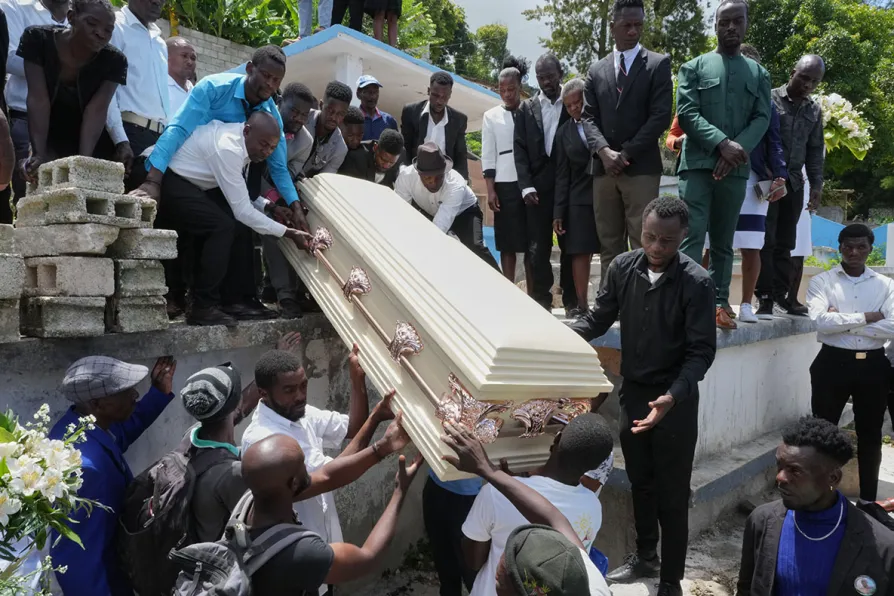
 Relatives carry a coffin to the cemetery for burial after the funeral ceremony for four victims of a gang attack in the Kenscoff neighbourhood of Port-au-Prince, Haiti, August 30, 2026





HUNDREDS of people crowded into a church near Haiti’s capital Port-au-Prince for the funeral of four of the people killed in a brutal attack.
Armed men attacked the farming community of Kenscoff on August 23, killing at least 47 people and kidnapping more than 50 others in the middle of the night.
It was one of the biggest mass kidnappings in Haiti in recent years, and survivors have organised protests and blamed police for not preventing the attack which included bodies being set on fire by the attackers.
Yvon Marleus, a Kenscoff resident who lost a cousin in the attack, blamed the police for not stopping the assault.
She said the police “didn’t act in time to stop the carnage.”
Haiti’s National Police has said that it ordered an investigation to establish the truth about the attack, and whether it was “due to complicity or negligence.”
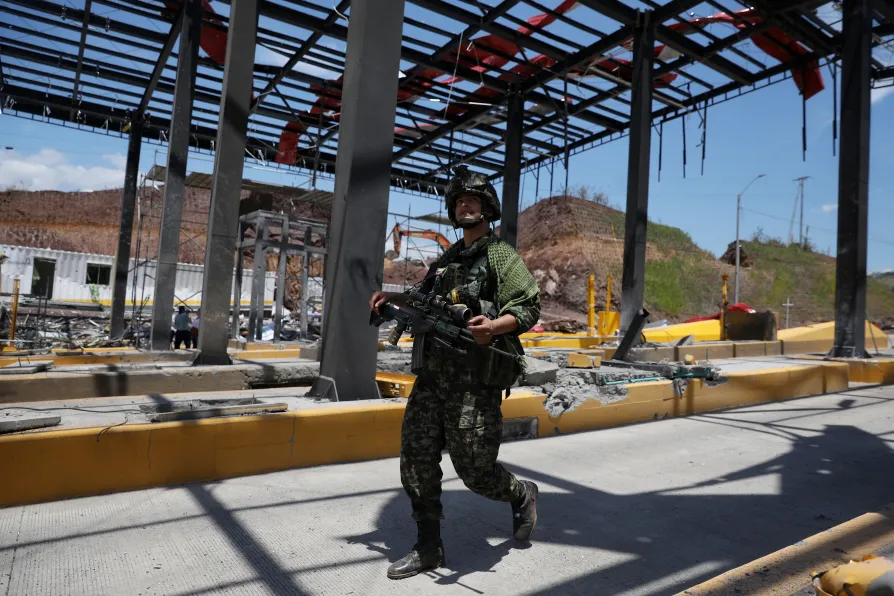
Outside the church, civilians took matters into their own hands by standing guard with automatic weapons, ready to repel any potential new attacks with the help of police officers stationed nearby.
Marta Hurtado, a spokesperson for the United Nations Human Rights Office, said some 150 heavily armed gunmen were involved in the attack.
She said they first killed 13 people who tried to flee and then pursued 50 more who had sought refuge inside a church.
“After forcing them out from the premises, they executed 22 of them in the church courtyard and 12 others behind the church,” she said.
Dozens of others were injured, and more than 2,600 people were left homeless.
The attackers later released six children and seven women following an intervention by community leaders and Unicef, but dozens remain abducted.
Violent attacks have displaced around 1.5 million people across Haiti, where more than 3,050 people were reported killed from January to June, according to UN statistics.