
APURBA CHATTERJEE explains how British artists in India used the “picturesque” to reshape colonial landscapes and celebrate imperial power


Film is not political? Excuse me...
RITA DI SANTO points out that political films at Cannes, and overtly pro-Palestinian statements by film-makers, contradict the apolitical stance of the jury
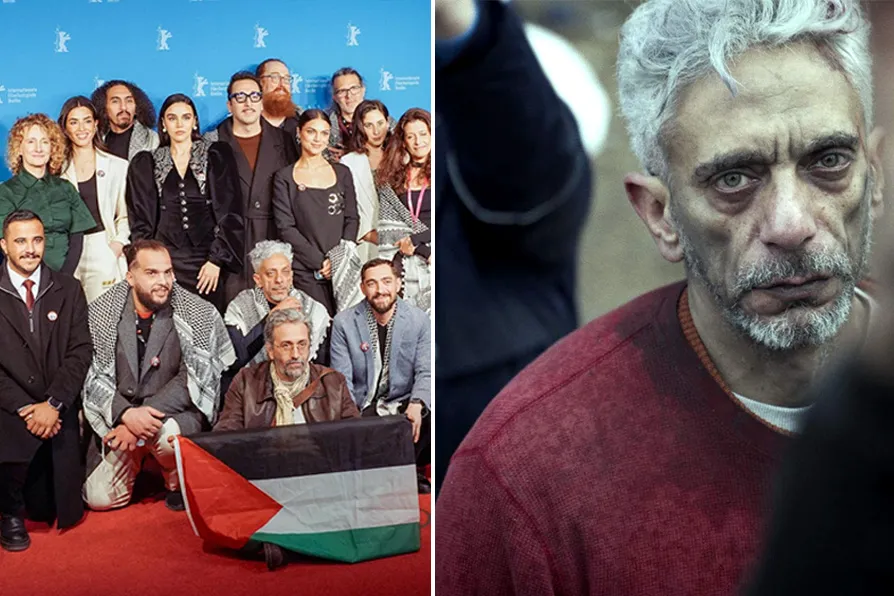
 (L) Cast and crew of Abdallah Alkhatib's film Chronicles From The Siege at Berlin Film Festival; (R) Nadeem Rimawi in a scene from the film [Pics: IMDb]
PAUL DONOVAN welcomes a revival of Reginald Rose’s classic play that reminds us of the fundamental need for trials with juries
SIMON PARSONS applauds an exceptional performance of Wesker’s little-known play, by the same actor for whom it was written 45 years ago
ANDY HEDGECOCK and MARIA DUARTE review Late Fame, The Death of Robin Hood, Leviticus, and Gail Daughtry and the Celebrity Sex Pass
ANGUS REID recommends a uniquely accomplished documentary collage that contemplates our relation to the natural world
GORDON PARSONS enjoys Kant’s ‘mind-boggling’ theory of human reality: that we create the reality we experience





WE have long been aware that the Berlin Festival tends to avoid explicitly addressing the genocide in Gaza. In 2024, the documentary No Other Land, made by an Israeli-Palestinian collective, received the Documentary Award, igniting controversy when the film-makers fervently criticised foreign policy regarding the Gaza war during their acceptance speech.
This is not an isolated case; for a festival that describes itself as “political” and has openly taken clear stances on the Ukraine conflict and in support of Iranian artists, this silence is notable. However, this year the controversy has intensified, starting with jury president Wim Wenders’ words at the opening festival’s press conference: “We are the counterweight of politics, we have to do the work of people — not the work of politicians.”
Soon after, Arundhati Roy walked away in disgust, and a response surfaced featuring more than 80 artists, such as Ken Loach, Javier Barden, Brian Cox, Mike Leigh, Nan Goldin, Avi Mograbi and Tilda Swinton. They signed a letter criticising the festival’s “silence” on the Gaza genocide and denouncing Wenders’ suggestion that artists should “stay out of politics.”
At the awards ceremony marking the conclusion of this year’s 76th Berlinale the festival director Tricia Tuttle took the stage, expressing her emotions as she spoke to the audience. She recognised that this year’s Berlinale unfolded in a world that feels increasingly unsettled and divided, with many attendees carrying a palpable sense of grief, anger and urgency regarding the current global situation.
However, despite the heartfelt nature of her diplomatic speech, it ultimately fell short of providing substantial guidance or solutions.
The awards ceremony itself became a political stage as film-maker after film-maker used their acceptance speeches to denounce what they termed Israeli aggression in the Middle East and to call for the “freeing of Palestine.” As the prizes were distributed, the stage became a platform for pointed political statements.
Lebanese director Marie-Rose Osta made headlines upon receiving The Golden Bear for Best Short for her film Some Day A Child. In her acceptance speech, she condemned the Israeli bombings in her homeland and criticised the erosion of international law. “If this Golden Bear means anything, let it signify that Lebanese and Palestinian children are not negotiable,” she declared, prompting sustained applause from the audience.
Someday A Child is a captivating 27-minute portrayal of a child with extraordinary powers, living with his uncle in a Lebanese village frequently overflown by Israeli fighter jets. The short film evokes a dreamlike world through the eyes of a child, offering a thought-provoking and profound experience, akin to a memory or dream that cannot be stopped or erased.
Other winners during the evening echoed similar sentiments. Abdallah Alkhatib, whose film Chronicles From The Siege won the Best Perspective prize for debut films, brought a Palestinian flag on stage. He concluded his impassioned speech with a call to “free Palestine from now to the end of the world!” which elicited another long round of applause.
Alkhatib’s film transcends a single location and is reportedly inspired by the director’s own experiences in Yarmouk. It reflects the broader Palestinian experience over many years, powerfully portraying the situation in Gaza and capturing the daily complexities and struggles faced by the Palestinian people. The film serves as a poignant reminder of the ongoing challenges faced by the Palestinian community, effectively using archival material to depict the harsh realities of life under siege.
The director’s personal connections to the footage enhance the narrative, transforming it into not just a documentary but a powerful act of remembrance and resistance. By focusing on the lived experiences of individuals, the film challenges global indifference and underscores the importance of preserving dignity through storytelling.
This year’s Golden Bear was awarded to Turkish director Ilker Catak’s film, Yellow Letters, recognised for its artistic value and content. The film opens with a text introducing “Berlin as Ankara,” symbolising political exile. It portrays a universal drama about a couple — a university professor and writer, and his wife, an actor — who face unjust dismissals and persecution for opposing the Turkish regime.
Overnight, they become the target of the state and lose their jobs and their apartment. They must choose between their values and their future together as a family. Yellow Letters serves as a poignant reminder of the fragile nature of freedom and the heavy toll of political oppression. The film not only captures the harrowing journey of its protagonists but also resonates with audiences worldwide, urging us to reflect on the price of integrity in the face of tyranny.
In a world where the truth can be weaponised, Ilker Catak’s powerful narrative compels us to stand firm in our values, even when the forces against us seem insurmountable. It is a clarion call to recognise the resilience of the human spirit amid adversity, making this film not just a story of personal struggle, but a universal testament to the enduring fight for justice and dignity.
The Silver Bear was awarded to Queen at Sea by Lance Hammer. Amanda (Juliette Binoche) and her stepfather (Tom Courtenay) face a moral dilemma while dealing with her mother’s Alzheimer’s. The film explores family dynamics and the shortcomings of a distant welfare system, questioning who is responsible for the vulnerable.
Set in London, it presents a tragic narrative that encourages reflection on the plight of those left alone. Notable performances include non-professional actors, real social service workers who portray the challenges of their roles, using modules and tests with emotionally detached responses, leaving a lasting impact on the audience.
