Labour must deliver its manifesto promises in full and begin the bigger task of restoring workers’ collective power, says MATT WRACK


 Latest editorial
End the siege on Cuba – solidarity is needed now more than ever
As Cuba faces an unprecedented US energy siege and growing threats of military intervention, TUC Congress must stand unequivocally with Cuban workers and their right to determine their own future, writes STEVE GILLAN, POA general secretary and TUC president
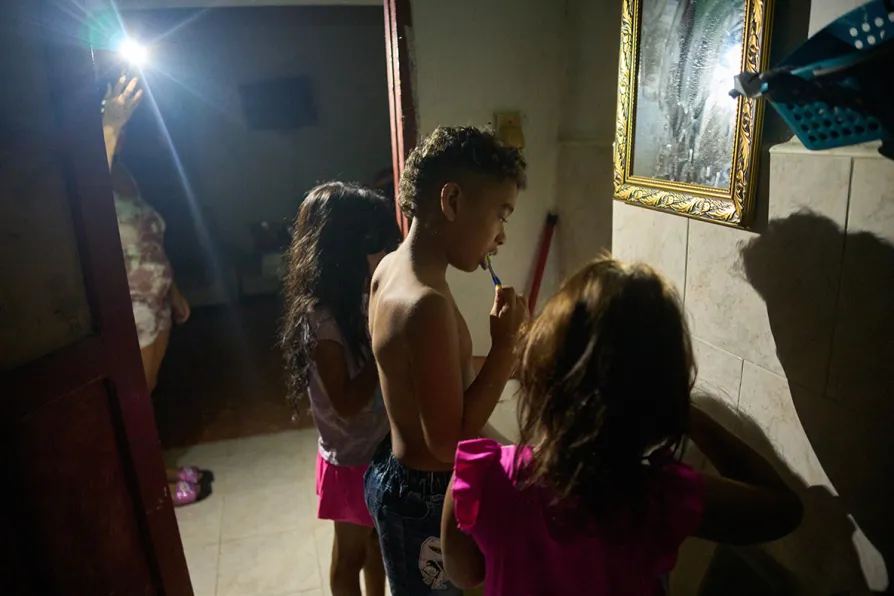 Cuban children brush their teeth during a power outage
This summer’s fire outbreaks highlighted once again the deadly cost of job, equipment and funding cuts to the fire service. Ten years after the Grenfell tragedy, serious lessons still need to be learned, says STEVE WRIGHT
Live music and musical education are both under attack and threaten to impoverish our culture. The Musicians’ Union seeks allies in the fightback, writes NAOMI POHL
The TUC fell for the illusion of a ‘Social Europe’ in 1988 and backed single-market membership. DOUG NICHOLLS argues that dramatic changes in the EU prove the need for an independent economic policy
By organising for boycotts, divestment and sanctions, trade unionists can turn solidarity into action, writes JESS BARNARD





SEVEN years ago, I moved a POA motion at TUC Congress condemning Donald Trump’s escalating economic warfare against Cuba.
I said then that these were worrying times for Cuba and that the Cuban people needed our solidarity.
Today, the situation is immeasurably more dangerous.
Last week, Cuban Foreign Minister Bruno Rodriguez presented Cuba’s latest report to the United Nations on the impact of the US blockade. The figures are devastating.
Between March 2025 and February 2026 alone, the blockade caused an estimated $8.083 billion in losses — the highest annual figure ever recorded and 7 per cent higher than the previous year. The cumulative cost now stands at more than $178bn.
Behind all these numbers are human beings.
Rodriguez described months in which Cuban families have survived on two or three hours of electricity a day or less: food spoiling without refrigeration; unbearable heat making sleep impossible. Workers struggle to reach their workplaces because there is no fuel for transport. Hospitals face shortages of medicines and equipment. Water pumping and food production are disrupted by power cuts.
Infant mortality, which stood at four per 1,000 live births in 2018, rose to 9.9 in 2025.
As Rodriguez rightly said: “These are children. They are not numbers.”
This is the context in which the POA has submitted Motion 76, End the Siege on Cuba, to this year’s TUC Congress.
Since January, the Trump administration has blocked fuel reaching Cuba by threatening tariffs against any country supplying the island.
And while Cuba has been desperately attempting to expand renewable energy to overcome the crisis, the US has looked for ways to stop this by imposing sanctions on shipping companies supplying solar panels to the island.
At every turn Washington has continued to tighten the screw, even sanctioning the Cuban Friendship Institute which organises the volunteer work brigades that many of our young members have participated in.
Only days before Congress, the Trump administration announced another round of sanctions, including measures targeting Cuban energy companies.
We should be absolutely clear about what is taking place. This is economic warfare intended to create unbearable living conditions in the hope that desperation produces political destabilisation.
Even more alarming is the increasingly open threat that economic warfare could be followed by military intervention.
Cuba’s latest report to the United Nations warns of regular threatening rhetoric from senior US officials about using force to remove Cuba’s political and economic system.
That threat cannot be dismissed.
When Donald Trump was asked whether still greater economic pressure could be placed on Cuba, his answer was chilling: there was little more that could be done, he said, “unless you go in and smash the place up.”
For trade unionists, the response must be unequivocal: Hands off Cuba.
That is why our motion calls on the British government to oppose the extraterritorial application of US sanctions, reject any attempt at military intervention, provide humanitarian assistance and defend Cuba’s sovereignty and right to self-determination.
Congress will also have the privilege of hearing directly from Osnay Miguel Colina, general secretary of Cuba’s trade union confederation, the CTC.
He comes to Britain at an extraordinarily difficult time for Cuban workers.
Those workers are keeping hospitals, schools, public services, transport and workplaces functioning under conditions deliberately made harder by their spiteful northern neighbour.
Whatever differences people may have about Cuba’s political system, no government has the right to deliberately deprive another country of fuel, food and medicines in order to impose political change.
That is a fundamental trade union and internationalist principle.
The POA has a proud history of solidarity with Cuba. We have supported the Cuba Solidarity Campaign and stood against the blockade for many years because solidarity cannot simply be something we practise within our own workplaces or our own borders.
In 2019 our Cuba motion was carried unanimously by Congress. Much has changed since then, but unfortunately US hostility has not.
What has changed is the severity of the attack.
Congress therefore has an opportunity this week to send an unmistakable message to Washington and to our own government: British trade unions will not remain silent while an entire population is subjected to collective punishment.
And we can send an equally important message to Osnay, the CTC and millions of Cuban workers:
You are not alone.
End the siege. End the blockade. No US intervention in Cuba. Steve Gillan will be speaking alongside Osnay Miguel Colina at the CSC End the Siege on Cuba fringe meeting from 5.30pm on Monday September 14 in Room 1D of the Brighton Centre. Open to all TUC Congress pass holders. See cuba-solidarity.org.uk for full details.

Similar stories

As Cuba faces the most dangerous moment in its recent history, Britain must do more than condemn the US blockade at the United Nations, writes KEVIN COURTNEY, chair of the Cuba Solidarity Campaign
The best tribute to Fidel is to stand with the Cuban Revolution today as the Trump regime tries to starve it to death, argues Cuba Solidarity Campaign communications manager NATASHA HICKMAN
Trade unionists are mobilising to support Cuban workers and public services, amid escalating US pressure on the socialist island. RONAN OGILVY explains
Where normally only the US and its ally Israel vote to strangle Cuba economically, there have been special efforts to slander and isolate the besieged socialist island nation year — so we must redouble our solidarity, writes TARIQ ANDERSON