
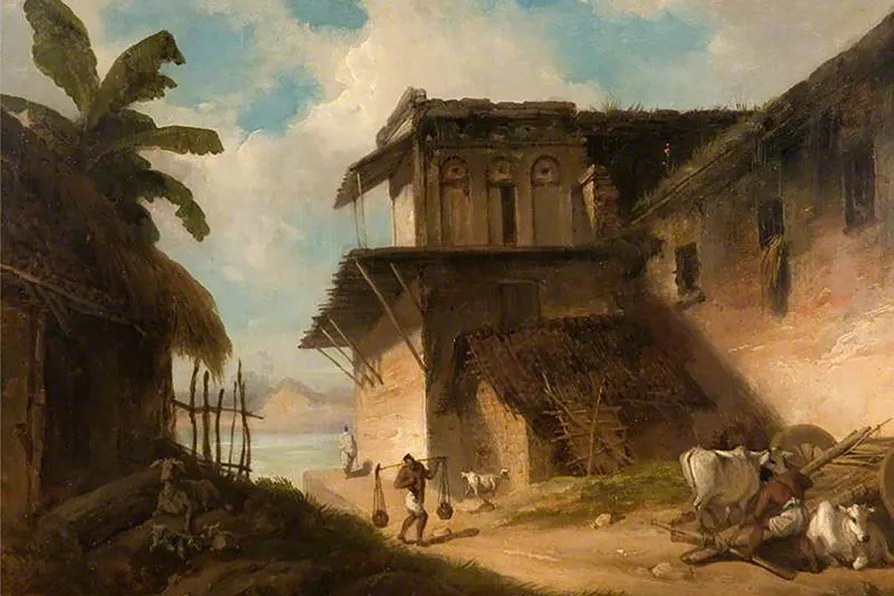
APURBA CHATTERJEE explains how British artists in India used the “picturesque” to reshape colonial landscapes and celebrate imperial power


Cotton, coal, canals and women's football
SYLVIA HIKINS is compelled by a travel writer’s personal exploration of his native Lancashire, by the Morning Star’s own Chris Moss
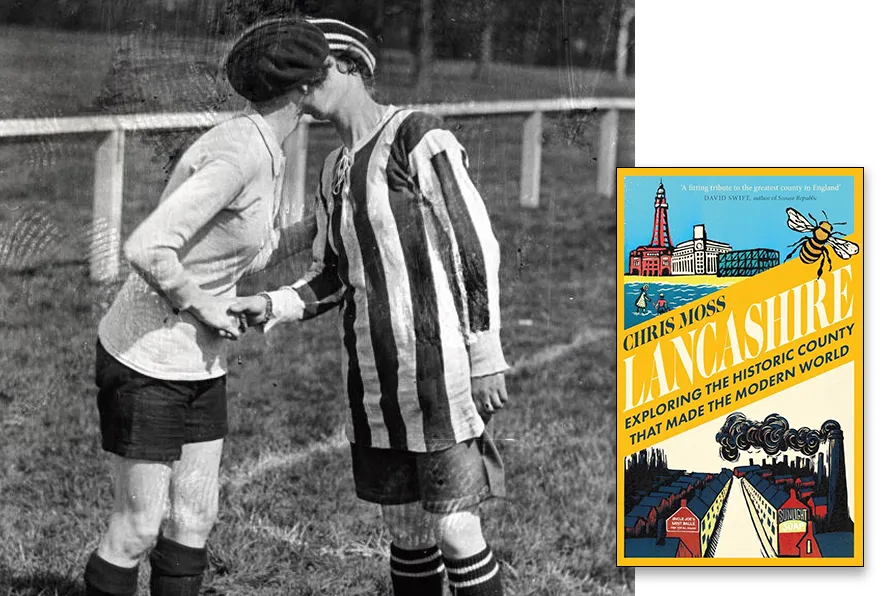
 Alice Kell of Dick, Kerr Ladies F.C. (striped shirt) greets Madeleine Bracquemond of France for the first women's international football match in Preston, Lancashire, England, 1920. Dick, Kerr Ladies FC, representing England, won 2-0. [Pic: Public Domain]
PAUL DONOVAN welcomes a revival of Reginald Rose’s classic play that reminds us of the fundamental need for trials with juries
SIMON PARSONS applauds an exceptional performance of Wesker’s little-known play, by the same actor for whom it was written 45 years ago
ANDY HEDGECOCK and MARIA DUARTE review Late Fame, The Death of Robin Hood, Leviticus, and Gail Daughtry and the Celebrity Sex Pass
ANGUS REID recommends a uniquely accomplished documentary collage that contemplates our relation to the natural world
GORDON PARSONS enjoys Kant’s ‘mind-boggling’ theory of human reality: that we create the reality we experience





Lancashire
Chris Moss, Old Street Publishing, £25
CHRIS MOSS is an interesting travel writer whose four previously published books combine travel, history and culture. Born in Lancashire, in this book, his first publication in four decades, Moss rediscovers his home county.
Spanning the centre of the front cover, set below a drawing of the Blackpool Tower and above a terraced street surrounded by black, polluting, industrial chimneys — plus a busy bee, symbolic of the factory workers who would reside in such an area — are the words: “Exploring the historic county that made the Modern World.”
Before the introduction of regions Lancashire included Liverpool, once the world’s busiest port, gateway for essential raw materials provided by the British Empire; also Blackpool that, thanks to its railway network, created a working-class seaside resort (middle and upper classes went abroad on holiday, the day trippers were the plebs); and also Manchester, power-house of the Industrial Revolution.
To this day, the impact of the Industrial Revolution still affects the way we live and it was an impoverished Lancashire workforce that provided factory labour, often working in dreadful conditions, that in the early days included young people horrifically exploited until regulations were introduced through a Parliamentary Act.
Cotton, coal and canals; trains, technology and television. Lancashire has shaped the modern world.
Chris Moss takes us on a captivating tour of the region that combines social, cultural as well as economic history. He shares his personal memories in a forthright and unadulterated fashion, looking at little known corners of the county as well as areas of national significance.
Eleven chapters take us on a journey ranging from Liverpool Drift, Mancashire, Madchester and Manc-hatten, to Pendle Hill, where in 1612, local women were condemned as witches and murdered by the State. Moss reveals that James 1st not only sent independent-minded women to the gallows but, specifically for Lancashire, produced a book declaring who could play such sports as archery, bowls, bull-baiting, cock-fighting which fitted in with the patriarchal and religious norms of the day.
He then moves forward to football, to women’s teams like Dick, Kerr Ladies FC, founded in 1917, that attracted huge crowds before being subjected to the Football Association ban.
This compelling text is enhanced with a fantastic range of colour photos, together with 80+ black and white photographs and relevant illustrations.
In his preface, Moss writes, “England is in a state of perpetual decline. It is politically and economically a shadow of its pre-1950 self.” He then goes on to say: “Lancashire was the first to turn the engine off and the lights out.”
This is a fascinating book that combines history, travel and culture with a look at the past to make sense of the present.
A truly compelling read.
