


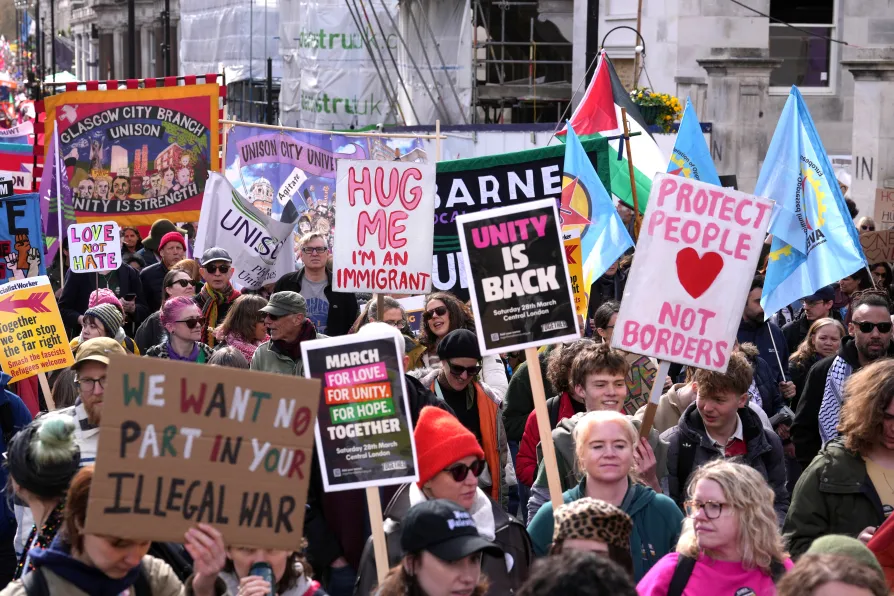
 People take part in a Together for Palestine march organised by Palestine Coalition, in central London, March 28, 2026






MINISTERS are preparing for mass protests over the cost of living, with the Telegraph reporting “near-daily” Cabinet briefings on the likelihood that price spikes from the Iran war will cause serious discontent.
We can already see such mass unrest in Ireland, where farmers and hauliers have blocked roads for days.
The political character of these protests is up for grabs. The right blame fuel taxes and green energy policies for high prices.
But cutting taxes and abandoning climate change commitments do not solve the root causes of the problem.
In Britain these include the privatised energy sector which prioritises profits over the needs of households or industry, and has not bothered to invest in significant storage capacity to mitigate price shocks (Britain’s natural gas reserves would run dry in a few days if imports ceased, compared to three months for Germany).
Globally they include continuing reliance on fossil fuels, which often have to be transported vast distances on routes vulnerable to geopolitical disruption, as we have seen during the US-Israeli war on Iran.
The right’s “solutions” increase fossil fuel dependency and ignore the only way to set prices in line with public need — nationalisation of the energy sector.
It is important that the left articulates clear demands for public ownership and price controls in the context of gathering discontent — and that it takes the lead in organising cost-of-living protests around such demands.
Rebuilding the People’s Assembly, which led many of the anti-austerity protests under the Tories, is important here and unions should look to co-ordinating with trades councils too to intervene in the coming crisis.
The hard right advanced strongly in 2024-25, establishing a steady lead for Reform UK in the polls and staging the biggest-ever far-right demonstration in Britain in September.
Recently their polling has slid — one recent poll saw them lose first place to the Greens. They have lost two by-elections they hoped to win in Caerphilly and Gorton and Denton, and the Together demo against the far right last month dwarfed their own September march.
But if the left is not front and centre when it comes to protecting ordinary people from the cost of Trump’s war, that could change.
Keir Starmer claims that his government is ready to adapt the country to a more volatile world. He accuses previous governments of merely “[managing] the crisis, [finding] a sticking plaster and then desperately [trying] to reassert the status quo.”
Sadly this is a description of his own approach. The government ducks public ownership of energy and even water, where privatisation is an international anomaly and water companies’ pollution and profiteering is a national scandal. None of its announced measures in response to the Iran war amount to more than sticking plasters: they are temporary, limited interventions that leave underlying vulnerabilities in place.
We need to go further. Here we should note that across Europe, countries intervening to shield the public from soaring costs have been warned by the European Commission to stick to “sticking plasters” — interventions to control prices or subsidise households must be “limited in time and scope” or they will upset the markets.
Too many on the left, including the insurgent Greens, undermine the radical potential of their demands by tying them to the framework of an EU which they counterpose to Trump’s US as a bastion of stability and reason.
Actually the EU is part of the same imperialist alliance as the US and obstructs in its member states many of the demands crucial to protecting living standards. The last left-wing upsurge in Britain foundered on confusion over the EU: we need a clear-eyed, class-based movement that puts democracy above markets, not its opposite.
Real pain is coming the way of most British households. Labour shows no indication of being serious about stopping it. The left has to be.
