
The Defence Universities Alliance is a bit to co-opt higher education into the wider drive to war — we should resist as earlier generations of scientists did, argue say ROX MIDDLETON, LIAM SHAW and MIRIAM GAUNTLETT of SCIENCE AND SOCIETY


Colombia in the crosshairs
With US sanctions, military pressure and electoral interference looming, the struggle over Colombia’s sovereignty — and the fate of its fragile peace process — has reached a critical moment, says NICK MacWILLIAM
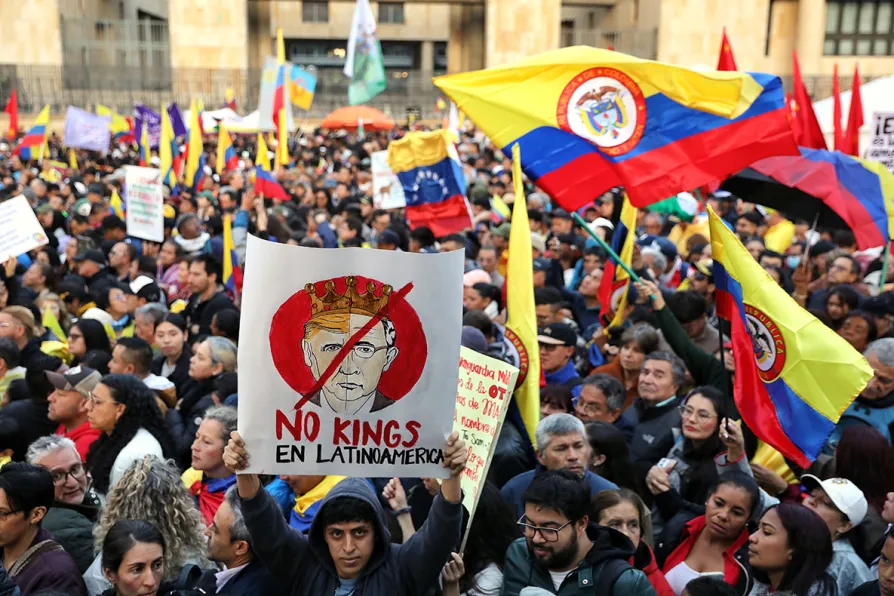
 Supporters of Colombian President Gustavo Petro attend a rally he called to protest comments by US President Donald Trump, in Bogota, Colombia, January 7, 2026
In the third of a four-part serialisation from her new book No to Nuclear, LINDA PENTZ GUNTER explains how the world had a chance to build an energy system around renewables more than 70 years ago — instead, it chose nuclear
In the fourth and final part of our serialisation from LINDA PENTZ GUNTER’S book No to Nuclear, she asks how anyone can see nuclear as value for money given its constantly ballooning costs
Elon Musk says AI will make work optional. The world of abundance he predicts actually spells the end of the capitalist system, argues FAWZI IBRAHIM
CARLOS MARTINEZ responds to liberal hawk Simon Tisdall’s evidence-free China-bashing and asks whose agenda it really serves
Indian students have fought for the right to education, schooling us all in the process. Comrades from the Students’ Federation of India (SFI) — UK comment on the resistance and its ripples here





WHEN Gustavo Petro entered office in August 2022 as Colombia’s first ever progressive president, he was under no illusions as to the size of the task ahead.
Petro inherited a country racked by over half a century of armed conflict and gaping inequality, issues perpetuated under a ruling class accustomed to using violent force to suppress any challenge to its dominance.
“We are writing a new history for Colombia, for Latin America, for the world,” the president-elect declared at his victory speech almost four years ago. “Real change is coming,” he promised a jubilant support base formed of those most excluded under Colombia’s unconstrained capitalist model: the poor, the young, rural communities, African-Colombians and conflict victims.
Indeed, Petro and Vice-President Francia Marquez had nicknamed their movement a “Government of the Nobodies,” an ironic poke at the redistribution of political power now under way thanks to mass mobilisation of the social grassroots.
Back then, the scale of the challenge for the new government was clear. Yet it is unlikely Petro foresaw the precarious situation facing the final months of his presidency: a hyper-aggressive US administration under Donald Trump — seemingly consigned to history when Petro was elected — that, energised by the January 3 abduction of President Nicolas Maduro in neighbouring Venezuela, has Colombia, or more specifically the Petro government, in its crosshairs.
This was made clear in the immediate aftermath of the Venezuela attack. Asked whether he was considering military action against Colombia, Trump responded “sounds good to me” and that Petro should “watch his ass.”
Trump has called Petro a “drugs leader” and “sick old man.” As with the allegations against Maduro, these false accusations aim to legitimise US intervention against an independent-minded government in Latin America.
Justice for Colombia warned that, by attacking Venezuela, the US had “emboldened Colombia’s far-right opponents of peace, fuelling a dangerous and counterproductive polarisation.” Colombian far-right politicians, dutifully subservient to Trumpism, have urged the US to take action against their country’s democratically elected president.
The legitimacy of Trump’s anti-drugs crusade — which has focused solely on countries under leftist governance such as Colombia, Mexico and Cuba — has been undermined by his pardoning of former Honduran president Juan Orlando Hernandez, who in 2024 was convicted of drugs trafficking by a US court and sentenced to 45 years in prison.
Colombia today is in new territory. For decades it was a bastion of US power in Latin America. Throughout the 1990s-2010s, it was, after Israel and Egypt, the third-largest recipient of US military aid, as right-wing governments held onto office even as most of the region swung left.
The US indictment against Maduro, his wife Cilia Flores and other officials cites a supposed collusion with Colombian guerilla groups the Farc, which demobilised following the 2016 peace agreement, and the still-active ELN to smuggle cocaine into the US. As with Maduro, the US has provided no evidence that these groups conspired in drug trafficking.
But the indictment embroils Colombia in the case and could open the door to similar lawfare targeting progressive figures there, such as presidential frontrunner Senator Ivan Cepeda, who is loathed by the Colombian right for his defence of human rights and exposure of state and paramilitary violence.
US far-right antipathy towards Petro has been brewing since the 2022 election. Petro’s success saw Florida governor Ron DeSantis label him a “former Narco-terrorist Marxist” — a reference to Petro’s past membership of the M19 guerilla movement that disbanded in 1990 — stoking anti-communist sentiment prevalent among Miami’s large, and widely reactionary, Latin American population.
However, the Joe Biden government adopted a constructive approach to Colombia, while simultaneously ramping up sanctions against Venezuela and Cuba.
Under Trump’s second presidency, tensions have escalated, partly due to Petro’s resolute denunciations of the US role in Israel’s genocide in Gaza that led Colombia to suspend coal exports and arms purchases with Israel.
Relations soured shortly after Trump’s inauguration last January when Colombia refused to receive US deportation flights if its citizens were treated inhumanely, with an agreement subsequently reached.
In August, US Secretary of State Marco Rubio — widely suspected to be driving Washington’s hawkish policy in Latin America — blasted the “weaponisation of Colombia’s judicial branch by radical judges” who had sentenced far-right former president Alvaro Uribe to 12 years’ house arrest for witness tampering and procedural fraud.
Uribe’s sentence has since been quashed. Rubio and Uribe are close, having campaigned together in 2015 against peace negotiations then under way with the Farc.
In September, the US “decertified” Colombia for alleged failure to tackle drugs production, despite cocaine seizures and destruction of processing labs having increased significantly under Petro.
Washington sanctioned Petro, his wife, son and other officials, thereby confiscating assets, blocking bank accounts and preventing travel to the US.
The following month, Petro condemned US bombings of small boats in the Caribbean and Pacific, which has killed over 100 people including Colombian fishermen, as part of “a war for oil.” The US’ huge military build-up in the Caribbean, belligerent rhetoric and volatile nature has left progressive governments across Latin America uneasy: after Venezuela, they wonder “who is next.”
Trump’s unpredictability resurfaced on January 7 when, in a marked change of tone following weeks of insults and threats, he posted it was a “great honour” to speak to Petro via telephone. However, Petro subsequently warned a “real threat” against Colombia persists.
The two leaders will meet in Washington on February 3: whether that encounter will ease or exacerbate tensions is open to question.
While welcoming dialogue between the two heads of state, the leftist candidate Ivan Cepeda, who is topping electoral polls, emphasised this is a dangerous moment for his country: “There is a gigantic aircraft carrier off the coast of Colombia, a military presence never seen in the past, and the president is on a list of drug traffickers … these facts remain,” he said in a recent interview.
Indeed, were Cepeda to win the election, he would likely face intense hostility from the US and its compradors in Colombia. To what extent would they be prepared to destabilise or subvert a Cepeda government?
The progressive government has faced difficulties in addressing problems facing Colombian society. Armed conflict still affects several regions, including along the Venezuelan border.
A legislative agenda to tackle inequality has faced intense opposition in Congress, where the government lacks a majority, and those measures that have passed have then been challenged in the courts.
As a result, material improvements in people’s lives have been delayed, although the government did pass important social reforms in labour rights and pensions, as well as rural reform that reduced poverty and strengthened the rights of rural people.
Yet, as Cepeda notes, Trump’s aggression may hinder the right’s hopes of regaining power. Many Latin Americans do not look kindly upon attacks on their national sovereignty and integrity. An editorial in the centrist El Espectador newspaper called the threats against Petro a challenge to Colombian sovereignty. This could bolster the left ahead of legislative elections in March and the presidential election in May.
For now though, the central question is how far the US will attempt to influence the electoral process and whether it will accept the result if it favours progressive forces. The future of peace and progress in Colombia hangs in the balance.
Nick MacWilliam is trade union and programmes officer at Justice for Colombia. For more information, visit www.justiceforcolombia.org.
