Labour must deliver its manifesto promises in full and begin the bigger task of restoring workers’ collective power, says MATT WRACK


 Latest editorial
Cave art and the age of humankind
Recent research pushes back the date of the earliest cave art by several thousand years. ROX MIDDLETON, LIAM SHAW and MIRIAM GAUNTLETT look into the science applied
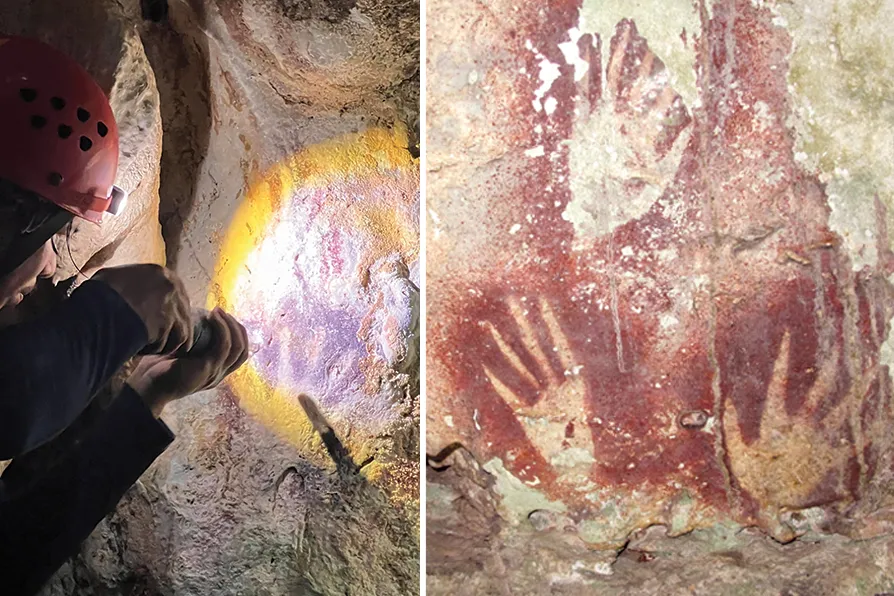 (L to R) Adhi Agus Oktaviana studies handprints on the walls of a cave; Handprints with sharpened fingertips - both in Sulawesi, Indonesia / Pics: (L to R) Maxime Aubert via AP; Ahdi Agus Oktaviana/Maxime Aubert via AP

This summer’s fire outbreaks highlighted once again the deadly cost of job, equipment and funding cuts to the fire service. Ten years after the Grenfell tragedy, serious lessons still need to be learned, says STEVE WRIGHT
Live music and musical education are both under attack and threaten to impoverish our culture. The Musicians’ Union seeks allies in the fightback, writes NAOMI POHL
The TUC fell for the illusion of a ‘Social Europe’ in 1988 and backed single-market membership. DOUG NICHOLLS argues that dramatic changes in the EU prove the need for an independent economic policy
As Cuba faces an unprecedented US energy siege and growing threats of military intervention, TUC Congress must stand unequivocally with Cuban workers and their right to determine their own future, writes STEVE GILLAN, POA general secretary and TUC president
By organising for boycotts, divestment and sanctions, trade unionists can turn solidarity into action, writes JESS BARNARD





THE island of Sulawesi in Indonesia is the 11th-largest island in the world, just slightly smaller than mainland Britain. It splays out like an X, with an elongated top-left arm that curves back over the rest of the island.
The island has a remarkable biodiversity; the 19th century naturalist and explorer Alfred Russel Wallace, who visited it three times in his life, said it might be “the most remarkable and interesting” island in the world.
It’s now been claimed to be the site of the earliest known rock art made by humans.
A paper published in Nature this week has reported the discovery of art from a cave on Sulawesi made at least 67,800 years ago.
Somebody placed their hand on the wall and painted around it, then they altered the hand, painting it so that their index finger became a little narrower — we have no idea why. If correct, the dating suggests that people were travelling by sea between Borneo and Papua around 65,000 years ago.
The study of early humans, or paleoanthropology, is often characterised by fierce debate. The evidence can be patchy and limited, and therefore subject to radically different interpretations.
Take the previous record for oldest art. That came from a paper in 2018, claiming that a cave painting in northern Spain was from around 64,000 years ago.
Since the researchers who published that discovery thought that this was before Homo sapiens first inhabited Europe (approximately 54,000 years ago, although that too is debated) they suggested it was made by Neanderthals. Other researchers have disagreed about the reliability of their date measurements, and the debate rumbles on.
Most dating of this kind of art is based primarily on radioactive decay. An element such as uranium comes in several forms known as isotopes, which are chemically identical but have different radioactive decay rates. They’re given numbers that refer to their atomic mass, which differs between isotopes.
Most naturally occurring uranium is U-238, but there are other isotopes too, including U-234, which all water contains in very small amounts. U-234 decays at a slow but predictable rate over time to another element, thorium.
Since the rate of decay is stable, measuring the ratio of U-234 to its decay product, thorium, can tell you how old the material containing the U-234 is.
In caves, layers of sediment form on surfaces over time like scale in a kettle, so measuring this ratio within the sediment that forms over a piece of art after it was initially made can tell you how long the deposit has been there.
In this case, you have to first vaporise tiny amounts of the sample with a laser to take your measurements from.
There are complications. One is checking your measurements against another sample with a confident age given from another method. The researchers looking at the painting in Sulawesi used two samples of coral from Pacific Islands (since corals build up into layers that can be dated with precision) which they ground into powder before taking measurements.
But another difficulty is whether the sample is really a closed system. The dating method assumes that no thorium was present in the sample to start with, and that none was added over time except by radioactive decay.
If other sediments from other times can get in and contaminate the sample, these may add thorium and make the sample look older than it is. A great deal of the paper’s methods discussion covers why the authors don’t think it’s the case here, listing the checks that they made of their method’s assumptions.
It’s the oldest art that receives the attention, but caves of this type typically have many layers of art because people over many generations add to what they find, like graffiti artists who use the same spot.
The cave where the hand stencil was discovered is covered with drawings of birds, pigs and horses that are from only a few thousand years ago. The researchers used their knowledge of previous styles of cave art to pick what they thought would be the oldest example.
Remarkably, the most recent cave art they found, reported in another cave in the paper, was from around 500 years back.
Making cave art is clearly something Homo sapiens have done for tens of thousands of years, and possibly for longer. And not just Homo sapiens.
There were multiple archaic human species that lived tens of thousands of years ago, including in this part of the world. One from a nearby island called Flores was named Homo floresiensis, famously dubbed “the Hobbit” based on the small size of fossil remains. (The Tolkien estate didn’t see the joke, and banned one researcher from using the term in a public lecture.)
In the Sulawesi paper, the rock art has been attributed to Homo sapiens because of evidence about their presence on the island, the size of the fingers and because of the “added technical and stylistic complexity.”
The last point seems a little unnecessary. It seems very plausible that other human species made art. Indeed, if the claims about the cave in northern Spain are correct, Neanderthals did.
Some researchers have even claimed that an engraved shell from half a million years ago is art, suggesting the marks were made by Homo erectus. The shell was found on Java, another Indonesian island.
Though the dating of the shell is accepted, other researchers have questioned whether the marks could be more recent additions, and others have disagreed about whether the markings can really be counted as an artistic expression or just a “doodle.” In this case, as in many others, art is in the eye of the beholder.
