Trade unions need to step up and force a turn in the policies of the labour movement to effectively confront the far-right threat, argues NICK WRIGHT


 Latest editorial

Burnham is right: MPs cannot ignore care crisis when voting on assisted suicide
The new prime minister has shown a willingness to reconsider his previous views on assisted suicide and focus on improving care services. CHRIS WHITEHOUSE hopes other MPs will do likewise
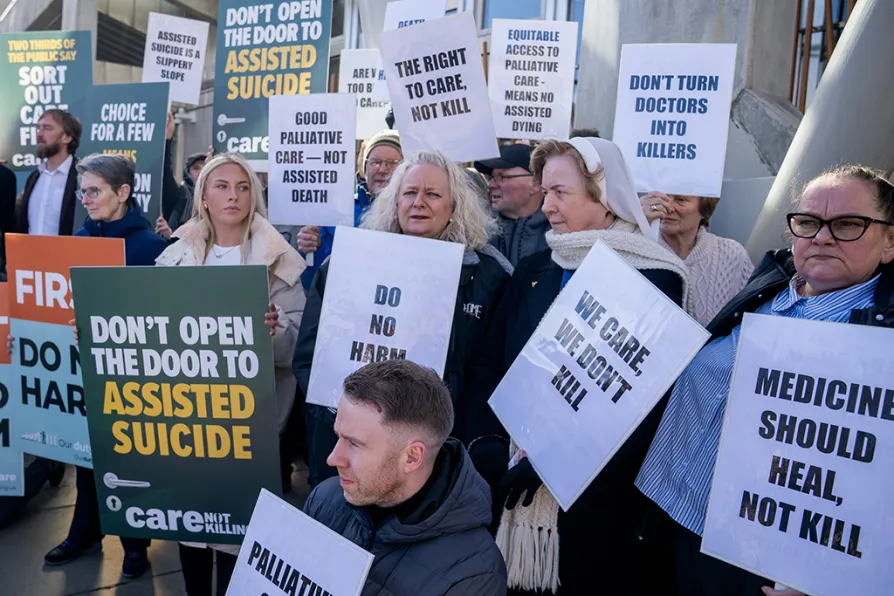 Protesters against assisted suicide legislation outside the Scottish Parliament in March

As the 90th anniversary of the outbreak of the Spanish civil war is marked, Teesside campaigners will gather to remember the local men and women who stood against fascism, explains TONY FOX
Whatever differences exist among international sympathisers of the Bolivarian revolution about its current trajectory, they should unite against the imperialist power that is the source of an enforced retreat, argues ROGER D HARRIS
Washington’s inability to subjugate Iran is an example of how it is trying to preserve a regional order that no longer exists, argues RAMZY BAROUD
US financial instability is exposing the limits of a dollar-dominated global economy — and giving the Global South a historic chance to build an alternative, says MURAD QURESHI
Deprivation is a fundamental factor in criminal behaviour that must be addressed but, KENNY MacASKILL argues, there needs to a major rethink in sentencing to tackle overcrowding





ANDY BURNHAM has prioritised a powerful theme for his leadership: care.
Speaking at a care home in Golders Green in North London this month, the new PM said he wanted to establish a “national care service” in England “that sits alongside the National Health Service” and “works in a similar way,” delivering care that is person-centred, preventive and integrated with other services.
The matter is a personal one for the new PM. His father suffers from dementia and requires full-time care in a nursing home. In fact, two million adults in England have unmet care needs. In his speech, Burnham described people facing crippling costs “just to live their life,” and care staff kept on “poverty pay.” He’s willing to spend political capital to tackle the crisis, he said.
The state of palliative care is also alarming. Parliament’s own health and social care committee reported in March that palliative care can be a “postcode lottery,” with just 18 of England’s 42 integrated care boards offering 24/7 palliative-care telephone coverage across their entire area, despite such access having been recommended as a minimum service for nearly two decades. The Royal College of General Practitioners agrees that provision is “variable and inequitable.” Marie Curie research estimates that nearly one out of three deaths in England are of people with unmet palliative care needs. In March, Hospice UK reported that almost 60 per cent of hospices were planning or were considering cuts to front-line services.
Against this backdrop of mounting concern, Burnham’s comments on assisted suicide make a lot of sense. It’s not fair to even bring that discussion to the table, he explained, until adequate care for vulnerable people – the sick, the dying, the elderly, the disabled – is in place. The Equality and Human Rights Commission, which takes no position for or against assisted suicide, has agreed on this prerequisite. It warned that regional differences in care could leave some people considering assisted suicide when they might not have done so had appropriate services been available. The Royal College of Physicians has taken a similar view.
This intervention from the PM is significant, no matter one’s personal beliefs about the ethics of assisted suicide. Burnham himself previously flirted with the idea of supporting a change in the law. But all who genuinely want to see “better deaths” in this country should be able to unite around delivering far better end-of-life care first, to ensure that suicide is not treated as a fatal alternative to poor end-of-life treatment.
The public agrees. A poll of 10,222 people across Great Britain, conducted by Whitestone Insight for The Other Half in May this year, found 60 per cent agreed that Parliament should prioritise fixing the NHS and improving palliative, social and end-of-life care before considering assisted suicide. Just 19 per cent disagreed. The MRP modelling found a majority taking that “fix care first” position in every constituency in Great Britain.
Lauren Edwards’s Bill returns to the Commons for its Second Reading on September 11, making it one of the first items on parliamentarians’ agendas after the summer recess.
Scale of crisis
Supporters of the Bill point out that doctors could discuss palliative care options as an equal alternative to assisted suicide, and that one does not necessarily negate the other. “We can have both!” is the retort to these concerns. But this view is ignorant of the sheer scale of the on-the-ground care provision crisis.
Telling somebody about a service they cannot actually obtain does not make that service available. A doctor cannot conjure up a hospice bed, a social care package, a district nurse or proper pain relief at two o’clock in the morning – and with the best will in the world, this will not be fixed overnight. It will take years of dedicated government investment to truly raise standards. As former Health Secretary Wes Streeting explained, improving care is “a journey, not an event.”
The previous assisted suicide Bill (an almost identical proposal from Kim Leadbeater MP) passed its final Commons vote by just 314 votes to 291 – a margin of 23, meaning that if 12 MPs change their votes to oppose the revived Bill at Second Reading, it will fall.
For any wavering MPs to change their mind this time, it would not look foolish, nor require embarrassing backtracking. Parliamentary scrutiny stopped the Bill from progressing last time because of genuine concerns about adequate care provision – it would be wise, rather than foolish, for MPs to act on what this scrutiny revealed.
Burnham, after all, has led the way, revising his initial support for the idea to be conditional on the context and needs of the country today. The question before MPs is not about what happened in the past – it’s whether they can accept the views of specialists across the country that the answer is, at the very least, “not now.”
Assisted suicide legislation may introduce a quick death to the vulnerable, but the more noble outcome for Parliament would be to secure a good life for those facing death, with the adequate support required.
Chris Whitehouse is a medical ethicist and expert on health policy with lobbying agency Whitehouse Communications.
