APURBA CHATTERJEE explains how British artists in India used the “picturesque” to reshape colonial landscapes and celebrate imperial power


 Latest editorial

Beatriz Gonzalez: I accuse
LEO BOIX reviews a dazzling art exhibition by one of Latin America’s most important and rebellious artists, whose art exposes the way state violence operates not only through physical force, but through culture
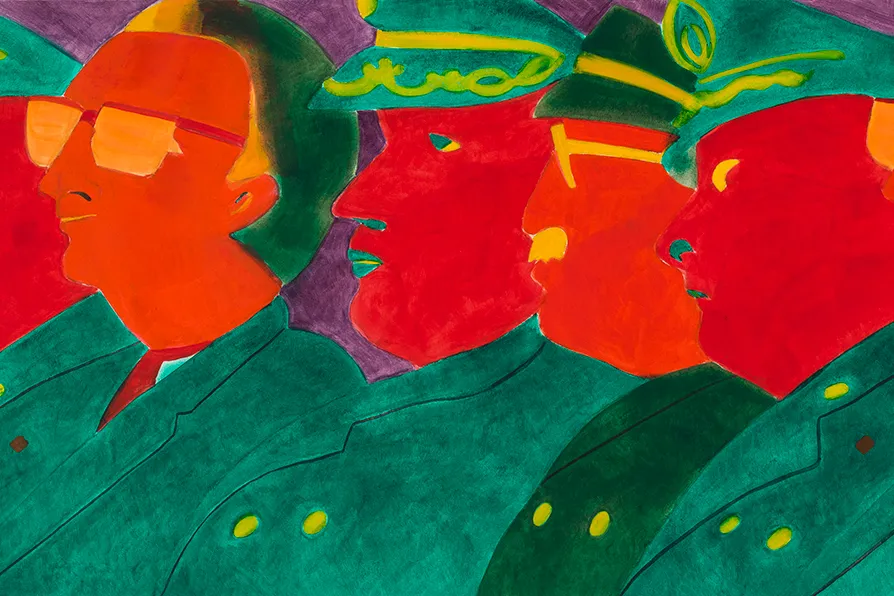 Beatriz Gonzalez , Los papagayos (The Parrots), detail, 1987. Collection [Pic: © Beatriz González. Courtesy Pérez Art Museum Miami/Oriol Tarridas]
PAUL DONOVAN welcomes a revival of Reginald Rose’s classic play that reminds us of the fundamental need for trials with juries
SIMON PARSONS applauds an exceptional performance of Wesker’s little-known play, by the same actor for whom it was written 45 years ago
ANDY HEDGECOCK and MARIA DUARTE review Late Fame, The Death of Robin Hood, Leviticus, and Gail Daughtry and the Celebrity Sex Pass
ANGUS REID recommends a uniquely accomplished documentary collage that contemplates our relation to the natural world
GORDON PARSONS enjoys Kant’s ‘mind-boggling’ theory of human reality: that we create the reality we experience





Beatriz Gonzalez
Barbican, London
⭑⭑⭑⭑⭑
“ART says things that history cannot,” Beatriz Gonzalez insisted, with the persistence of someone who knew that official history is too often written by those who benefit from silence.
Walking into the Barbican’s extraordinary retrospective of the Colombian artist, one senses immediately what she meant. Here is art that refuses silence. Here is art that shouts, mocks, mourns and remembers — often all at once.
Gonzalez, who died earlier this year at 93, spent more than six decades confronting the realities of Colombian life under capitalism, militarism, patriarchy and imperial influence. Colombia’s internal armed conflict, which began in 1964 and killed hundreds of thousands while displacing millions, forms the political horizon of her work.
But Gonzalez was never merely an illustrator of tragedy. She was its interpreter, its saboteur, its unwilling archivist. She understood that power survives not only through guns and money but through images — through the carefully staged photograph, the patriotic mural, the decorative surface that conceals brutality. Her art tears those surfaces open.
The Barbican exhibition, bringing together more than 150 works, makes clear that Gonzalez was not content to paint in isolation from social life. She scavenged her imagery from newspapers, postcards and official portraits, recycling the visual detritus of power into something corrosive.
Her palette is defiantly bright — acid greens, feverish yellows, sugary pinks that seem, at first glance, almost cheerful. But Gonzalez weaponises colour. These hues do not soothe; they accuse. They expose the artificial optimism of official narratives, the cosmetic surface of regimes built on violence.
One of the exhibition’s most devastating works, Senor Presidente, Que Honor Estar con Usted en este Momento Historico (Mr President, What an Honour to be with you at this Historic Moment, 1987), addresses the burning of Colombia’s Palace of Justice in 1985, when government forces retook the building after a guerilla occupation, resulting in catastrophic loss of life.
Image
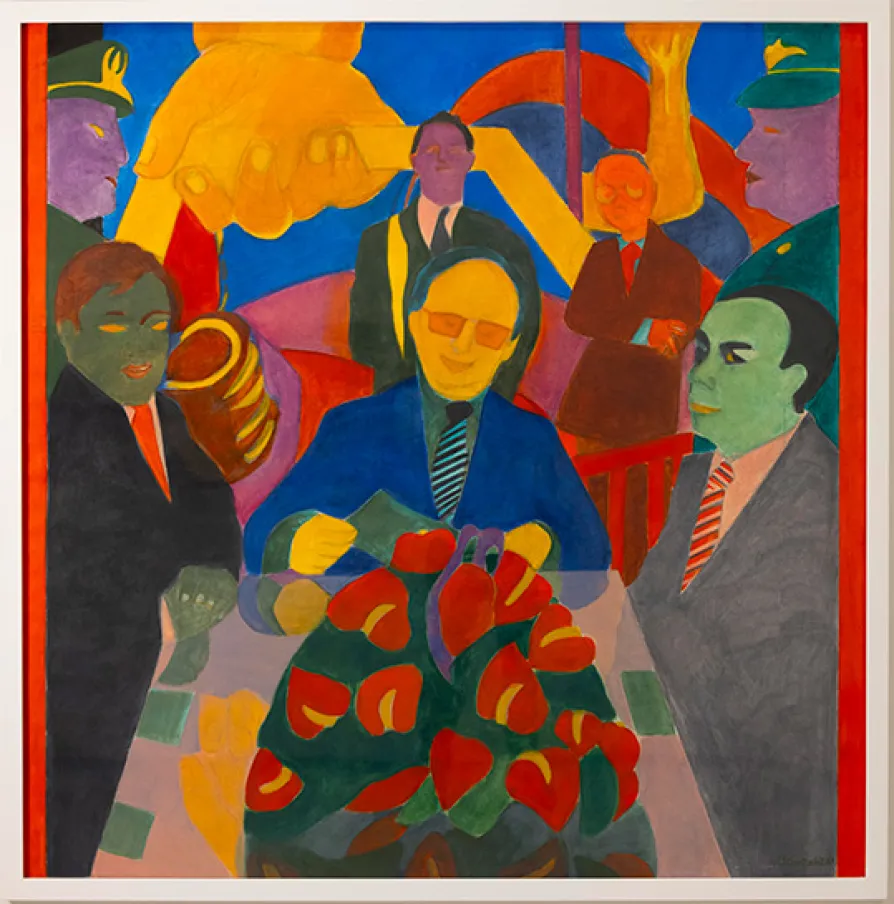
Gonzalez paints president Belisario Betancur seated at the head of a table, flanked by ministers and military officers. The composition borrows from colonial religious painting: the president appears almost Christ-like, sanctified by the structure of the image. Yet this sanctification is precisely the point. Gonzalez reveals how political power cloaks itself in the visual language of moral authority.
Across the table lies a bouquet of anthuriums, their lurid red petals echoing blood. In an earlier version, Gonzalez had placed a charred corpse there instead. By replacing the body with flowers, she exposes the lie at the heart of official mourning. The state replaces the evidence of its violence with symbols of decorum, asking its citizens to admire the arrangement while forgetting the dead.
Gonzalez does not let us forget. Her painting is an indictment disguised as ceremony.
If this work exposes the theatre of power, Decoracion de Interiores (Interior Decoration, 1981) dismantles its domestic facade. This monumental screenprint, originally produced as a 140-metre curtain, depicts president Julio Cesar Turbay Ayala attending a party. The image derives from a press photograph — a moment of elite leisure. But Turbay’s presidency was marked by repression, including security laws that drove intellectuals like Gabriel Garcia Marquez into exile.
Image
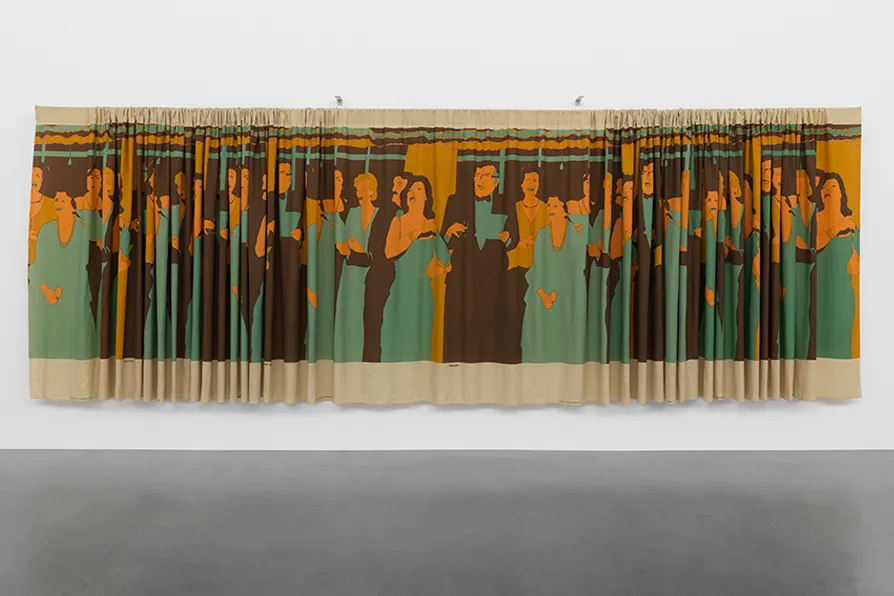
Gonzalez transforms the photograph into fabric, into something literally woven into the texture of everyday life. In doing so, she implicates the domestic sphere in the reproduction of political authority. This is not merely a portrait; it is a pattern. Power becomes decor. The president becomes wallpaper.
Here Gonzalez’s feminist insight becomes unmistakable. Decoration has historically been dismissed as feminine, trivial, apolitical. Gonzalez turns decoration into a weapon. She exposes how the aesthetics of comfort and respectability sustain regimes of violence.
When visitors were invited to purchase fragments of the curtain by the metre, the work ceased to be a singular object and became a dispersed political banner. It moved into homes, into private spaces, carrying its critique with it. Art was no longer confined to the museum. It became part of the social fabric, literally and figuratively.
Gonzalez’s engagement with international art history is equally subversive. In Mural para Fabrica Socialista (Mural for a Socialist Factory, 1981), she reimagines Picasso’s Guernica, itself a protest against fascist violence during the Spanish civil war. But Gonzalez does not simply reproduce Picasso. She translates him. She subjects his iconic composition to the visual logic of Colombia: tiled grids inspired by working-class architecture, colours drawn from local murals, the title referencing socialist factories she visited in Cuba.
This act of remaking is political. It challenges the hierarchy that places European art at the centre and Latin American art at the periphery. Gonzalez refuses to be a passive recipient of Western influence. She appropriates, transforms and provincialises it. Picasso’s universal tragedy becomes specific, situated, Colombian. Violence is no longer distant history; it is immediate reality.
Throughout the exhibition, Gonzalez returns repeatedly to the figures of authority who populate Colombia’s national mythology: presidents, generals, liberators, proceres (heroes) elevated to near-sacred status. Yet she treats them with a distinctly Colombian irony. “We, Latin Americans, have taken refuge in humour. We wouldn’t be able to survive without it,” the artist once said.
Her leaders are often stiff, absurd, diminished by their own pomp. They appear less as heroes than as actors trapped in their roles, performing authority for the camera. Gonzalez reveals the fragility beneath the spectacle.
What makes this exhibition so urgent for a socialist audience is Gonzalez’s unwavering commitment to exposing how violence operates not only through physical force but through culture, through images, through the stories nations tell about themselves. She understood that national identity is constructed, that patriotism can be mobilised to justify repression, that the visual language of heroism can conceal the reality of suffering.
Yet Gonzalez was never cynical. Her work is animated by curiosity, by a restless desire to understand her society. She paints not from distance but from engagement. Her art mourns the victims of violence while refusing to grant legitimacy to those who inflicted it. It insists that memory is a form of resistance.
At the Barbican, Gonzalez emerges not simply as one of Latin America’s most important artists, but as one of its most important political thinkers. She teaches us that art can challenge power precisely because it operates where power feels safest: in the realm of images, symbols and appearances.
History may attempt to forget. Gonzalez does not allow it. Her paintings remain, vivid and unyielding, demanding that we see what power would prefer to keep hidden.
A must-see show.
Beatriz Gonzalez runs until May 10. For tickets and more information see: www.barbican.org.uk.
