
APURBA CHATTERJEE explains how British artists in India used the “picturesque” to reshape colonial landscapes and celebrate imperial power


Baby steps
RUTH AYLETT recommends this book if you want to learn how AI’s large language models work
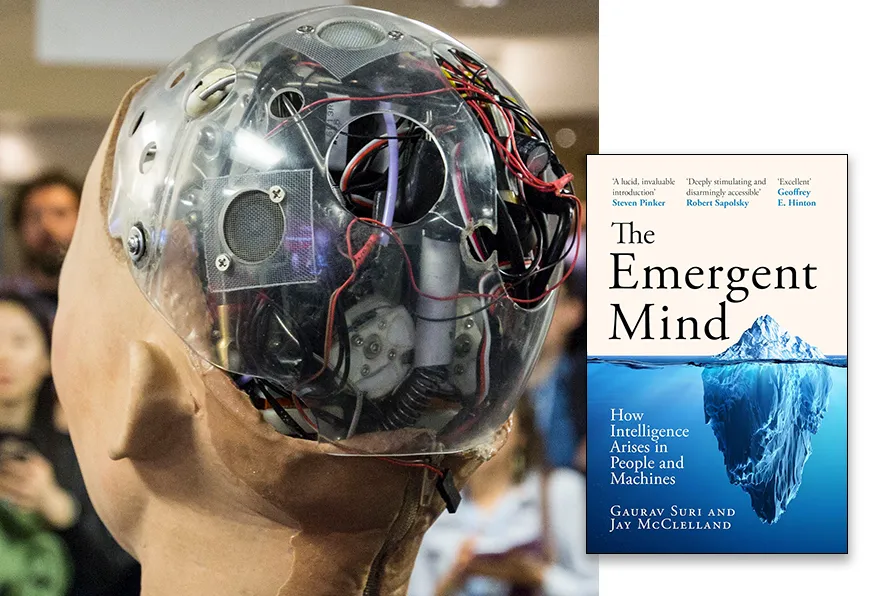
 Sophia, First Robot Citizen at the AI for Good Global Summit 2018 [Pic: ITU Pictures/CC]

PAUL DONOVAN welcomes a revival of Reginald Rose’s classic play that reminds us of the fundamental need for trials with juries
SIMON PARSONS applauds an exceptional performance of Wesker’s little-known play, by the same actor for whom it was written 45 years ago
ANDY HEDGECOCK and MARIA DUARTE review Late Fame, The Death of Robin Hood, Leviticus, and Gail Daughtry and the Celebrity Sex Pass
ANGUS REID recommends a uniquely accomplished documentary collage that contemplates our relation to the natural world
GORDON PARSONS enjoys Kant’s ‘mind-boggling’ theory of human reality: that we create the reality we experience





The Emergent Mind
Guaray Suri and Jay McClelland, Macmillan, £22
THE question of what is a conscious mind has puzzled humans since they became aware they had one. However, while sending rockets to the moon is now just engineering, conscious minds are still a scientific mystery.
Christianity separated body and mind into two entirely different things: one made of flesh, the other some kind of divine soul special to humans, that would be later gathered up into heaven; an approach known as dualism. But a materialist approach starts from the idea that minds are a property of brains — after all, we can see that many other animals have minds and some degree of consciousness.
The Emergent Mind takes the materialist approach and discusses artificial neural networks (ANNs), computer-based data structures that mimic some aspects of the networks of neurons in the brain using linked nodes with attached weights. It asks whether such structures can model some of the properties of minds.
We know that there are no specific neurons in the brain that directly hold specific items of data, like who your parents are. Study of brain damage – lesions – has shown that its engagement with the world is distributed across many, many networks, albeit in partly specialised brain regions. This is why stroke victims can regain some functions as new parts of the brain take over from damaged ones.
Suri and McClelland start by explaining emergence, a powerful idea that shows how complex structures and behaviours can emerge from interactions between very simple elements but cannot be attributed to any particular one of them. Think of the arrow of migrating geese, which is not due to prior agreement or planning, but to the tendency of more tired birds to coast a bit, behind the bodies of less tired birds. Physicists could point to gas laws relating pressure to volume and temperature, that are created by interaction between randomly moving molecules.
This book gives clear and accessible explanations of emergence in ANNs, which can be set up to discriminate between different groups of perceptual objects or courses of action with upsides and downsides very similar to human ones. The bigger and deeper the network, the greater the range of object or decisions it can separate. The ChatGPT-type large language models (LLMs) are built on this principle: “large” because they have access to vast amounts of data, but also because they have many nodes linked in many layers. If you want to understand how LLMs actually work, this book is well worth the read.
Unlike the Tech Bros and their hype about “advanced general intelligence,” Suri and McClelland do not make unsustainable claims for ANNs. They are not trying to build some ultimate intelligent being but to use these models to better understand how humans work.
The last chapters discuss the inherent limitations of their approach with three arguments: that ANNs cannot reason logically, that they cannot have motivations or follow goals, and that they cannot have consciousness. Given the excessive claims made for LLMs, not to mention the panic about possible “super-intelligences,” this is a very important discussion.
An elementary limitation is that ANNs lack semantics - that is, have no conception of what anything means. The book discusses early on a network that can separate details of a group of gang members into their two possible gangs, Jets and Sharks. We know that the inputs are personal characteristics and the outputs are membership of a specific gang – but this is because human minds have this thing called “meaning” and we know what our words are actually about.
However, the ANN is taking a bunch of numbers and separating them into two groups without knowing anything at all. This is why LLMs have been called stochastic parrots – they can sound very convincing when they output language, but have no conception of meaning, or indeed accuracy. This is why they routinely provide plausible but inaccurate outputs.
Seeing mind as a property of brain is certainly a step forward from souls, but neurologists will tell you the brain is not separate from the body in the way we often assume. It is the developed end of a whole nervous system bound tightly into our whole physical body with its senses and muscles and whole-body regulatory systems. Emergence is indeed a very powerful way of thinking about mind and consciousness, but perhaps we also need to see meaning as a property of being in the world, both physical and social.
A baby not exposed to language does not acquire it. ANNs are an exciting technology, but a baby step — if that — in the emergence of mind and consciousness.
