
The US administration is endangering lives by reversing environmental protection laws, CHAUNCEY K ROBINSON argues

The best defence
The Defence Universities Alliance is a bit to co-opt higher education into the wider drive to war — we should resist as earlier generations of scientists did, argue say ROX MIDDLETON, LIAM SHAW and MIRIAM GAUNTLETT of SCIENCE AND SOCIETY
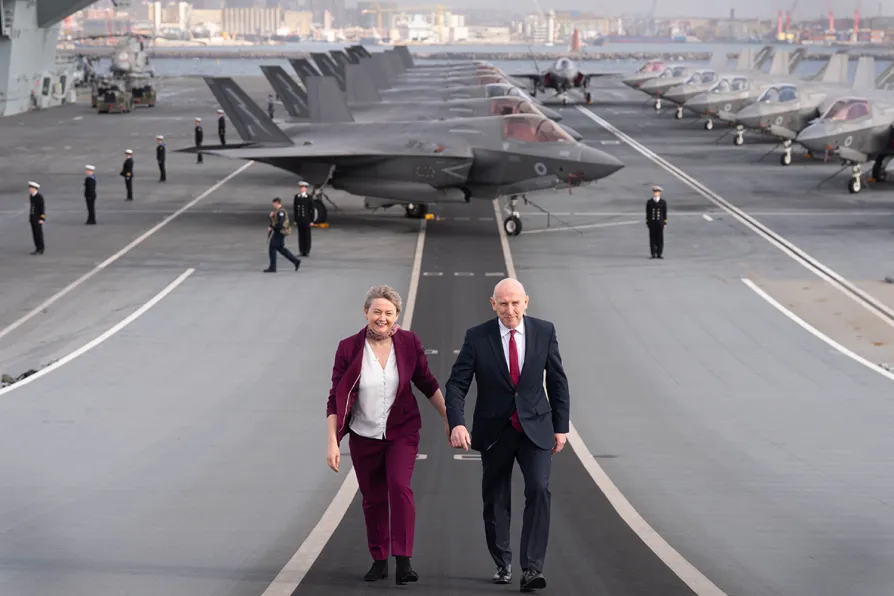
 Then Defence Secretary John Healey and Foreign Secretary Yvette Cooper during a visit to HMS Prince of Wales anchored of the coast of Naples, Italy, November 17, 2025
It’s time to stop retreating and go on the offensive to promote working-class interests, argues DOUG NICHOLLS
Marco Rubio wants to defeat socialism in Nicaragua, not restore ‘democracy,’ writes JOHN PERRY
Believe it or not, there was a time when the US government built beautiful homes for working‑class Americans to deal with a housing shortage, writes ERAN BEN-JOSEPH
DIANE ABBOTT provides an analysis of the reasons for EU and British voters’ dramatic swing to the right
Train drivers’ union Aslef general secretary DAVE CALFE speaks to Ben Chacko about his hopes that Burnham’s devolution agenda will include the importance of the railway





A MONTH ago, the government announced the formation of the Defence Universities Alliance which will “bring together academia and the Armed Forces.” A hundred universities rushed to join, of which only 35 were selected. They include some of Britain’s leading universities: Manchester, Liverpool, Sheffield, UCL, Bristol, Glasgow, Oxford and many others.
The Alliance is intended to create “meaningful connections” between universities and the defence sector as part of the Labour government’s plan to “prepare for warfighting readiness.” The idea was worked on by John Healey in Starmer’s government as part of the 2025 Defence Industrial Strategy, before Healey resigned as Minister for Defence over inadequate funding.
Those hoping for a change of tack from Andy Burnham have been disappointed. Burnham has made it clear that he intends to follow defence strategy — and probably to exceed Starmer’s position. Some measure of this can be taken from his cabinet reshuffle: Healey back in as Chancellor, and the hawkish Luke Pollard left in place as Minister for Defence Readiness and Industry.
For now, the Alliance is less about hard cash and more a statement of priorities. It forms one part of a £182 million investment to build defence-related skills in Britain, helping students to “gain greater access to exciting defence careers.” In the context of the £62 billion the government already spends on defence this is marginal. But it sets a clear message to universities that they should dance to the government’s mood music.
Indeed, academics are feeling the pressure from other decisions. UCU members at the University of Nottingham have recently been on strike over proposed mass redundancies in its physics department.
Research funding is in a chaotic state. For example, funding to the Science and Technology Facilities Council will be reduced by £160m over the next four years, resulting in cuts to flagship national laboratories. Academics have warned the iconic Jodrell Bank observatory could face closure unless it can find more sources of funding. Others like the Diamond synchrotron in Oxfordshire will be kept open but with a significantly reduced budget that will impact their activities.
Given all this, the attraction of a funding source that is increasing rather than decreasing is obvious. The campaign group demilitarise Education (dED) has compiled a database of links between universities and arms companies showing connections worth £2bn since 2017. Direct investments by universities in arms companies are usually small; the issue is “partnerships” where money flows from the company to the university. Taking BAE Systems as an example, universities hold £940,000 in direct investments, compared to research partnerships with the company worth £130m.
Universities that have pursued growth at any cost, despite the throttling of funding from home student fees, now find themselves desperately chasing any money they can. The attraction of research funding, particularly from the government, is that it often allows the university to claw back a fixed percentage of the research costs to fund overheads: energy bills, estate maintenance, staffing costs. But this flow of money contaminates education and warps research priorities.
Beyond universities, militarisation is a growth industry at a time when the political establishment has decided to constrain spending in other areas. Labour’s Defence Industrial Strategy expanded the definition of Britain’s “defence industrial base” from the arms industry alone to include academic institutions.
It also now includes banks, insurance firms, technology firms and trade unions. The country is being put on a war footing. Many areas of society that might oppose this — for example, war is not usually good for small businesses — may be effectively bought off if they are brought into the funding club.
Historical parallels can be misleading, but it is worth considering the situation in the late 1930s as a comparison. Prompted by the Spanish Civil War, which showed the horrors of aerial bombing, the government began to issue misleading advice about what to do in the event of air raids. Left-wing organisations like the Cambridge Scientists’ Anti-War Group, which included the physicist JD Bernal and the biochemist Joseph Needham, critically examined this advice.
The scientists’ hope was that by highlighting the inadequacy of the preparations they could encourage people to unite to prevent war. Unfortunately, as the physicist JD Bernal recalled, this turned out to be a forlorn hope: “there was not enough goodwill in time.” At the time, the left-wing Popular Front of anti-fascist parties in Great Britain, France and the Soviet Union was committed to opposing the government’s policy of appeasement of Nazi Germany.
The focus was on the need for civil defence against fascism, but the line between civil defence and other military plans was thin. Bernal contributed to a memorandum in 1938 that set out how the “special character of scientific work in the service of national defence” could be realised. Although the emphasis was on defence, it also explained how scientific research could be used in areas including military operations.
In the event, such efforts spurred greater commitments to use science during wartime. Bernal’s outspokenness on bombing meant he was invited to join the Civil Defence Research Committee in 1939, and as the war went on he and other scientists critical of the government were drawn further and further into the military establishment.
Today, the war situation is very different. There is no aggressor with ambitions comparable to Nazi Germany, which sought to conquer continental Europe under fascism. Even the most pro-military commentators have to admit any potential war involving Britain is vague and uncertain. Russia and China are invoked as the irresponsible actors, and the danger of war is presented as inexorably smouldering regardless of Britain’s decisions, not as something that could be ignited by them.
In his recent book 85 Seconds to Midnight, the physicist Carlo Rovelli makes what he calls “a physicist’s argument against rearmament.”
His view is one shared by many scientists across the world. Today, British universities may appear keen to embrace the government’s militaristic ambitions. But participating in the Defence Universities Alliance represents an undemocratic decision taken by senior leadership, not the sentiment of the vast majority of workers in universities.
Those of us who oppose militarisation have to speak up, and do our best to oppose the confident strides of governments sleepwalking towards war.

Similar stories

The question is not simply how much we spend on defence, but what we understand defence and security to mean, says SIMON BRIGNELL
PM commits to blowing millions on nukes

JENNIE WALSH reviews an urgent political intervention by physicist Carlo Rovelli at a time of escalating militarisation and war