
Washington’s inability to subjugate Iran is an example of how it is trying to preserve a regional order that no longer exists, argues RAMZY BAROUD


Outlaws, rebels and young revolutionaries
JOHN CALLOW introduces the work of Geoffrey Trease, who placed ordinary people at the centre of his historical fiction for children, creating adventurous stories to inspire the possibilities of social change
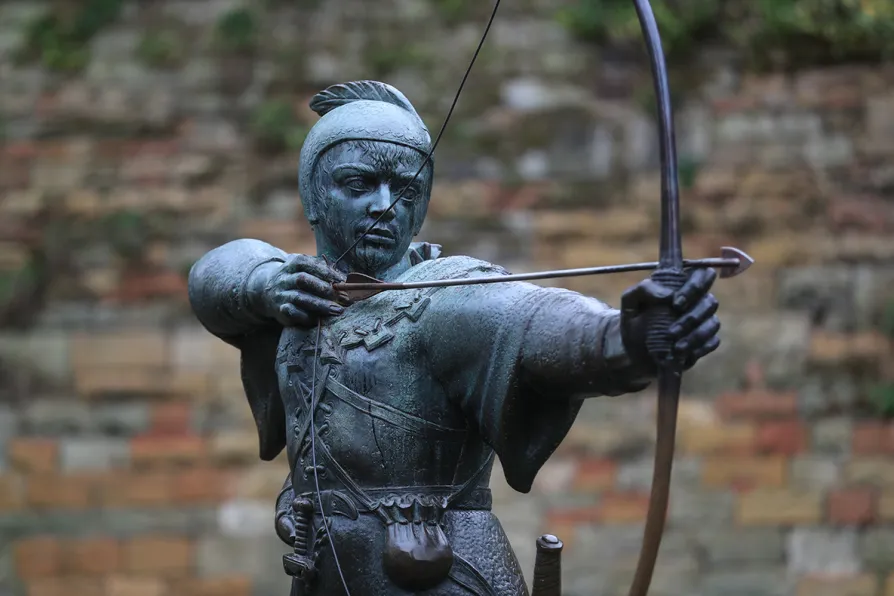
 The Robin Hood statue in Nottingham
US financial instability is exposing the limits of a dollar-dominated global economy — and giving the Global South a historic chance to build an alternative, says MURAD QURESHI
DOUG NICHOLLS says the parasitic finance markets must be challenged or another British government could be toppled
The late country singer’s Imagination Library has put hundreds of millions of books into children’s hands. We should build on that legacy by defending the libraries at the heart of our communities, says BRENDA AITCHISON
Deprivation is a fundamental factor in criminal behaviour that must be addressed but, KENNY MacASKILL argues, there needs to a major rethink in sentencing to tackle overcrowding
MML director MEIRIAN JUMP outlines the recently refreshed library’s busy autumn schedule that ranges from book sales, archival exploration, community work with online education and the ever popular site tours
TONY BURKE surveys the shifting political landscape and the challenges Labour needs to address if it is to prevail in the 2028 federal elections





IT’S a case of hit and run, kill or be killed. The outlaws move silently through their forest sanctuary, hunting and hunted. Their bows are great levellers, bringing down heavily armoured knights, inverting societal and military norms, and leaving proud lords to bleed out among the scrub and bracken.
Yet, around the campfire, hidden away in caves at the heart of Sherwood, these escaped serfs, highway robbers and “criminals of want” speak of better days that lie ahead; of destroying the feudal system; of creating just laws and a land free from want, where property takes second place to need, everyone is a comrade and liberty is the watchword of the commons.
This was Geoffrey Trease’s radical, and radicalising, reimagining of the Robin Hood story, first published by Martin Lawrence (the forerunner of Lawrence & Wishart), for young readers, in 1934. It was an immediate success, heavily promoted in the pages of the Daily Worker and quickly translated and republished in the USSR, in a print run of 10,000 copies. Bows Against the Barons caught the spirit of the times — of high ideals, revolutionary politics and class conflict — and effectively back-projected them into medieval England.
Familiar settings and legendary characters were skilfully deployed to discuss pressing modern issues around access to land (the mass trespass on Kinder Scout had taken place two years earlier), and the right to a life free from the scourge of starvation and poverty (the Hunger Marches organised by the National Unemployed Workers’ Movement had surged through Trease’s hometown of Nottingham during the early 1930s). As such, the novel’s avowedly socialist message assumed an element of camouflage through the choice of subject matter that suggested, yet thoroughly subverted, the established “Boy’s Own” tradition of children’s literature. There was precious little that was “Merrie” in Trease’s England.
Further commissions from Martin Lawrence followed. Comrades for the Charter centred around the Chartist rising at Newport in 1839; while Red Comet (informed by Trease’s five-month stay in Moscow and the Crimea in 1935) took a British girl and boy on a whirlwind tour of the Soviet Union, courtesy of a prototype racing plane.
Several short stories appeared in the beautifully produced children’s annuals, issued by the publisher in time for the Christmas holidays. By far the best of these was an encounter between classmates; a brash young lad caught up by the splendour of Empire Day and tales of colonial conquest; and an intelligent, normally quiet girl who challenges his assumptions about war, imperialism and the nature of power.
At the conclusion, the boy vows to learn more about the world and its workings, and that from now on he would only “fight for his own class.” Nuanced, spirited and edgy, the tale perfectly captures a sense of amity — and of political and sexual awakening — in the chance exchange of ideas between adolescents poised on the threshold of maturity.
Adult novels and plays followed, including Colony for the Unity Theatre, which was originally to have starred Paul Robeson, and which opened, in 1938, with Robert Adams (the founder of one of Britain’s first black theatre groups), taking the lead as a union activist on a West Indian sugar plantation.
However, the impact of the second world war seems to have marked a watershed in Trease’s politics and, after the publication of a hagiography of Marshal Voroshilov in 1940, a marked distancing from the Communist Party, having already left Lawrence & Wishart for mainstream, commercial publishers. Thereafter, his children’s books came increasingly to be orientated towards the source material that fell immediately to hand.
Consequently, Trumpets in the West (published in 1947) essentially mirrored the view of the revolution of 1688 provided by the lens of Winston Churchill’s biography of Marlborough; while the Samuel Pepys of Popinjay Stairs (published in 1973) is the farsighted and lovable patriot of Arthur Bryant’s popular accounts, rather than the embezzler of funds destined for the Tangier garrison, and proto-absolutist, of hard, archival reality.
Later editions of Bows Against the Barons were reworked to exclude “anachronistic” material and language. Robin and his band stopped addressing one another as “comrade” and social criticism was muted against the backdrop of the cold war.
Yet, while one can see areas of duplication of plots, characters and stock phrases, this needs to be understood in the context of the high-paced work of a professional writer, who lacked private means, and who needed to be prolific in order to maintain his profile and earn a reasonable living.
Some 113 books flowed from his pen over the course of a career that ran from 1934 to 1997. Among them were sparks of brilliance that retained the power to inspire and challenge young readers, whether in No Boats on Bannermere (1949) — superficially a clone of Arthur Ransome’s Swallows and Amazons which explores deeper conflicts over landlordism, the right to roam, and the securing of archaeology for public as opposed to private interests — or in The Field of Forty Footsteps (1977), which throws a surprisingly harsh light on the cynicism and corruption of Charles II’s court through the rise and fall of a London theatre company.
Trease excelled as a short story writer and in Gentlemen of the Sealed Knot (first published in 1950), he provides an entirely original and gripping account of a royalist plot to murder the ambassador of the English Republic to The Hague. The Cavaliers, stripped of all glamour, are brutal and brutalising survivors of a lost and discredited cause, while the republican government is to be defended and celebrated through the eyes and actions of the youthful protagonist, as he hurries across a frozen landscape, mauled and bleeding, to prevent the attack.
Here, history was seen from below and explored as a vibrant, exciting and radical current, fully capable of transforming lives and alongside it a society that was often revealed to be harsh, grubby and exploitative.
With Trease there are few “happy” endings of the conventional storybook variety. Death and disappointment accompany discovery and self-realisation. Robin’s band are betrayed and slaughtered; the Welsh Chartists are shot down by automaton-like soldiers sheltering behind loop-holed walls; while the Restoration players are fooled by Charles II’s smiles and thrown back upon the road by his whims and need for ready cash.
Yet, the children returning to the grim reality of 1930s England after leaving the Red Comet, and the surviving fugitives from the outlaws’ camp, have undergone experiences that have profoundly reshaped them, expanded their horizons, and confirmed them in the belief that progressive change can and, indeed, will transform society and improve the lives of all those who follow them.
“Every child,” wrote Trease, “deserves [their] own bookshelf.” This, together with the public library system that he consistently and assiduously promoted, were the cornerstones of lives based upon imagination, inquiry, critical thinking and creativity.
When asked, at the height of his popularity, to define the purpose of children’s literature he had no trouble in delivering a verdict that still holds true today.
“An author’s function,” he concluded, “is not solely to hold up mirrors — it is [their] job also to open windows, windows with long views and in many different directions … I did not want to call to my readers, ‘Stay in your magical childhood, you will never have it so good.’ My impulse was to beckon them on and shout: ‘There is a wider view from the next bend. Come along — it’s dangerous but it’s worth it!’”

Similar stories

FIONA O’CONNOR questions the achievement of this year’s Orwell prize winner for political fiction

From post-human revolution in Puerto Rico to trans poetics and queer mythmaking, these three books that imagine new ways of being together
A remarkable excavation in the Netherlands has raised hopes of locating the grave of Louis XIV’s famed captain of the King’s Musketeers. JOHN CALLOW introduces the real figure behind the hero of Dumas’s novels
JULIA THOMAS unpicks the mental processes that explain why book-to-film adaptations so often disappoint