Latest editorial

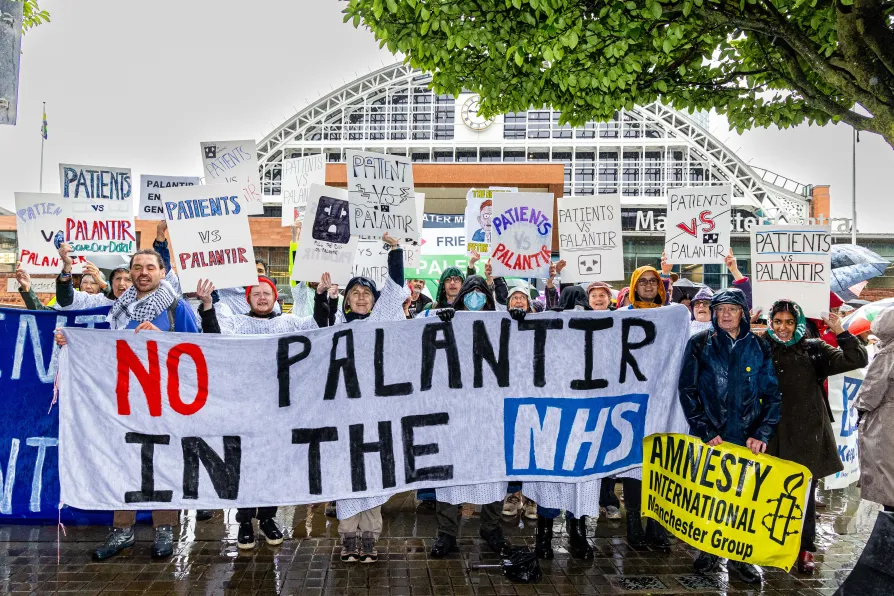
 NHS staff blockade the entrance to NHS England's headquarters in central London demanding the cancellation of its contract with Palantir, which supplies advanced technology to Israel's military, April 3, 2024






ANDY BURNHAM is not “minded” to grant contracts to CIA-linked tech firm Palantir, we learn from Westminster briefings this week.
The Makerfield MP’s impending coronation leaves us in a strange transitional period where his reported preferences are the stuff of gossip, rather than policies being demanded as the price of support. He has delivered a pitch to the nation of sorts: but no questions were taken, and pinning the PM-to-be down is much harder in the absence of a leadership contest.
We were never going to see a mass campaign like those fought by Jeremy Corbyn for the leadership in 2015 and 2016, which took on elements of a national conversation about challenging the political pieties of the previous 40 years (Burnham says he too rejects them).
The rules have been changed to stop such democratic engagement. Given the current PM prevailed by simply lying about what he would and wouldn’t do in office, the labour movement’s approach should shift anyway to mobilising political and industrial pressure on ministers, rather than asking for pledges.
But the fact remains that treating Burnham’s premiership as a foregone conclusion allows him to be troublingly vague.
His allies can reassure the left that he isn’t keen on Palantir, citing his record as Manchester mayor in which role he never awarded it a contract; he himself avoids any specific commitments either on future contracts or — significantly — existing ones.
Palantir’s contracts reek of corruption — the recusal of Department of Health permanent secretary Samantha Jones from working on them, announced today because she has worked for a healthcare consultancy that participated in Palantir’s bid to develop the NHS federated data platform, is only the latest example.
Dozens of top British officials, including from the health and defence ministries, have gone on to jobs for Palantir after it secured lucrative government contracts in those sectors. Even the meeting between Keir Starmer and Palantir’s far-right founder Peter Thiel involved a conflict of interest, since it was set up by disgraced ambassador to Washington Peter Mandelson whose firm Global Counsel carried out work for Palantir.
Direct, personal corruption looms ever larger in our politics — the arms industry interests of the retired generals demanding grotesque increases in military spending are an obvious example.
But the subversion of our public services by profit-seeking corporations is corrupting on a deeper level.
Thiel is a plutocrat as sinister as Elon Musk, with whom he shares an upbringing in apartheid South Africa: an advocate of “post-democracy,” arguing that democracy is incompatible with human (by which he largely means corporate) freedom and, also like Musk, pitching his own tech companies as future mechanisms of rule.
Palantir’s facilitation of horrific racist policing methods in the US, and still more horrific war crimes by the Israeli military, is well known but cancelling its contracts is not simply a question of ethics.
We have to question the idea that companies as powerful as this provide services on a politically neutral basis, given their founders are explicitly hostile to public services as such.
The same applies to the wider relationship with the United States, whose government openly supports Britain’s race-rioting far right: this is not an administration we can enjoy a mutually beneficial relationship with, something clear as the appalling cost to the NHS of the trade deal Starmer and Wes Streeting struck is now emerging.
The idea that opening public services up to competition — something Burnham supported in Tony Blair’s government — would improve efficiency has long been a sick joke; the monopoly position of the big contractors makes a mockery of it anyway.
But worse is the perversion of those services themselves to serve corporate agendas — which can themselves be political.
It’s good that Burnham is not “minded” to favour Palantir, but a comprehensive rejection of outsourcing policies which now threaten democracy itself is what’s required.

The greatest threat to democracy may no longer come from political parties but from unelected tech oligarchs like Peter Thiel and his powerful Silicon Valley network, argues JOHN GREEN