


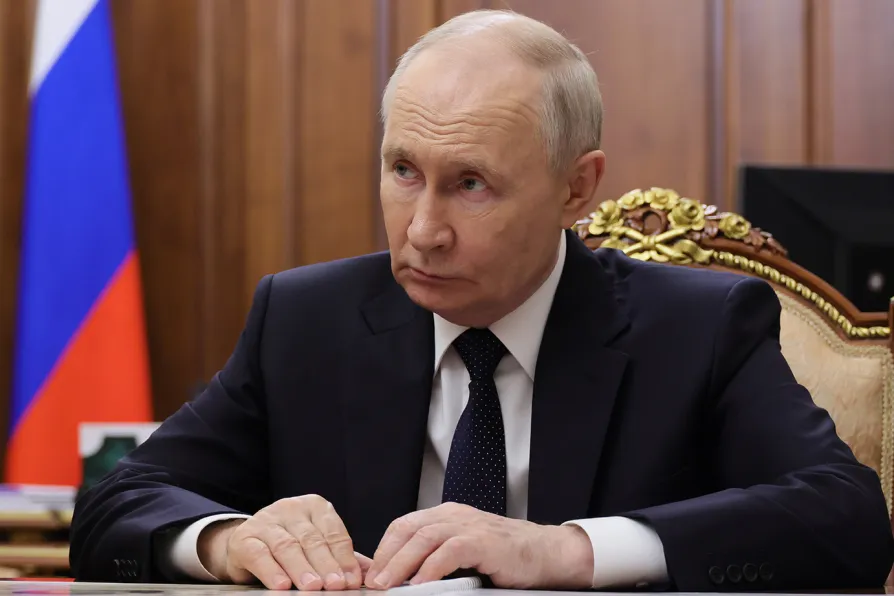
 Russian President Vladimir Putin





THOUSANDS of delegates from 120 countries are gathering in Moscow for the International Security Conference this week.
Russia has attracted most countries across Africa, Asia and Latin America by billing its summit a response to the twin threats of neocolonialism and neonazism.
There are elements of hypocrisy here — but the huge audience shows the pitch has hit its mark.
Russia’s accusations of a neonazi revival focus on Ukraine, whose open celebration of Nazi collaborators continues; just this week it reburied near Kiev, with President Volodymyr Zelensky in attendance, Organisation of Ukrainian Nationalists (OUN) leader Andriy Melnyk. The OUN fought alongside the Wehrmacht during the invasion of the Soviet Union and murdered hundreds of thousands of Poles and Jews.
But with Trump ally Elon Musk publicly engaging in Nazi salutes and the US using bogus claims of “white genocide” to try to reverse the verdict on apartheid in South Africa, fear of the revival of fascist ideology goes much wider.
That was reinforced by US Secretary of State Marco Rubio’s tribute to European colonial empires at the Munich Security Conference in February. The age of European greatness, Rubio said, ended in 1945, not coincidentally when fascism was defeated.
The US promotion of a new colonialism — visible in its resource grabs from Venezuela to Congo — is resented worldwide.
By no means is every country represented in Moscow this week a Russian ally or supporter of its war in Ukraine. But three-fifths of the world is there because there is deep alarm at the trajectory of Western politics — and a widespread determination in the global South to build a multipolar world.
