Councillor SAM WHEELER says there’s a tangible shift in mood on the left in the city whose mayor has recently become PM — but there’s no room for complacency



Unity against the right in Wales
TUC Cymru’s programme offers a potential roadmap for co-operation between Labour and Plaid Cymru on jobs, services and economic democracy, says DAI MORGAN
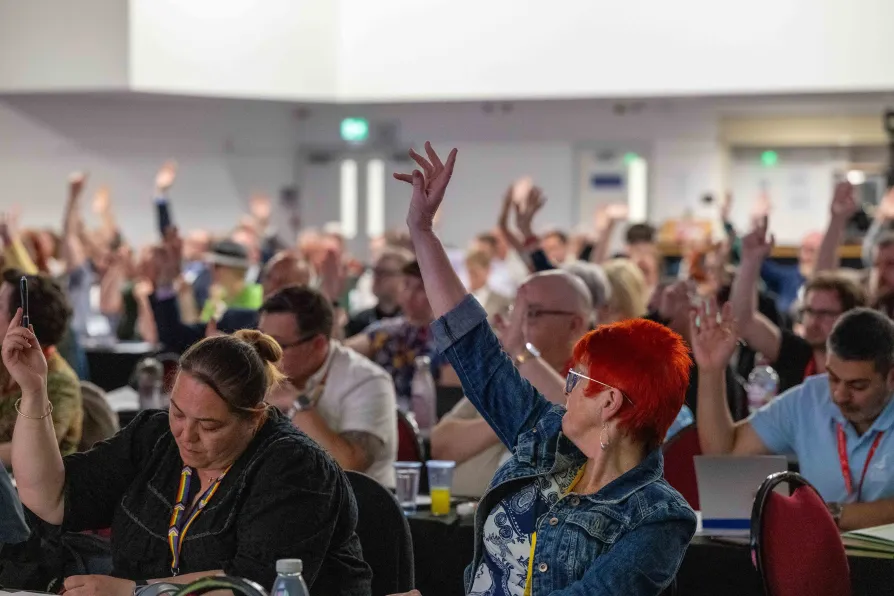
 Delegates voting at TUC Cymru Congress. Photo: Natasha Hirst
Communist Party leaders Alex Gordon and Lorraine Douglas deliver vital medicines in trip to besieged socialist island
TUC Cymru is playing a leading role in tackling far-right ideas in the workplace, says LAURA DOEL
A New Delhi press conference in which Sheikh Hasina and her son implied the new order in Bangladesh is a security threat to India has sparked fears she is planning a comeback. SIAM SAROWER JAMIL reports on the fallout
Two months of student unrest have forced out India’s education minister and rattled the BJP regime. Could this be the beginning of the end for Modi, asks Communist Party of India (Marxist) general secretary MA BABY
MAT COWARD says the heatwave is a testing time for gardeners — but he has some tips





OUR best hope for progressive policies in this Senedd term? The TUC Cymru position paper “How We Build a Wales that Works for Everyone” provides the platform that we can build unity around. And it is unity that we need.
The presence in the Senedd of so many Reform members, not to mention residual Tories, provides a hostile landscape.
A landscape that demands maximum collaboration between Plaid Cymru and the Labour Party on a progressive agenda.
So what is likely to be possible? The two parties may be coming from different ideological and strategic positions, but there is much shared interest.
The TUC agenda provides an outline of overlapping priorities in economic development, public services, transport, education, energy and social justice.
Industrial strategy and economic development is a key priority. Importantly the TUC Cymru, Plaid and Labour approaches all reject a purely market-led approach and instead support a more interventionist economic model. The proposed national development agency can play a key role in the modern industrial strategy the unions are calling for.
Much of the vital role of ensuring that public funding results in public good will be done by trade unions in their workplaces and through their interventions in public procurement strategy.
A movement needs to be built for a more ambitious vision for economic democracy means that workers and communities — not shareholders — control economic decisions. This does not just mean better consultation; it means changing ownership and power including; public, community and worker ownership of key industries; democratic planning of investment and production; and trade union rights embedded in economic decision-making.
One of the clearest areas of convergence is the importance of developing a high-skill economy. TUC Cymru emphasises the importance of worker training through the Wales Union Learning Fund and argues that workers must be prepared for technological and environmental change.
These demands need to find their way into Plaid’s proposed Wales-wide skills audit which clearly has room to draw further inspiration from Labour’s proposals for a lifelong retraining guarantee, expanded apprenticeships, and skills policies linked to clean energy, manufacturing, and digital industries.
We need to press for investment in staff training as a requirement for public-sector funding and procurement contracts.
Energy and climate policy represent another significant area of policy overlap. The Welsh Labour manifesto promoted an “Energy Independent Wales” based on renewable energy, community ownership, and green jobs.
Plaid Cymru similarly advocates a national energy strategy, expanded community-owned renewables, and stronger public involvement through Trydan Gwyrdd Cymru.
TUC Cymru supports the low-carbon transition while stressing that workers and communities must benefit from it.
We need to press for real progress on renewable energy expansion, green job creation, and ensuring that the economic benefits of decarbonisation are retained within Welsh communities.
A growing consensus on the need for a rejuvenation of public transport is emerging.
Shared priorities suggest potential agreement around cheaper fares, expanded services, better rural connectivity, and transport investment as a driver of economic growth and social inclusion.
The crisis of health provision in Wales is recognised in both the policy documents and in the day-to-day experience of Welsh workers. Pressures facing the NHS and social care system, particularly around waiting lists, workforce shortages, and increasing demand are understood across the labour movement and progressive political parties.
Plaid Cymru’s focus heavily on preventative healthcare, is welcome. But the need for properly valued public-sector workers needs to be fought for. Removal of profit from care services is a vital component of the national care service we need and a long held ambition we have the opportunity to realise.
The major commitment on childcare that the new government have proposed, needs to be seen through the wider lens of fair wages, prices and economic security for working households, the genuine solution to the cost-of-living crisis.
Finally, we should be able to reach meaningful agreement around devolution and fair funding. The “independence” bogeyman is simply not on the agenda at this time. That fork in the road lies many miles down the way. All our ambitions will suffer if we fail to travel as far down the self-government road as our current consensus already allows.
TUC Cymru’s argument that Wales should receive funding based on social and economic need rather than population share alone is a key principle to uphold.
Success against the far right in Wales can only be built on the foundation of a vibrant alternative trade union agenda delivered in unity without sectarian squabbles.
