ANDY HEDGECOCK and MARIA DUARTE review Late Fame, The Death of Robin Hood, Leviticus, and Gail Daughtry and the Celebrity Sex Pass


 Latest editorial

Benign disobedience
GEORGE FOGARTY wallows in a celebration of music as a community practice
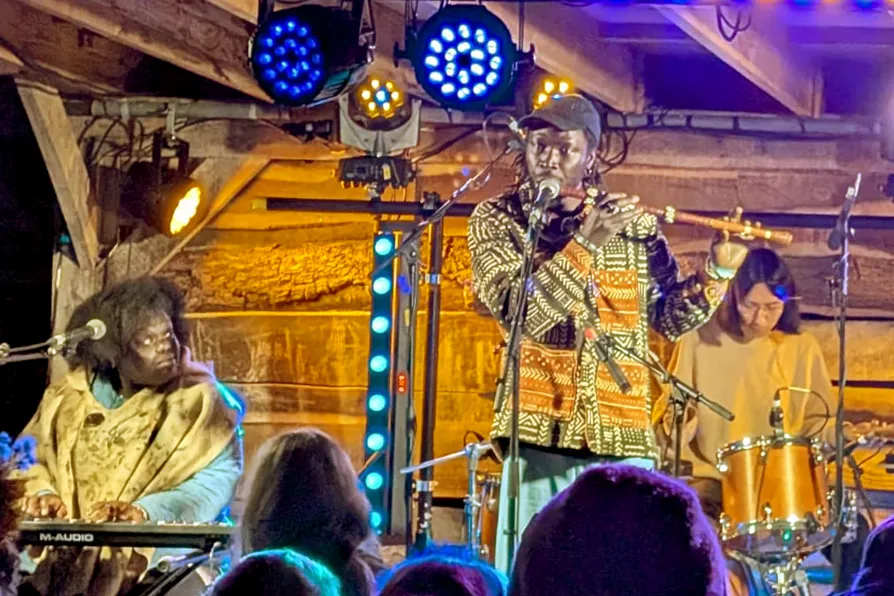 Falle Nioke and his band [Pic: Lorna Gooch]
GORDON PARSONS enjoys Kant’s ‘mind-boggling’ theory of human reality: that we create the reality we experience
DAVID RABY welcomes a biography that emphasises how Fidel’s unique characteristics became hallmarks of the ongoing Cuban revolutionary process
IAN SINCLAIR recommends a readable, if partisan, account of the astonishing campaign of New York's new mayor
MATTHEW HAWKINS witnesses a contemporary ballet that represents human life as subjected to artificial intelligence
by Marwa Paikan





Wood Festival 2026
★★★★★
WOOD FESTIVAL is a tiny, child-friendly, festival in Oxfordshire. Its small scale encourages face-to-face interactions and conversations, and its line-up emphasises the tradition of music as a community practice.
Friday night’s headliner Falle Nioke first made waves with his band Pigeons, named in honour of the much-maligned bird which he kept as a pet in his native Guinea. That band was seeded when Tom Dream, raised in the Irish culture of communal singing, was drawn to Falle as a fellow inheritor of that tradition having seen him perform on Margate harbour.
Their collaboration soon grew into a five-piece, specialising in what could perhaps be termed psychedelic Afro-electronica, and Falle’s sound tonight is in a similar vein. The first half is more mellow, based around shuffling breakbeats and grooves which build slowly and subtly, before shifting a gear as drummer and keyboardist swap roles, the beats become more African, and the whole set becomes much more pounding and intense.
Over it all, Falle flits between mbira, djembe and flute, while his silky and versatile voice soars with a beautiful urgency in multiple languages, informing us that “we have come to melt down the weapons industry — we don’t want to swim in blood no more” and reminding us that “we are all from the same family and we are all going to be in paradise together.”
Similar to Africa in the ubiquity and importance of music in society is, of course, Ireland, both places maintaining a culture of music as something that you participate in, rather than something you pay others to do for you. Not coincidentally, both also have a strong tradition of oral storytelling, creating a deep palette of material from which to draw. The result, of course, is an endless stream of incredible artists emerging from this fertile soil.
The passing down of this culture is beautifully evident in Seamus Fogarty’s set, in which he is accompanied by his partner Emma and seven-year old daughter Nora on the fiddle and backing vocals. Accompanied at times also by heavy electronic beats from an analog drum machine, and telling compelling tales of lost souls and wrong ’uns, this is an age-old tradition kept exquisitely alive and relevant.
Another act demonstrating the exemplary fruits of cross-cultural collaboration are Saturday night headliners in the Treebadour tent, Ranglin. Starting off as a tribute band to Jamaican jazz guitarist Ernst Ranglin — and specifically his incredible Below The Bassine album — they have since taken that sound in new directions of their own.
Hearing Below the Bassline for the first time was a revelatory moment for me, the first time I had heard a jazz record I not only liked, but adored. Comprising a dozen of the greatest reggae classics in the Jamaican canon, reinterpreted by the country’s greatest jazz musicians, it was an instant hit.
Tonight’s set reprises some of that album’s stand-out tracks, including Toots and the Maytals’ 54-46 Was My Number, and The Congo’s Congo Man, the rhythm section combine frenetic shuffling jazz drums with the laidback vibes of heavy dub basslines to scintillating effect, before moving into some of their own compositions. The clean, crisp sound of the four virtuoso musicians is absolutely delicious and by the end there is not an unsmiling face in the entire tent.
Among all the music and workshops, the Kindling tent plays host to a plethora of stimulating talks and discussions. Particularly popular this year was Ed Finch’s interactive musical lecture entitled What the F@*% is Wrong With Education?
Mr Finch, as we know him, was a much-loved primary school teacher in Oxford for many years before moving to Devon where he is now a headteacher. Often seen around the playground wielding his ukelele, Finch has always been an advocate of teachers bringing their passions and eccentricities — that is to say, their humanity — into the profession.
But, he points out, neoliberalism is today steadily squeezing out the spaces in which such humanity — among either staff or students — can flourish. The only solution, he notes “is disobedience” — to the toxic accountability culture of Ofsted, to the commodification of education, and to the dehumanising uniformity imposed on schools through the demand for rigid adherence to off-the-shelf Powerpoints.
It is inspiring to hear this message, and gives hope that perhaps a new movement pushing back against the loss of humanity in education is possible. It is certainly needed.
Woods Festival ran from May 15-17. For more information see: woodhq.org.
