
The US administration is endangering lives by reversing environmental protection laws, CHAUNCEY K ROBINSON argues

The Massacre of Tranent and Scotland’s hidden radical history
The 1797 slaughter of protesters and bystanders in Tranent exposed the brutality of the British state during a period of democratic repression, says KENNY MacASKILL
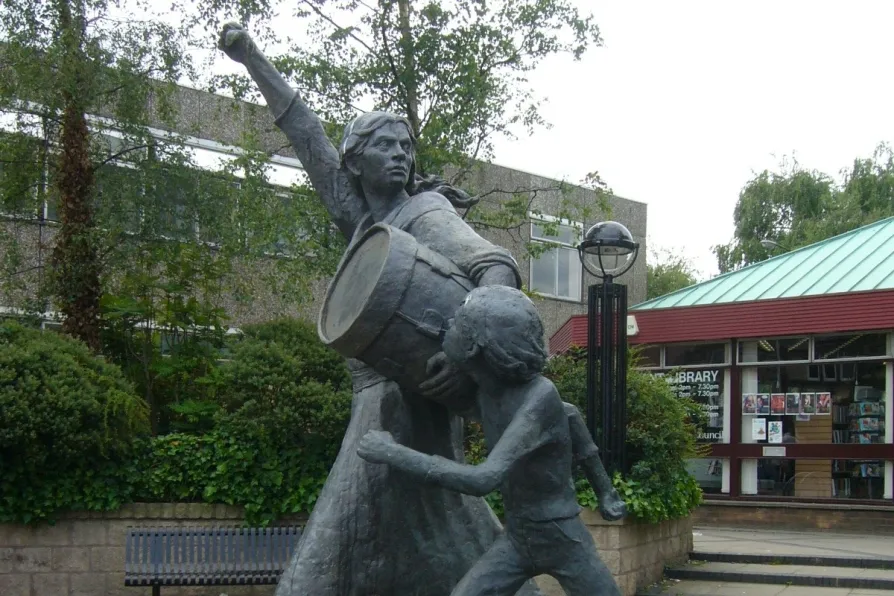
 OVERLOOKED: A memorial depicting Jackie Crookston, one of 12 local people killed in the ‘Massacre of Tranent’ in 1797, when colliery workers resisted conscription under the Militia Act of that year. Photo: Kim Traynor/Creative Commons
It’s time to stop retreating and go on the offensive to promote working-class interests, argues DOUG NICHOLLS
Marco Rubio wants to defeat socialism in Nicaragua, not restore ‘democracy,’ writes JOHN PERRY
Believe it or not, there was a time when the US government built beautiful homes for working‑class Americans to deal with a housing shortage, writes ERAN BEN-JOSEPH
DIANE ABBOTT provides an analysis of the reasons for EU and British voters’ dramatic swing to the right
Train drivers’ union Aslef general secretary DAVE CALFE speaks to Ben Chacko about his hopes that Burnham’s devolution agenda will include the importance of the railway





THE Gaza genocide, along with other horrors of war, can make historical military atrocities seem minor conflagrations. But exposure of military brutality wherever and whenever it happened remains essential, and they should also never be forgotten.
The My Lai massacre is the most publicised and has been given further recent profile with the biopic of Seymour Hersh who first exposed the slaughter of the Vietnamese villagers by US troops. Britain, though, has its own atrocities and not just those shamefully inflicted upon colonial peoples across the empire.
There’s also been those conducted against our own people in Britain. Derry last century continues to reverberate and Peterloo remains totemic for the socialist movement.
Scotland has also suffered a military atrocity and not just the ethnic cleansing by “Butcher” Cumberland in the Highlands after Culloden.
The Massacre of Tranent took place on August 28 1797. Tranent’s a town on the south-east edge of the City of Edinburgh. As with those atrocities in Northern Ireland and Manchester, a cover-up would follow and justice prove elusive for victims.
It has sadly never had the same prominence and even today is little known in Scotland, let alone elsewhere. Perhaps not just because of who perpetrated it but also because it occurred as part of a wider series of disturbances known as the anti-militia riots and which are part of our buried radical history.
It was a time when Europe was convulsed by the French Revolution, and its reverberations had affected England and Scotland. Liberty, Egality and Fraternity were still on the lips of many as the tumultuous events gave hope of a new and better life on earth, not just in heaven.
The horrors of the guillotine, as the monarchy were executed and the revolution devoured itself, saw sympathy recede, and war against France saw many others rally to the flag, as happens in almost every conflict.
Repression had commenced, with Thomas Muir and his fellow Scottish political martyrs transported to Botany Bay for seeking democracy. The construction of garrisons across central Scotland had also started replicating what had happened in the Highlands after the Jacobite rebellions.
This was ostensibly due to the increased size of the army, which could no longer simply see troops billeted on local taverns and households. Privately the authorities were expressing fears of troops being suborned and equally seeing the requirement of garrisons for what they described as “internal tranquillity.”
In addition to a far larger army and yeomanry and volunteers, there were demands for a militia. Conflict on the European continent saw troops embarked there, yet fears of a French invasion remained and a militia had been established in England several years before.
That had been resisted in Scotland due to fears of its unpopularity. However, as war continued to be waged and concern about French activities increased, it was agreed to bring one into Scotland.
Its terms were to be more restricted than those south of the border, with assurances that there would be no requirement to serve outwith Scotland. Conscription was to be made by ballot for those aged between 19 and 23. But it was still deeply opposed. As ever, it would hit the poorest hardest, both unable to pay for substitutes and taking away economically active young men.
Late August into September 1797 saw some 40 disturbances take place across central Scotland and into Highland Perthshire when the procedures commenced. Scots troops having been dispatched to Europe resulted in the Pembrokeshire and Cinque Port cavalry moving north to deal with any unrest.
Opposition to the procedure had started in Tranent the night before the massacre as people marched through surrounding villages gathering support to challenge the authorities.
On the morning of the 28th government officials arrived with a military escort and were faced by a hostile crowd. Stones started to be flung at soldiers from rooftops and the cavalry paraded down the street seeking to restore order.
That simply inflamed the crowd who could run through closes avoiding the troops and continue their onslaught. Pistol shots were then fired as warnings, but again to no effect.
It’s never been detailed who gave the order to fire or attack but carbines were then drawn and slaughter commenced.
Neither women nor the elderly were spared. A woman was gunned down at the entrance to a close and others likewise killed on the street in the town. But worse was to follow as the troops pursued some rioters through neighbouring fields before embarking on random slaughter.
Innocent tradesmen entering the village were cut down and two young brothers who had been watching events and were returning home were chased through fields.
One survived by good fortune, the other wasn’t so lucky. Others were hunted down and even killed after being toyed with by soldiers with a blood lust.
Twelve were killed, a large number, for what was then a small village. A subsequent investigation accepted that most had been entirely innocent, but no action was ever taken against any soldier.
The Pembrokeshire Cavalry, who seem to have been largely responsible, were quickly moved south. The only people taken to court were those who wrote about it.
The wider disturbances seem to have largely been unco-ordinated but both draconian legislation and government fears about an organisation called the United Scotsmen give some credence to the view that attempts were made to ferment opposition against the Militia Act.
That clandestine group was modelled on the United Irishmen who would rise under Wolfe Tone the following year in the Great Rebellion of 1798.
But the Tranent massacre seems to have just been a protest which turned into a riot before the military slaughter commenced. Its brutality, along with wider repression, largely killed radicalism for almost a generation. But it would return.
Today a statue stands in Tranent depicting the drummer who led the demonstration the evening before. The massacre should be remembered both for the victims and as part of our radical history.
