Councillor SAM WHEELER says there’s a tangible shift in mood on the left in the city whose mayor has recently become PM — but there’s no room for complacency



Train drivers still waiting for basic Dignity at Work
DAVE CALFE, general secretary of Aslef, the train drivers’ trade union, writes exclusively for the Morning Star as the union’s five-day annual conference opens in Birmingham
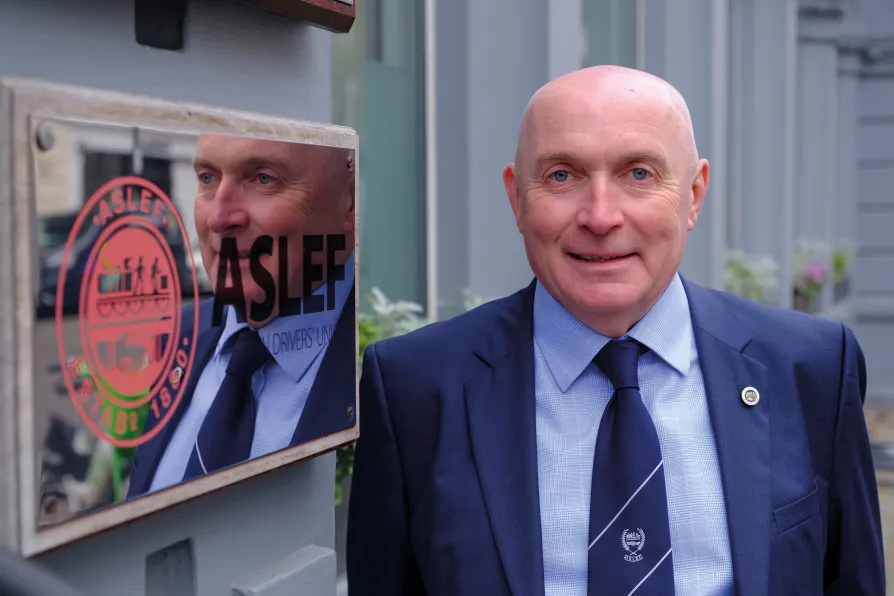
 Aslef general secretary Dave Calfe
Communist Party leaders Alex Gordon and Lorraine Douglas deliver vital medicines in trip to besieged socialist island
TUC Cymru is playing a leading role in tackling far-right ideas in the workplace, says LAURA DOEL
A New Delhi press conference in which Sheikh Hasina and her son implied the new order in Bangladesh is a security threat to India has sparked fears she is planning a comeback. SIAM SAROWER JAMIL reports on the fallout
Two months of student unrest have forced out India’s education minister and rattled the BJP regime. Could this be the beginning of the end for Modi, asks Communist Party of India (Marxist) general secretary MA BABY
MAT COWARD says the heatwave is a testing time for gardeners — but he has some tips





RICHARD HINES, His Majesty’s chief inspector of railways, and director of railway safety at the Office of Rail and Road, wrote to every train and freight operating company on Tuesday July 29 last year telling them to provide proper facilities for railway staff.
That meant, we thought, that train drivers would, finally, have access to toilets at work and would no longer have to go more than four hours on duty without access to a toilet.
The industry had signed up, eventually, to Aslef’s Dignity for Drivers campaign — which we launched with MPs at Westminster in November 2024 — after our women’s committee item was adopted at our annual assembly of delegates, our annual conference, concerning the health benefits of cutting maximum continuous driving hours, and diagramming more frequent PNBs, easing and preventing conditions that include decreased risk of toxic shock, DVT, bladder issues, colorectal cancer, and prostate cancer.
After being told by many train operating companies and freight operating companies that we would have to pay for any changes, we made it clear that Dignity for Drivers was not, and is not, a productivity issue — we are not paying through negotiation for our health and wellbeing or for access to toilet facilities — because it is clearly the employer’s responsibility.
As a result of our campaign Hines convened an industry roundtable, in June 2025, at which they agreed to our four key demands: a maximum period of four hours without access to toilet facilities as standard across the railway industry; the provision of safe, clean, accessible and dignified toilet and welfare facilities right across the network; train drivers to be able to go to the toilet based on individual and personal need, without being subject to management interference, discrimination or disciplinary action; and all train and freight operators to provide free sanitary products in the workplace, and for these to be available right across the network for drivers who want and need to use them.
When Hines followed up that meeting with his letter in July — with his instructions to the employers in our industry — we felt, understandably, that this was the successful culmination of our Dignity for Drivers campaign. Hines told the industry that “access to clean, safe and reliable welfare facilities is not a luxury — it is a basic requirement in any civilised society.”
He added: “The current situation, where some railway workers still lack adequate facilities or the time to use them, is unacceptable. This is a matter of human dignity, health, safety and respect to our people.”
Hines went on: “I urge all industry partners to take ownership of this issue and work collaboratively to deliver tangible, lasting improvements, meeting legal duties as employers under the Workplace Health, Safety and Welfare Regulations (1992). The development of a shared welfare charter, mapping of existing facilities, and practical pilots are important enabling steps — but they will only succeed if we embed a culture of shared responsibility and leadership at every level across the industry.”
I wrote in the Aslef Journal, our monthly magazine, at the time: “The industry is now on notice to make real change for train drivers to have access to toilet facilities across all parts of Britain’s railway network. We look forward to the industry implementing, in full, the welfare charter.”
Ten months later, very little has changed. The industry, and the government, appear to be ignoring the health and wellbeing of Britain’s train drivers, putting us in potentially unsafe situations with distraction and dehydration as well as ignoring toxic shock syndrome and the long-term health implications that arise.
It’s utterly disgraceful because all those stakeholders attended that roundtable workshop last year and agreed to our demands. The trouble is that the industry and the government have been dragging their heels.
It would appear that they do not care about the good health and wellbeing of Britain’s train drivers.
But we will — one way or another — hold them to the agreements they made last year and make sure that they deliver.
This time last year, in May 2025, Hines attended our annual assembly of delegates in Durham. He gave a very warm, and very frank, speech which went down very well in the room.
Hines told Aslef delegates: “The secretary of state speaks of the railway culture and the issue of welfare is key to changing the railway culture. We need to tackle this sort of stuff, the issues clearly set out in this Dignity for Drivers report. So thank you for raising this issue. We have a clear focus on health and safety and that will impact on reform.”
As we meet again for this year’s annual assembly of Aslef delegates in Birmingham, I am putting the industry on notice that they need to heed Hines’s words, take notice of his letter last year, and the instructions he gave them, and put into practice what they all agreed to do when they signed up to that welfare charter.
I have already written to Heidi Alexander, the Secretary of State for Transport, and Network Rail, and I will be writing to the Cabinet Secretary for Transport in the Scottish government, and the Cabinet Secretary for Transport in the Welsh government. And our officers have been engaging with all the train and freight companies. Because we are determined to get Dignity for Drivers in Britain.
Dave Calfe has been a train driver, and Aslef member, for 41 years. He joined the railway as a traction trainee in 1985 and drove passenger and freight trains for British Rail, Eurostar, Virgin West Coast, and Avanti West Coast. A member of Euston branch, he was branch secretary, company council rep, and then an executive committee member for 20 years, and EC president for the last seven years, before being elected general secretary. Dave drove Aslef’s Dignity for Drivers campaign, and was one of the union’s three-strong negotiating team, with Mick Whelan and AGS Simon Weller, which successfully concluded the two-year national pay dispute, the longest industrial dispute in Aslef’s history, in 2024.
