


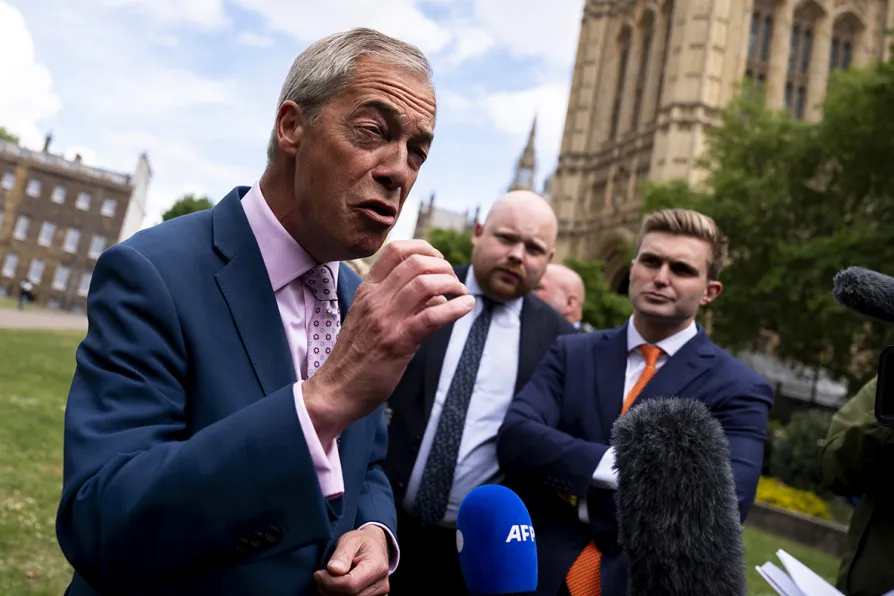
 Reform UK leader Nigel Farage being interviewed by the media after an eve of poll photocall at College Green, Westminster, on the last day of campaigning ahead of the local elections on Thursday, May 6, 2026






MILLIONS of votes will be cast on Thursday in Scotland and Wales in the election of these two nations’ devolved governments and in England a cross-section of communities will vote — in six places for regional mayors — and in 5,000 seats where the composition of 136 different councils are up for grabs.
This is the biggest test of electoral opinion since Keir Starmer took office on millions of votes fewer than won by Jeremy Corbyn.
The calamitous fall in Labour’s popularity is the main feature of these elections but we should not discount the scale of the Tory collapse.
You might think that the defection of much of Boris Johnson’s Cabinet to Reform UK would have given Kemi Badenoch the opportunity to recover something of the traditional Tory vote, such as it exists. This, at least would be an innovation but, like Labour, the Tories are no longer a credible party of a future government.
Reform UK is faltering with a certain sense that the Establishment is setting limits on its ambitions. The monopoly media is not so tolerant; opinion polls are less encouraging and the more Nigel Farage’s privately owned electoral vehicle resembles the Tory Party the fewer workers are prepared to swallow its fetishisation of the market and its hostility to public services.
Today the Trump connection plays badly even on the deluded right.
Where elections are cast as a choice between voting Reform UK or a credible alternative, voters are showing an acute sense of responsibility. That this means variously a vote for the Greens, for Plaid Cymru or the Scottish Nationalists and occasionally for Labour or Lib Dem is a factor that sets limits on Farage’s expectations. And a vote for principled socialist and communist candidates is never a wasted vote.
If Farage ever makes it into government it will not be with an unqualified mandate but strictly on the Establishment’s terms. In the meantime, the electoral field is one where the working class is without an organised and effective national presence. This mirrors the reality that the British working class in all its diversity is not, in most places, a class that is both conscious of itself as a class or present in politics as a class for itself.
This is the real consequence of the hyper-liberalisation of social democracy not just in Britain but throughout the capitalist world. Labour in its present form and under its present leadership has lost the confidence of millions. This is not simply because its policies in government inflict harm on working people but because it is tarnished with its complicity in imperialism’s wars, not least the present war on the peoples of the Middle East.
Many working-class and progressive voters will do the sensible thing today and divine the best channel to give voice to their preferences. This is a sensible tactical response to the situation but rather highlights the strategic problem which lies in two parts.
Firstly, what needs to be done, or can be done, about constituting an electoral voice for workers. If Your Party has a role in this it needs to get its act together.
Secondly, if the Labour left, in Parliament and in the constituencies, is to be a material factor in a reorientation of Labour after Starmer goes, it can only be in collaboration with Labour’s affiliated unions.
And for a recalibrated trade union presence in the Labour Party to change working-class opinion about Labour, it must be expressed as both a profound change in policy and a substantial effort to ensure those people given a Labour mandate in Parliament, devolved assemblies or local government, act consistently in the working-class interests.
