


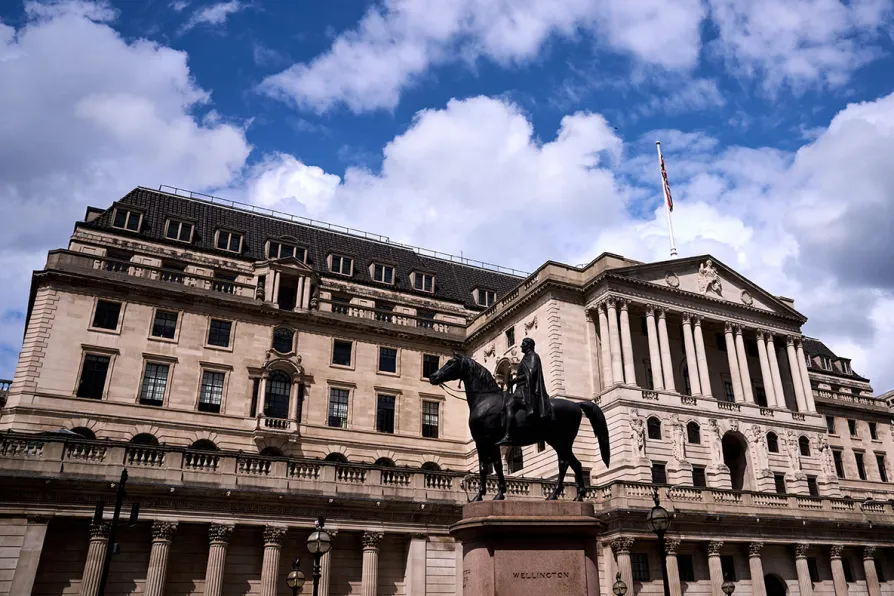
 The Bank of England in the City of London





BRITAIN faces a recession this year with interest rates soaring to 5.25 per cent if the Middle East crisis doesn’t end by 2027, according to the National Institute of Economic and Social Research (Niesr).
Even in the “best case scenario” that the US-Israeli war on Iran ends this year, the energy shock caused by the blockade on the Strait of Hormuz will wipe about £35 billion from the economy over the next two years, the think tank predicted.
Its latest quarterly economic projections expect the Bank of England will hold interest rates at their current level of 3.75 per cent tomorrow.
But they predict a rise to 4 per cent in July and for the rate to stay at that level for the rest of year.
If the war doesn’t end this year, Niesr believes inflation will soar to 5 per cent this year before interest rates rise as high as 5.25 per cent.
Higher interest rates are the “last thing the working people need,” TUC general secretary Paul Nowak warned following the publication of Niesr’s report today.
“Coupled with Trumpflation, higher rates would pile the pressure on already stretched families and businesses,” he said.
“The Bank must remain focused on cutting rates as soon as possible. Lowering rates would provide vital support for economic growth, which is an important part of the Bank’s remit too.”
Even under the best case scenario, Niesr still predicted Britain would narrowly avoid recession this year and downgraded its expected economic growth for 2026 to 0.9 from 1.4 per cent it predicted in February.
Niesr also warned that low-income households will be hit the hardest as inflation is set to exceed an expected 3.3 per cent wage growth next year.
Growth in real personal disposable income is forecast to slow to 1 per cent in 2026 and 0.6 per cent in 2027.
Niesr director David Aikman described the energy crisis as a “serious blow” to the government’s mission to get the economy growing again which “has laid bare the fact that the UK remains highly exposed to global energy shocks.
“Even if hostilities ease rapidly, higher energy prices will leave households poorer, businesses facing higher costs, and the economy materially smaller than we expected only a few months ago.”
