


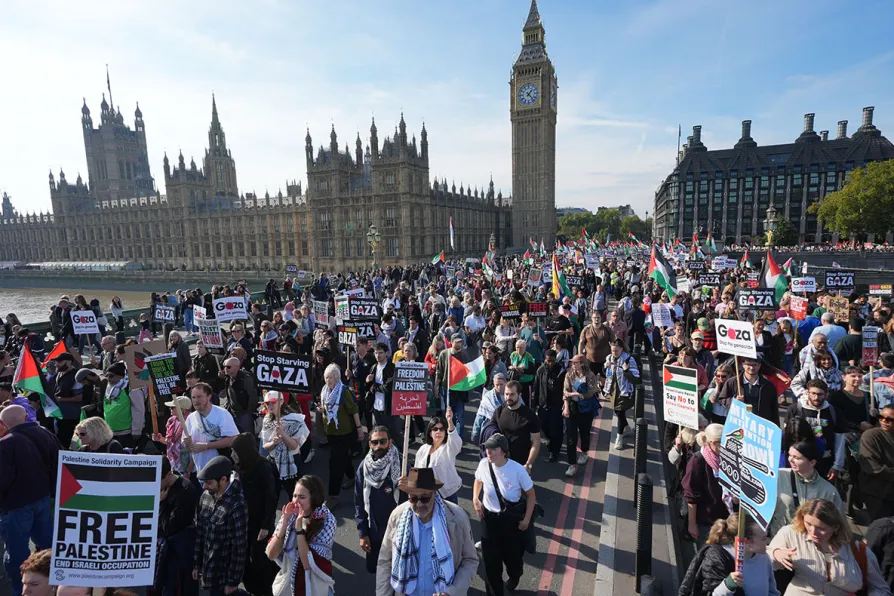
 People on Westminster Bridge as they take part in a Palestine Solidarity Campaign march in central London, October 11, 2025






NEARLY 1,700 council candidates have made the “Pledge for Palestine” ahead of the May local elections, the Palestine Solidarity Campaign (PSC) announced today.
The best represented party was the Greens, making up 1,086 of the 1,688 who made the vow to “take all appropriate steps” to uphold the inalienable rights of the Palestinian people and stand up to Israel for its crimes of genocide and apartheid.
They were followed by 209 Labour candidates, though this is fewer than the 234 independent candidates who backed the pledge to also ensure their council is not complicit in Israel’s violations of international law.
Labour is braced for unprecedented losses when polls open on May 7 for 136 local councils in England, with a further 73 councils where elections are being held for half or one-third of the seats available.
The PSC says Palestine could prove decisive in authorities where Labour is under threat from the Greens.
These include historic strongholds such as PM Sir Keir Starmer’s home borough, Camden, and Birmingham City Council, where the Labour-run administration has been heavily criticised over the long-running Unite bin workers’ strike.
PSC deputy director Peter Leary said: “Councillors who can get their councils to stop all complicity — such as divesting pension funds that are linked to companies that are enabling Israel’s crimes — can play a crucial role and voters at these local elections will be looking carefully to see who stands on the side of freedom and justice for Palestine.”
Rami Khayal, of the Birmingham Votes Palestine campaign, said: “Birmingham has long stood with Palestine.
“Throughout this genocide, the people have taken to the streets of our city.
“We launched Birmingham Votes Palestine because we know that accountability begins locally: in pension funds, in procurement, in the choices councils make every day.
“Labour is learning that silence has a cost; that it has lost this city.”
The PSC’s figures do not include candidates for six areas in London which are holding elections for directly elected local mayors or for the devolved administrations in Cardiff and in Edinburgh.
After Labour, the next largest party was Trade Unionist and Socialist Coalition with 116, followed by the Lib Dems’ 22, eight from the Communist Party of Britain as well as two from the Workers Party and one Conservative.
