

 Latest editorial
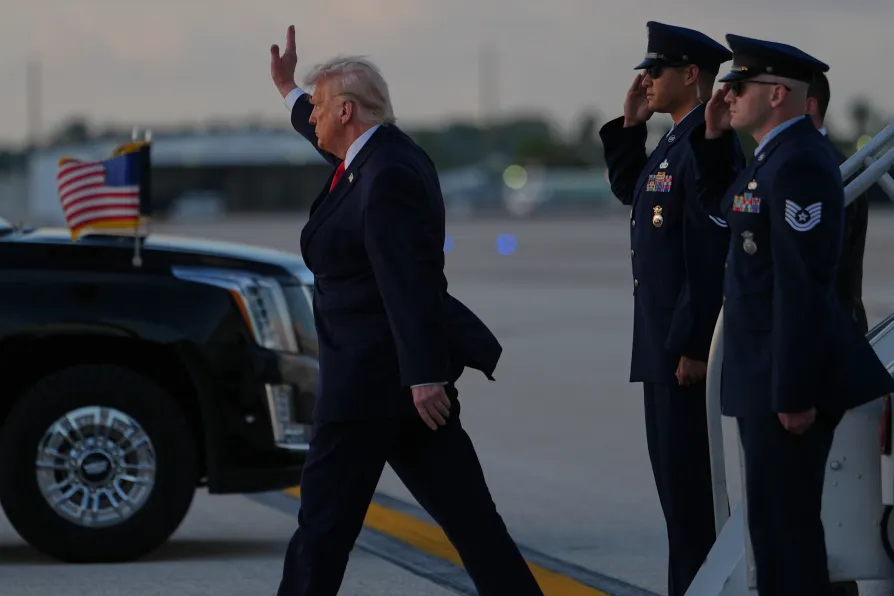 President Donald Trump waves after arriving on Air Force One at Miami International Airport, April 11, 2026, in Miami
Unions to campaign for legally enforceable maximum workplace temperatures





US PRESIDENT Donald Trump ramped up tensions even further in the Middle East today, announcing that the US navy would “immediately” begin a blockade to stop ships from entering or leaving the Strait of Hormuz.
This followed Iranian and US negotiators leaving the Pakistani capital Islamabad after failing to reach a deal in marathon peace talks to end the illegal and unprovoked war on Iran launched by the US and Israel.
In his first public comments after the 21-hour talks, the far-right US president sought to assume control over the waterway thorough which 20 per cent of global oil supplies passed before the war began, hoping to eliminate Iran’s key source of leverage.
The prospect of a US blockade is likely to further alarm global energy markets and send oil and gas prices soaring.
It was not immediately clear how a blockade might be carried out, but Mr Trump said the goal was to ensure that all ships could use the strait.
“It’s going to be all or none and that’s the way it is,” he insisted.
Mr Trump said he has “instructed our navy to seek and interdict every vessel in international waters that has paid a toll to Iran. No-one who pays an illegal toll will have safe passage on the high seas.”
He claimed other nations would be involved in the blockade, but he did not name them.
The president stressed that Tehran’s nuclear ambitions were at the core of the failure to end the war and that the US was ready to “finish up” Iran at the “appropriate moment.”
Each side blamed each other for not reaching a deal.
Iranian Parliamentary Speaker Mohammad Bagher Ghalibaf took to social media to say the Iranian side had entered into the talks with “the necessary good faith and will, but due to the experiences of the two previous wars, we have no trust in the opposing side.
“The opposing side ultimately failed to gain the trust of the Iranian delegation in this round of negotiations.”
US Vice-President JD Vance, who headed Washington’s delegation with property developer Steve Witkoff and Mr Trump’s son-in-law Jared Kushner, said: “The bad news is that we have not reached an agreement and I think that’s bad news for Iran much more than it’s bad news for the US.”
He said Iran chose “not to accept our terms,” adding that the US needs to see a “fundamental commitment” from Tehran to not develop nuclear weapons.
British Prime Minister Sir Keir Starmer urged the US and Iran “to find a way through” for the ceasefire to continue and warned against any further escalation.
In a readout of a phone conversation between Sir Keir and Oman’s Sultan Haitham bin Tarik al Said, a Downing Street spokeswoman said the leaders agreed that “it was vital there was a continuation of the ceasefire, and that all parties avoided any further escalation.”
Britain is set to host further talks on reopening the Strait of Hormuz with a coalition of countries next week.
Campaign for Nuclear Disarmament (CND) general secretary Sophie Bolt told the Morning Star that it was obviously “concerning that no agreement has been reached,” but she said Iran had already given a commitment on nuclear weapons at talks in Geneva “before the US and Israel sabotaged them by illegally bombing them.”
Ms Bolt added: “The US announcement it plans to carry out a naval blockade of the Strait of Hormuz is yet more evidence Trump is prepared to trash this ceasefire and instead carry out an incredibly reckless escalation.”
Stop the War Coalition convener Lindsey German said the failure to reach agreement was “not exactly surprising,” but, “instead of making further bizarre threats, President Trump should be ensuring the ceasefire.”
Communist Party international secretary Kevan Nelson said: “The collapse of the initial round of talks is no surprise, given the Trump administration’s lack of bona fides in past agreements and negotiations with Iran.
“World peace should not be at the mercy of the dishonest and warmongering US regime.
“The ceasefire must remain in force and further talks reconvened, perhaps involving permanent members of the United Nations security council.”
Black Agenda Report executive editor Margaret Kimberley branded Mr Trump’s threat to blockade the Strait of Hormuz “an act of desperation.”
Tricontinental Institute for Social Research director Vijay Prashad remained hopeful that both sides would return to the negotiating table.
“Walking away from negotiations does not mean a return to violence because that is a two-week window, unless Israel and the US break that agreement,” he said.
Pakistani Foreign Minister Ishaq Dar said: “We hope that the two sides continue with a positive spirit to achieve durable peace and prosperity for the entire region and beyond.”
In Iran, ordinary people appeared solidly behind Iran’s stance in the talks with the US.
Speaking from the capital Tehran, Farhad Simia said he stood with Iran despite the breakdown of the talks.
“I’m against war. I think negotiation is the better path,” Mr Simia said, while blaming “inappropriate demands” by the US for the failure to reach agreeement.
Mehdi Hosseini, also in Tehran, agreed, saying: “Considering the advantage Iran seemed to have on the battlefield, there was a real concern that we might lose all those gains in the negotiations.
“Whether the talks succeed or not is one matter, but the fact that the Iranian negotiating team managed to preserve what it achieved in the war, while refusing to back down and surrender, gives reason for hope.”
Hamid Haghi said “America’s overreach” was the reason for the talks’ failure.
The US wants “to come to the Strait of Hormuz, which is a legacy from our fathers,” he said. “We can oversee [it] ourselves.”
Like many Iranians, Mohammad Bagher believed Iran should continue to resist.
“We are a nation of dialogue and negotiation as long as our interests are respected. We have never sought war,” he said. “We will stand firm to the end, we are ready to sacrifice our lives and will not give them one inch of our land.”
The US and Israel have killed at least 3,000 people in Iran since they launched their illegal and unprovoked war on February 28.
Israel reports that 23 people have been killed by Iranian attacks, while the US admits that 13 of its military personnel have lost their lives.
Iranian attacks on targets in half a dozen Middle Eastern countries have caused major damage to infrastructure.
