


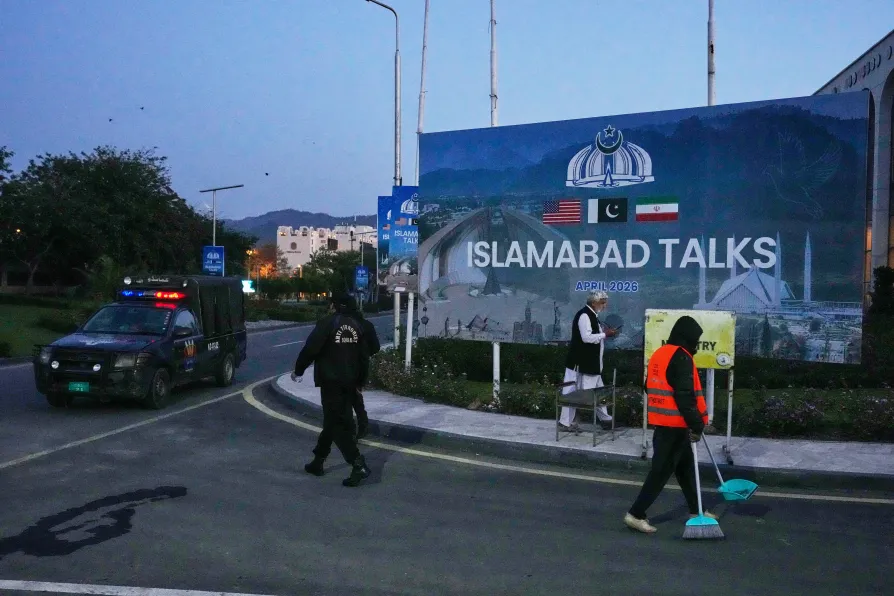
 A worker cleans the street as police officers walks towards their vehicle outside a media center close to Serena Hotel, the venue for the U.S. Iran officials meeting, in Islamabad, Pakistan, April 12, 2026





THE West no longer controls the world, and the United States can no longer dictate terms to countries it attacks.
That is the most significant takeaway from the course of the unprovoked war of aggression launched by the US and Israel against Iran six weeks ago, and the inconclusive peace talks in Pakistan over the weekend.
The United States has not been brought to heel. It remains extremely dangerous, and may respond to the failed talks by unleashing more death and destruction on Iran — pointlessly in military terms, but possibly soothing to bruised egos in the White House.
Britain is — despite Keir Starmer’s lies — wholly complicit in Donald Trump’s war, continuing to allow use of its bases as launchpads for the United States to bomb Iran.
Claims that the government drew a red line after Trump’s threat to wipe out Iranian civilisation are no more than wishful thinking.
All the government said on that day when the world held its breath is that its position on the US use of British bases had not changed, and missions flown from them needed to be defensive. This was generously interpreted by several newspapers as Starmer saying No to Trump.
But Britain had no way of determining the actions of US bombers taking off from RAF Fairford in Gloucestershire or RAF Lakenheath in Suffolk before Trump’s genocide threats, had none that day and has none now.
Until we close our bases and our airspace to the US military we are complicit in everything that military is doing to Iran — and that has involved the mass murder of civilians from day one, the horrific slaughter of 160 schoolgirls in Minab being the most egregious example.
All this could be repeated and pressure on our government to stop facilitating the war must be kept up.
But if the United States has not been brought to heel, it has been brought to the table — and humbled.
Iran set the terms of the talks. The United States had to send a delegation to a neutral country.
One with close relations both with Iran and Washington’s global rival China — whose role, with Russia, in vetoing a UN motion seeking to legitimise US-Israeli aggression by authorising the forcible opening of the Strait of Hormuz was key to forcing the US to the table with Iran.
US Vice-President JD Vance admits that the US tried to be flexible and to reach agreement with Tehran, but Tehran wouldn’t accept US terms. This is hugely significant, and not just for Iran.
It is striking proof that the US is not all-powerful and cannot use force to get its way.
The post-cold-war “unipolar moment” has been dying for a long time, but the sudden upsurge in US aggression this year — the bombing of Venezuela and kidnap of its president, the siege of Cuba, the bid to knock out Iran — was clearly an attempt to assert otherwise. It has failed.
That provides hope. Hope to besieged Cuba, whose defiant president told the US where to go with its regime change fantasies in a TV interview last week. Hope to embattled Venezuela, trying to maintain its sovereignty and recover its president while avoiding a lethal bullet from the gun to its head.
Hope that the belligerent and deluded governments of western Europe will also recognise the real-world limits to their power, stop pursuing an impossible military victory in Ukraine and accept, as the United States has been forced to, that peace comes through negotiation and compromise.
If this lesson is learned, it will go a great way to preventing the world war that the United States and European Union have been dragging us towards.
Our politicians will be reluctant to recognise reality. But they may yet be made to do so.
