


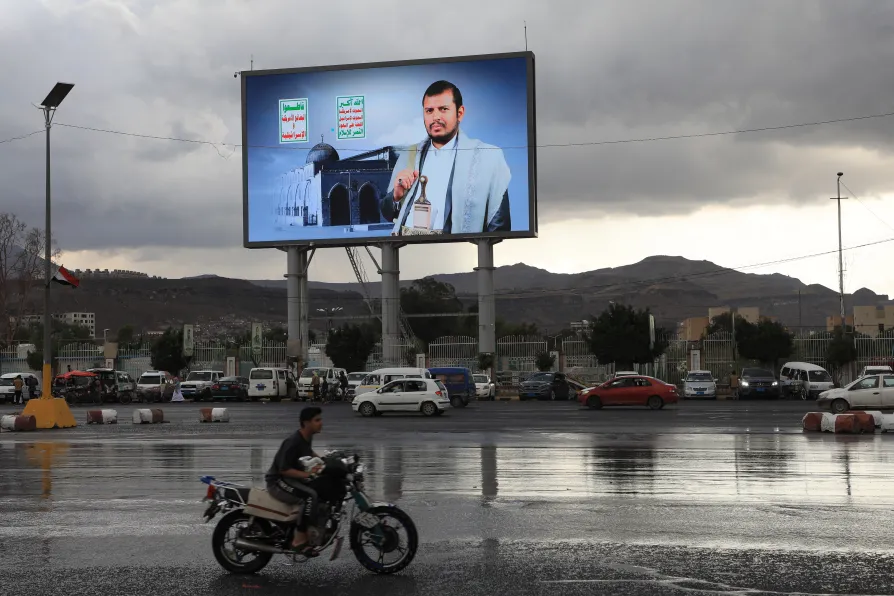
 Vehicles pass under a banner showing Houthi leader Abdul Malik al-Houthi, in Sanaa, Yemen, March 31, 2026





YEMEN’S teachers are being pushed to the brink, juggling multiple jobs and enduring hunger as salaries are delayed amid more than a decade of war.
The Houthis, who control the capital Sanaa and surrounding regions, have not paid public sector salaries since 2016, while the internationally recognised government has also failed to raise public sector wages or pay them regularly.
Mohammed Salem, who teaches at a government-run school in the mornings, before heading to another shift at a private school and then a third job at a hotel, said that if he had spare time for a fourth, “I would take it.”
“I return home at night completely burned out,” the teacher with 31 years of experience told Al Jazeera.
“Teachers are devastated and have no time to take care of their students.
“During classes, they are preoccupied with the next job they will take after school.”
Despite working all day, the father of six said he earns less than half of what he made a decade ago.
His family skips meals, has cut out meat and dairy, and moved to the city outskirts for cheaper rent.
He also asked one of his children to forgo university and instead join the military, where, he said, soldiers earn double what he makes a month.
During holidays and weekends, he lets his children sleep until the afternoon so they do not wake up asking for breakfast.
According to the UN, an estimated 6.6 million school-aged children have been deprived of education, while about 193,668 teachers — nearly two-thirds of the national total — receive no salaries.
Teachers and Educators Union leader Abdullah al-Khanbashi said protests in the government-run areas will continue until conditions improve.
“Teachers are showing up in torn clothing, and sometimes their students have more money in their pockets than they do,” he told Al Jazeera.
“Some families have broken apart, while others have been evicted from their homes because they could not pay the rent.
“Other teachers have children suffering from malnutrition because they cannot afford to feed them.”
The union’s Marib representative, Abdullah al-Bazeli, said local farmers have stepped in to help teachers remain in classrooms by giving them some of their produce.
He also called for teachers’ salaries to be raised to the level of ministers, saying: “A teacher’s salary should be equal to that of a minister.
“Teachers educate generations, while ministers often fail to make a meaningful impact. Some teachers have begun to die from hunger.”
