
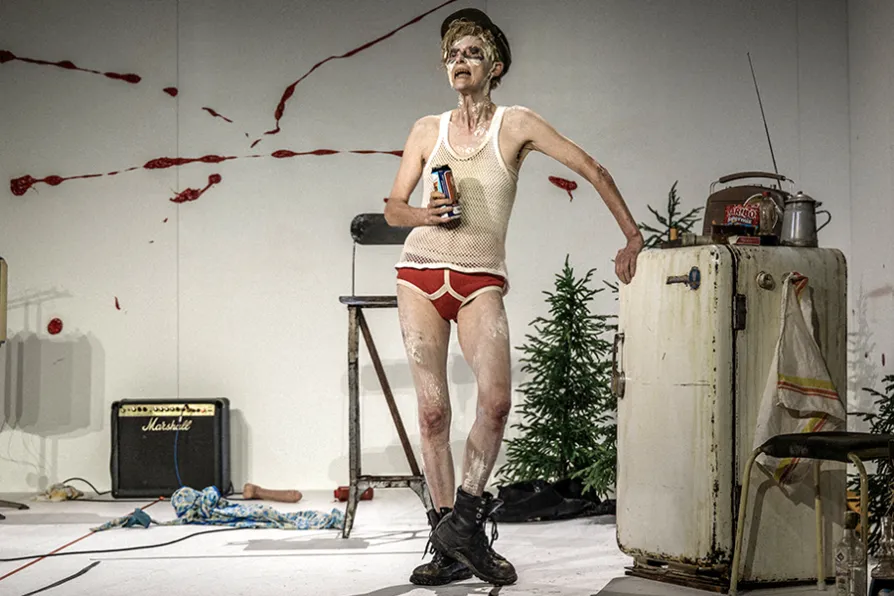
PETER MASON applauds the revival, 39 years later with the same team and cast, of Manfred Karge’s version of Brecht’s 100-year-old play, Mann Ist Mann

Myths and Mrs
GAVIN O’TOOLE welcomes a bold feminist subversion of classic folktales that are ubiquitous in the Irish imagination
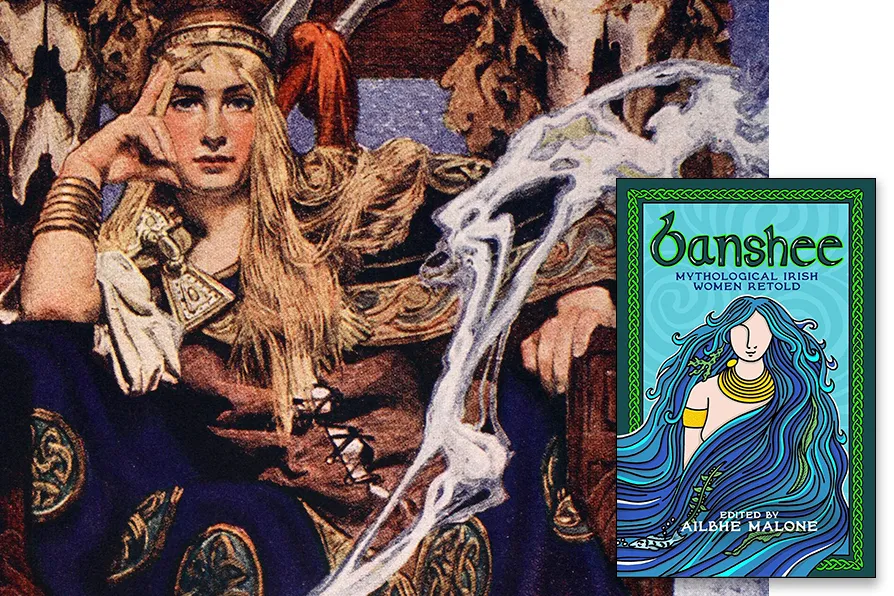
 Queen Medb of Connacht, Joseph Christian Leyendecker, 1911 [Pic: Public Domain]
New releases from Biita Houdei, The Mary Wallopers, and The Tubs
New releases from Biita Houdei, The Mary Wallopers, and The Tubs
MAYER WAKEFIELD applauds a fearless attempt to bring to the stage the 1984 toxic gas disaster in Bhopal, India
ALEX HALL applauds the account of a dogged, traumatic and punishing campaign for justice that has lasted from 1998 to the present day
NICK WRIGHT laments the political bias of an epic attempt to tell the history of the liberation of France from the Nazis, that excludes both the decisive contribution of the Soviet Red Army, and of the French communist party itself





Banshee: Mythological Irish Women Retold
Edited by Ailbhe Malone, John Murray, £22
MARXISTS should care about mythology, which since time immemorial has more often than not played an ideological role aimed at maintaining the dominant order.
Myths have been explained as the way pre-modern societies explained the forces of nature before technology; as inverted worlds that reflect alienation, by projecting powers onto supernatural beings; or as false consciousness, to rationalise oppression in non-material terms.
Above all, myths have served as potent instruments of social control by portraying power as mystical and hence beyond our reach, in so doing making hierarchy appear natural and unchangeable.
Given this, if you take the trouble to ask any woman for her observations about these narrative beasts, they will point out what passes by so many of us who fail to exercise a critical eye: most myths are patriarchal to their bones.
From Greek, Roman and Norse myths to those of the Celts, women are invariably depicted as objects of fate, not the subjects of their own destiny, or as foils to enlighten us about ancient male virtues that, today, would probably be called “toxic masculinity.”
It is this premise that was the inspiration for Banshee: Mythological Irish Women Retold, a bold feminist subversion of classic folktales that are ubiquitous in the Irish imagination.
Ireland is a land in which myth is cherished like nowhere else, but on closer inspection there is no doubt that most of these stories put the men centre stage when, upon reflection, the woman is clearly the star of the show.
Take what is arguably Ireland’s Iliad, The Tain or “Cattle Raid of Cooley,” in which we are introduced to the greatest character in Irish mythology, Cu Chulainn.
It’s a great yarn full of daring exploits but, if re-examined, we can note that the entire odyssey begins with the ambitions of Queen Medb of Connacht; and that Cu Chulainn is initially a shadowy figure who only gradually emerges as chief protagonist.
Banshee: Mythological Irish Women Retold challenges this male monopoly with a collection in which ten of Ireland’s leading women writers and poets revisit — and rebalance — well-known tales with an important female character.
As editor Ailbhe Malone writes: “Despite the choices presented to these women in these stories, it seems like they are driven by the actions of the men around them and by fate — but where might they have agency too? … I’m simply asking: why not let the women lead?”
If there is a common thread in how the contributors have approached their task — and a refreshing aspect of how they have done so is the diversity of styles on offer — it is that of agency.
This is clear from the outset with “Boann” by Jess Kidd, a retelling of a myth about how the river Boyne got its name, in which the lead, Queen Boann, plots her escape from the boredom of life with her tiresome spouse, King Nechtan.
In The Changeling by Jane Casey, the myth of an infant swapped for a fairy child is cleverly deployed by a long-suffering wife to rid herself of an abusive husband who, it turns out, is the real shape-shifter.
There is real menace in Megan Nolan’s interpretation of the story of Diarmuid and Grainne, doomed lovers pursued in the classic version by the warrior Fionn mac Cumhaill, with the modern couple fleeing the country to escape the controlling Finn.
And Salma El-Wardany’s brilliant reimagining of Deidre of the Sorrows reinvents the tragic heroine possessed of fatal beauty as the child of a woman incarcerated in a Magdalene laundry at the mercy of an abusive Catholic priest.
This gripping rendition of a traditional story of victimhood provides more than just a reflection of women’s agency that is the beating heart of this anthology.
By transforming the leading lady into the embodiment of female vengeance, it sabotages the outdated patriarchal motives of mythology itself.
