The World Cup, Olympics and rise of sports betting reveal how the playing field is increasingly shaped by power and inequality, writes DENNIS BROE


 Latest editorial

Porto strike twice to take first-leg lead over Stuttgart
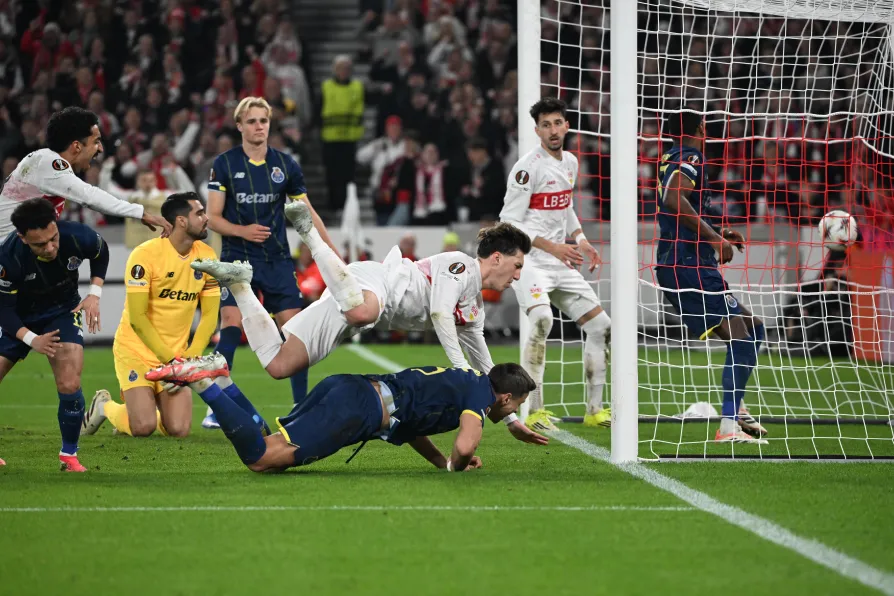 Stuttgart's Angelo Stiller, top centre, scores a goal that was disallowed after a VAR review, during the round of 16, first leg match against FC Porto

Snippets of news from the sporting world with JAMIE J





VfB Stuttgart 1-2 FC Porto
Europa League report
by Layth Yousif
at the Neckarstadion
AMID a relentlessly raucous atmosphere at the evocative Neckarstadion, Porto emerged 2-1 winners after this compelling Europa League round of 16 first leg clash against Stuttgart.
Twice winners of this tournament, Porto boosted hopes of a third crown after claiming a slender advantage following two quick-fire goals from Terem Moffi and Rodrigo Mora in the space of seven chaotic first-half minutes.
Deniz Undav reduced the deficit for the home side with an excellent finish five minutes before the interval, but Francesco Farioli’s Primeira Liga leaders held on.
Speaking after the match, Farioli, whose side hold a four-point lead over second-place Benfica as they chase major silverware on two fronts, said: “The performance was good, my players made a fantastic impact…but it was just the first of two [games].”
Despite Sebastian Hoeness’ Die Roten (The Reds) starting strongly in a compact and disciplined 4-2-2-2 formation, dominating possession with strong intent that saw Jamie Leweling and Ermedin Demirovic dovetailing well to put the visitors under pressure early on, Porto were to establish superiority.
Barely had the pyro from the visitors’ section died down after blazing bright, leaving smoke hanging heavy in the air, when Porto’s William Gomes curled an effort against the bar. Shortly afterwards, Moffi powered into the Stuttgart box to fire past home keeper Alexander Nubel’s near post and put Porto 1-0 up after 21 minutes.
Cue booming firecrackers being thrown from some of the Portuguese side’s jubilant 3,000-strong travelling support massed at the other end of this legendary stadium, while Farioli’s celebrating side drew a cacophony of ear-splitting ire from the home fans, furious over the goal, and provoked by Porto’s elongated jubilations.
Worse was to come for Die Roten six minutes later, when Zaidu Sanusi’s enticing ball into the box was steered home by Mora in an impishly improvised finish, to make it 2-0.
Yet, despite the Stuttgart team reeling from two blows, if anything, the atmosphere generated by the fervent home support situated on the Cannstatter Kurve (Cannstatt Curve) - that lasted from the first second until the 96th minute without a let up - grew ever louder and more frenzied, as the fevered ranks behind the goal exhorted their side on. This was raw support stripped bare of everything bar unreserved love for their team, made manifest by such a tumult of noise, an eruption of frenzy, and a blaze of colour.
Underwritten by such emotional solidarity, Hoeness’ side were nothing if not wantonly intrepid, as the lively Denis Undiv spun splendidly to hook the ball past Dragoes keeper Diogo Costa five minutes before the break to reduce the deficit at 2-1 to the visitors. Giving the home side hope in front of the 60,000 sell-out crowd at the iconic Neckarstadion.
While the Neckarstadion’s capacity for Bundesliga matches is officially listed as 60,058 - reduced to 54,812 for international matches - this legendary stadium’s record attendance was set back in 1950 when 97,553 were here for West Germany vs Switzerland, the country’s first officially sanctioned international match after the Second World War.
The site remains the only venue in Europe to have hosted multiple World Cup (1974, 2006) and European Championship (1988, 2024) games, as well as two European Cup finals (1959, 1988), with Alfredo di Stefano scoring in the first final during the mighty Real Madrid’s 2-0 victory over Reims, as the Spanish giants lifted their fourth title in succession, in a repeat of the fledgling competition’s inaugural showpiece.
The Neckarstadion also hosted the 1988 final, when PSV Eindhoven beat Benfica on penalties, while many may also recall Jack Charlton’s great Irish side beating England 1-0 here during ‘Euro 88’. The site even played host to games of baseball played by US servicemen stationed in the country during the Second World War.
The original stadium was built in 1929, and, in a sign of the turbulent inter-war years, bore the name of Adolf Hitler during the 1930s. Indeed, this correspondent’s pre-match stroll away from the angular, shimmering glass and steel structures present in Stuttgart’s centre, took in a hill that was assembled from rubble of the ruined city at the end of the Second World War.
Unsurprising, given that the city was heavily bombed by Allied forces due to a preponderance of industrial factories contributing to the Nazi war effort, culminating on the night of March 15, 1944, when 863 allied bombers attacked.
In total 45 per cent of the city was destroyed between 1940-45. Reminders of the dark past evident, when stumbling across an old Second World War bunker next to my hotel during the afternoon’s perambulations across the randomly steep gradients of the city, which has more than 500 staffele, or public staircases.
Yet, just as Germany recovered during the post-war peace that came afterwards, so too did Stuttgart, the club winning the national title in 1950 and 1952, to make it a total of five in the club’s history, the last delivered in 2007 - even if the national stereotype of Swabians is said to one of shaffle, shaffle, hausle baue (‘work, work, build a house’).
After a gloriously sunny Stuttgart spring day under clear blue skies in the Baden-Württemberg region of south-western Germany, the sun eventually set in a beautiful mauve farewell around the Neckarstadion, as the black night followed at the start of the second half, with Die Roten attempting to claw their way back into the tie.
Amid the ongoing fevered mania, Stuttgart thought they had equalised with 18 minutes remaining. Angelo Stiller squeezing home the rebound, following teammate Jeff Chabot’s effort from Bilal El Khannouss’ free-kick into a crowded box.
However, following a wretched VAR review, Lithuanian referee Donatas Rumsas ruled that Stuttgart substitute Tiago Tomas was deemed to be in an offside position, thereby obstructing Porto keeper Costa, and so the ‘goal’ was disallowed, as Farioli’s side hung on to post a first leg victory.
In a remarkable display of unity, the beaten, but not bowed, Stuttgart team headed over to their ultras behind the goal, as the players applauded the vociferous fan groups. In return, a myriad of red and white flags waving, amid an ear-splitting cacophony of noise, the tremendous home support acclaimed their team loudly despite the defeat. The spectacle was as captivating as it was heartening.
Hoeness reflected after the match, saying: “It was a high-quality game, but from our point of view, it is disappointing [to lose]. You could say in seven, eight minutes we lost the game,” before adding: “of course we wished for a different result, but I think the tie is still open.
“Porto have an advantage, but in football, anything is possible.”
As the fans eventually trudged away into the Stuttgart night, it was entirely fitting that the stadium PA at this grand old site played the 1981 hit ‘Don’t Stop Believin’ by Journey.
