
PETER MASON applauds the revival, 39 years later with the same team and cast, of Manfred Karge’s version of Brecht’s 100-year-old play, Mann Ist Mann

Uganda since Amin
GUILLERMO THOMAS recommends an important, if dispiriting book about the neo-colonial culture of Uganda under Yoweri Museveni
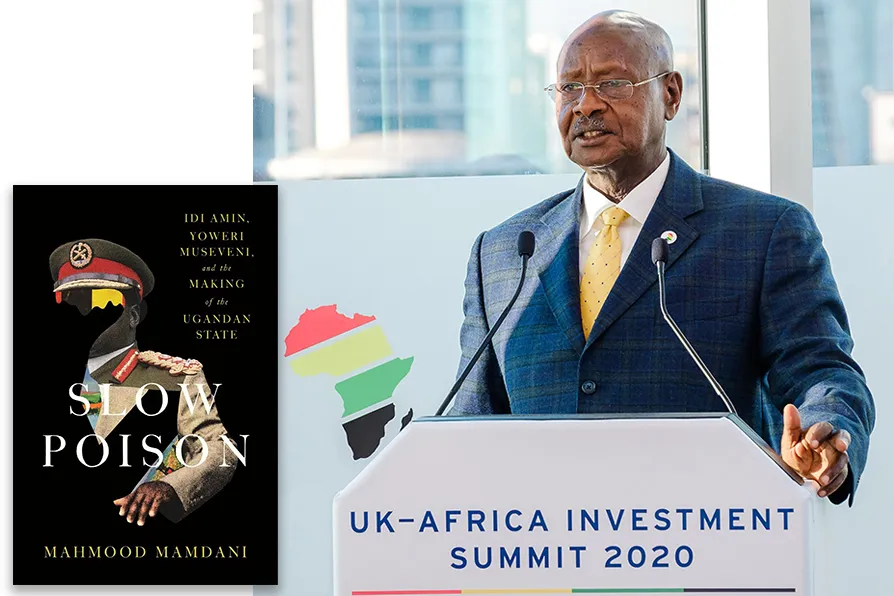
 A KEY US ASSET: President Museveni of Uganda, speaking at the UK-Africa Investment Summit, London, January 2020 [Pic: DFID - UK Department for International Development/Graham Carlow/CC]

New releases from Biita Houdei, The Mary Wallopers, and The Tubs
New releases from Biita Houdei, The Mary Wallopers, and The Tubs
MAYER WAKEFIELD applauds a fearless attempt to bring to the stage the 1984 toxic gas disaster in Bhopal, India
ALEX HALL applauds the account of a dogged, traumatic and punishing campaign for justice that has lasted from 1998 to the present day
NICK WRIGHT laments the political bias of an epic attempt to tell the history of the liberation of France from the Nazis, that excludes both the decisive contribution of the Soviet Red Army, and of the French communist party itself





Slow Poison: Idi Amin, Yoweri Museveni, and the Making of the Ugandan State
Mahmood Mamdani, Harvard University Press, £22.38
FOR many of a certain generation in Britain, Uganda is synonymous with the figure of Idi Amin, who was lampooned by the tabloid press as a buffoon and tin-pot dictator who, through sheer brutality of nature, in the 1970s expelled thousands of Asians, a great many of whom settled here to become the face of our corner shops.
However, most of the east African state’s post colonial history has been dominated by Yoweri Museveni, still in power after 40 years. Although the shine has come off him of late, for most of his rule Museveni has been a poster boy, presented as a force for stability and moderniser, for his sterling role in combating armed extremists in the “war on terror,” and for adopting fashionable neoliberal economic reforms.
Both characterisations of the two dictators are false and not disinterested. A new book attempts to set the record straight and while not absolving either of them of agency, to give a wider context to their strategies and actions.
Amin was presented in the West as a person of low intelligence. As author Mahmood Mamdani argues, he subverted these racist tropes, infusing his bombastic propaganda with a wicked sense of humour. Uganda’s former colonial master was a particular target for his ridicule: for example, in 1972, Amin launched a Save Britain Fund during its 1972 financial crisis with thousands of locals donating anything from chickens to plantain, and forced foreign secretary Jim Callaghan to bow to him (as he was forced to bend to get through the low door of a hut).
Museveni did not seem to have Amin’s popular touch – exemplified by him driving around in his own jeep — nor to have any firm ideals beyond an attachment to power, and he rapidly lost the backing of Ugandans. He did a deal with the World Bank and IMF; he didn’t have supporters, just clients, the author argues. The secret to his long rule has not only been graft and policies to suit the privileged (he invited wealthy Asians back to invest) but a clamp down on civil and political liberties, which he justified on the grounds of “security” and “stability” as he waged wars on the home front and abroad that were either avoidable or deliberately extended. But he also survived on certain kind of politics of “divide and rule.”
While Amin backed an idea of Uganda for “Africans” (to the exclusion of Asians), Museveni returned to the colonial legacy of tribalism, hugely fragmenting the country and a people.
Amin was a child soldier in the British colonial army and excelled in counterinsurgency, guilty yet repeatedly forgiven by white superiors of terrible abuses, including those against the Mau Mau in Kenya. The Britain and Israel who brought him to power knew exactly the kind of monster they were installing. He was, unsurprisingly, seen by peers as an imperialist stooge but like many other leaders in other subjugated places, he sooner or later (sooner in this case) refused to be grateful to his imperial master, turning his back on them.
In contrast, Museveni was a guerilla fighter with radical roots in the Resistance Committees he founded in the Luwero Triangle north of Kampala, and a commitment to pan-Africanism. He had little Western backing at the start but once in power, short of money and guns, he soon started courting it. Mass privatisation, foreign investment and forever wars ensued.
Amin, along with a number of other African leaders at the time, introduced land reforms: the tiller was guaranteed full rights over land, land which legally was made public, preventing tenants from eviction. At the same time, he also stole from Ugandan Asians on a grand scale, supposedly to share among ordinary black Africans, although much of the expropriated loot seems to have ended up among his cronies (this book makes clear that the facts of who exactly benefited among Ugandans will likely never become clear).
However, after four decades of Museveni at the helm “there is no line between theft and corruption, as we witness the devastation of society.”
As with many of the West’s strongman allies, Museveni’s rule has been exceptionally violent. The author argues Museveni’s protracted humiliation, brutalisation and expropriation of the Acholi people was “much worse” than the violence Amin’s soldiers meted out on soldiers he considered disloyal in the wake of the coup that brought him to power in 1971, or “anything experienced by Ugandan Asians in 1972.”
Yet we only know of Amin’s crimes. This is because Museveni’s Uganda was a key regional asset to the US, armed and funded to do its dirty work in eastern and central Africa with catastrophic consequences for Ugandans and peoples of its neighbours. A blind eye was turned.
The book shows not only how Western neo-colonialist military and economic structures continued to condition Uganda’s politics post independence, but also Britain’s colonial legacy of “institutionalised corruption and state repression” and “a political culture based on a fiction that the communities they conquered had long lived as isolated “tribes” each in their own “homelands.”
By transplanting colonial subjects from the Indian subcontinent to other parts of empire, Britain also created an Asian commercial and administrative elite in a number of colonies that caused varying degrees of friction after independence.
Britain’s post-colonial immigration laws formalising ancestral descent as a criterion for full citizenship – notably the 1968 Commonwealth Immigrant Act — contributed to the traumas east Africans experienced. If east African states like Kenya and Uganda were moving to identify citizenship with indigeneity or race, so was Britain. Asians living in Uganda were caught in this pincer movement, with the poor majority paying the heaviest price.
As a Ugandan Asian himself, having lived in Uganda during some of the period covered, and having known personally a number of the senior protagonists in his book, the author combines personal insights, anecdotes and detail with cold, hard and razor-sharp analysis of the politics of Uganda since independence.
Highly readable, at times dispiriting, this is an important book.
