

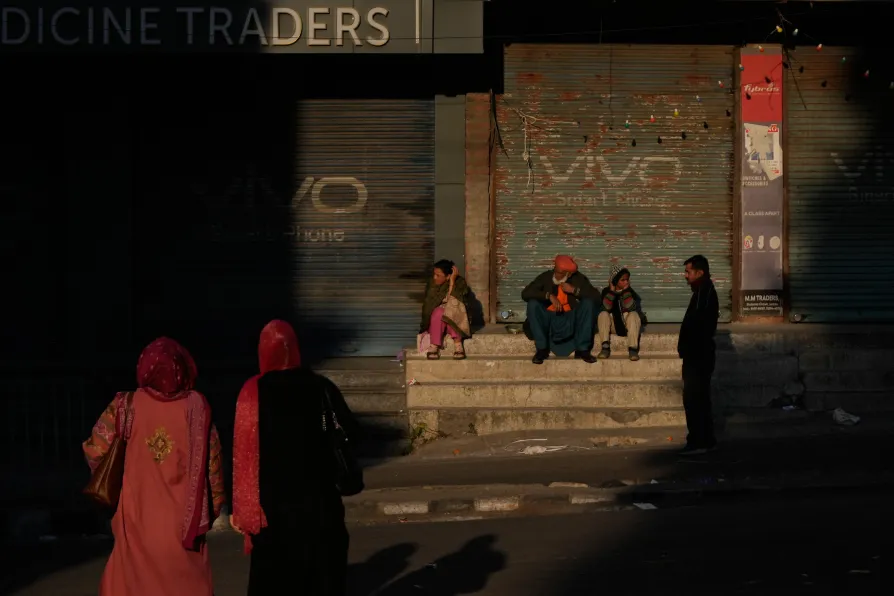
 People take sun bath early morning outside closed shops in Jammu, India, February 12, 2026





THE recent US-India trade deal is an unequal treaty akin to those imposed on semi-colonies in the 19th century, Indian communists charge.
The deal announced on February 6 has provoked uproar in India, and revoking it was a demand of India’s one-day general strike a week ago. Organisers say 300 million people took part in events related to the February 12 walkout, though it is unclear if as many took industrial action as in the 2020-21 Indian general strike, whose 250m participants made it the largest in history so far.
Marxist economist Prabhat Patnaik said two features of the treaty “mark it out as an unequal treaty” — first, India’s acceptance of 18 per cent tariffs on its exports to the United States, while it imposes no tariffs on US imports; and second, a stipulation that India must buy $100 billion (£73bn) in US goods every year for the next five years.
“A trade agreement providing the minimum amount of goods that one country must buy from another, come what may, flies in the face of the entire free market ideology so beloved of the bourgeoisie,” Mr Patnaik writes in the Communist Party of India (Marxist) publication People’s Democracy.
“Even more bizarre is the fact that this minimum amount is stipulated for only one country that is a party to the agreement.”
Since India cannot dictate to businesses what they must buy, Mr Patnaik argues, the projected steep rise in US imports — from $40-100bn annually — will most likely come down to two sectors where the government can control most imports, oil and agriculture.
Under US pressure, India is already cutting Russian oil imports, substituting US supplies which are typically 20 per cent more expensive. India has cut Russian oil imports by almost a third since late last year.
He warned US suppliers in agriculture are poised to take a monopoly position in key agricultural markets, particularly animal feed, further impoverishing Indian farmers.
Enthusiasm for the deal in Indian capitalist circles, reflected in stock market reactions, contrasts to bitter opposition among workers and peasants and marks a “fracturing of the anti-colonial class alliance” with India’s bourgeoisie capitulating to US imperialism, he concludes, a development with big ramifications for the Brics bloc and global US-China rivalry.
