

 Latest editorial

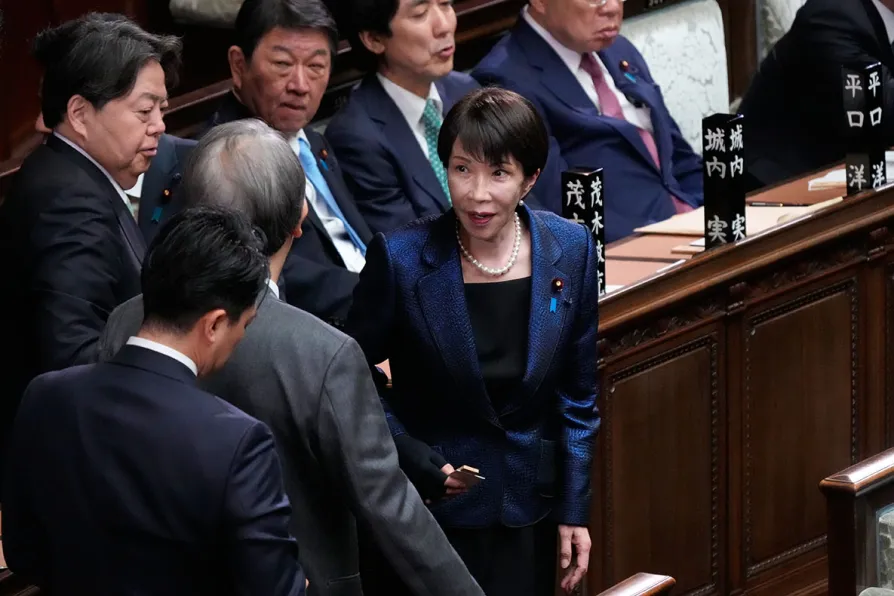 Japan's Prime Minister Sanae Takaichi (centre) talks with the ruling party's lawmakers during a special session of the lower house in Tokyo, Japan, February 18, 2026






JAPAN’S hard-right leader Sanae Takaichi was reappointed prime minister today, following last week’s landslide election win giving her the two-thirds majority she needs to abolish the country’s famous Peace Constitution.
Parliament gave Ms Takaichi authority to appoint her second cabinet, though she is expected to retain all ministers from her first, having only held the election to secure the supermajority which allows her Liberal Democrat (LDP)-led ruling coalition to override any rejection of legislation by the upper house.
She stresses her determination to revise Article 9 in Japan’s postwar constitution that renounces war as a right of the state, forbids the deployment of the Japanese military except in self-defence and bans the export of lethal weaponry — a longstanding goal of the Japanese right, but which it has previously lacked the power to drive through.
The Japanese Communist Party (JCP) said her supermajority placed the country in an “exceptionally dangerous” situation, enabling Ms Takaichi to build the “war-ready state” she talks of.
But it disputed her mandate to do so, pointing out that the majority was a product of “the single-seat constituency system” and that the LDP had only won 36.7 per cent in the regional lists, which are elected according to proportional representation.
“During her street speeches, she never spoke of the massive military build-up, the review of the Three Non-Nuclear Principles [that Japan does not possess, produce or allow onto its territory nuclear weapons], or the revision of Article 9 of the constitution,” it added, accusing her of masking the scale of the changes she plans.
The JCP called for “people’s struggles in every field to refuse to tolerate the authoritarian politics of the Takaichi administration, and to defend and advance peace, human rights, livelihoods and democracy.”
The reference to her “authoritarian politics” concerns a planned espionage law that would restrict media reportage on national security issues.
Ms Takaichi has ratcheted up tension with China, suggesting Japan might fight Beijing over Taiwan despite recognising it as Chinese territory, and has pledged huge capital investment in the United States to strengthen ties with the Donald Trump administration.
