

 Latest editorial
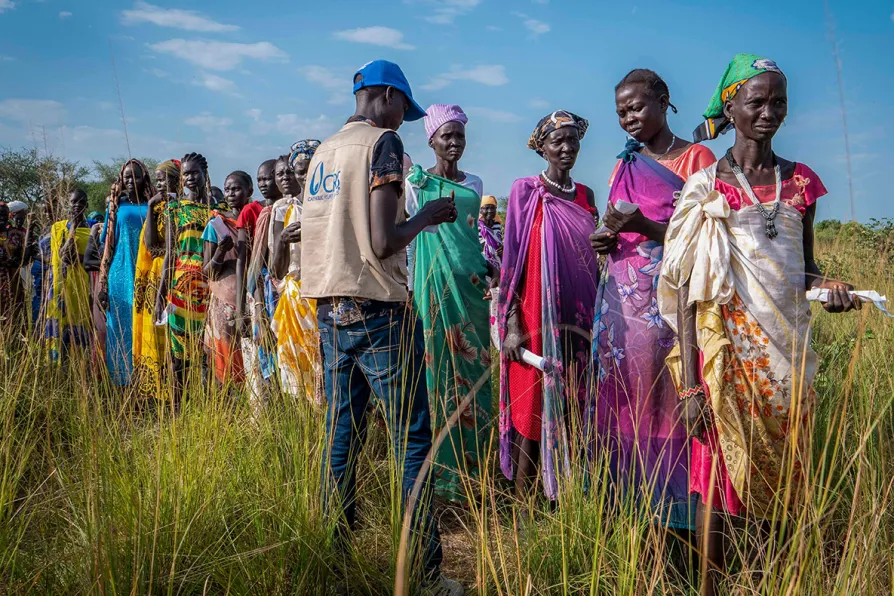 South Sudanese women line up for food rations at a World Food Programme (WFP) distribution point organised by Catholic Relief Services in Jonglei state, South Sudan, November 13, 2024





POLITICAL deadlock in South Sudan is escalating violence, putting the world’s newest nation on a “dangerous precipice,” the United Nations peacekeeping chief warned on Tuesday.
Jean-Pierre Lacroix urged the UN security council to ensure that South Sudan’s government and opposition return to dialogue.
He warned: “Both sides claim to be acting in self-defence, while at the same time preparing for the possibility of large-scale hostilities.”
There were high hopes of peace when oil-rich South Sudan gained independence from Sudan in 2011 after a long conflict.
But the country slid into a civil war in December 2013 when forces loyal to Salva Kiir battled those loyal to Riek Machar.
More than 400,000 people were killed in the war, which ended with a 2018 peace agreement that brought the opponents together in a government of national unity with Mr Kiir as president and Mr Machar as vice-president.
In a major escalation of tensions in March 2025, a Nuer militia seized an army garrison. President Kiir’s government responded, charging Mr Machar and seven other opposition figures with treason, murder, terrorism and other crimes, and suspended the vice-president.
Mr Lacroix, the UN undersecretary-general for peacekeeping, singled out the escalation of fighting in recent weeks in Jonglei state, north-east of the capital, Juba, pointing to reports of bombings, inflammatory rhetoric, severe restrictions on humanitarian access, and over 280,000 people displaced by the violence, “as per government sources.”
The peacekeeping chief said the African Union Peace and Security Council, the Intergovernmental Authority on Development and the United Nations have made clear that there is no military solution and the 2018 peace agreement remains “the only viable framework for peace and stability.”
He added that “without consensus, without the participation of all those who have placed their hopes into this peace process, and in all corners, in all 10 states of the country, any election will not be credible and therefore worthy of our support.”
He also called South Sudan one of the most dangerous places in the world for humanitarian workers, pointing to 350 attacks on staff and facilities in 2025 compared with 255 in 2024.
Against this upsurge in fighting, Mr Lacroix said the UN has been forced to cut its peacekeeping force in South Sudan because of a lack of funding, resulting in a reduction in patrols to protect civilians by up to 40 per cent in areas where UN forces are decreasing.
