A California union’s decision to host a meeting about US policy towards Cuba has prompted a congressional probe and renewed attacks on international solidarity, writes CAMERON HARRISON



From Mandelson to the markets: Big Finance’s rule over Britain
The Mandelson scandal reveals a political settlement in which democratic choice is curtailed and the power of markets eclipses the will of voters – only the left can challenge this, writes JON TRICKETT MP
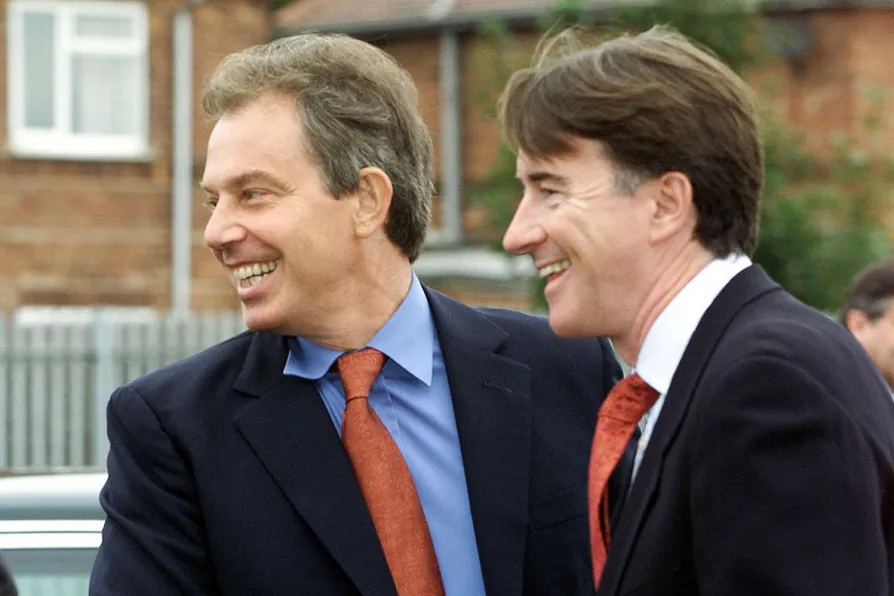
 Tony Blair and Peter Mandelson, September 7, 2001
The Baltic state is set to reverse its constitutional prohibition on nuclear weapons and foreign bases as part of accelerated Nato war preparations, warns TOM UNTERRAINER
Long-term underfunding and state neglect, while simultaneously probation services have been undermined, have intensified the prison crises, argues SOLOMON HUGHES
Holyrood incompetence has cost jobs and put the future of Clydeside’s Ferguson Marine shipyard into jeopardy. Its future should have been assured, argues KENNY MACASKILL
With the agitated debate now raging in the media about the early release schemes, Prison Officers Association general secretary STEVE GILLAN gives the view of those who work in the sector
The hounding of the late Jason Arday is an all too familiar experience for many black people. ROGER McKENZIE calls for collective action to combat what can feel like personal isolation





THE whole Mandelson revelations have been interpreted by the mainstream media through the lens of the appalling paedophilia of Epstein as well as whether or not the PM can survive.
But there are other truths which ought to be equally the focus of attention.
For more than a couple of generations, British politics has been conducted beneath the increasingly menacing shadows cast by the towers of concrete and glass in the City of London and around Canary Wharf.
Buildings that reach for the sky are owned and controlled by global financiers who exercise huge economic leverage. These are the new Masters of the Universe who along with big tech now stride like giants across the global economy. Recent events have cast a light into areas which are largely unseen.
Viewed from this perspective, we see that the emissaries of Big Finance have successfully penetrated governments of all shades. The revelation of Peter Mandelson’s role as an agent of the moneyed elite is extraordinary now in its transparency.
We now know that while the Prince of Darkness was effectively the deputy prime minister, he was funnelling private state information to Epstein the financier. It appears also that the former Prince Andrew was passing information gleaned from his role as trade ambassador.
We must conclude both that the betrayals now revealed were of extraordinary proportions but equally that it was not an isolated scandal or a matter of a few bad apples. It provides a window into a deeper truth: the systematic capture of democratic government by major corporations and financiers.
This corporate capture of our governing institutions has never been meaningfully described in mainstream media and there has never been an attempt to reverse it.
It defines the limits of what is possible today. It explains so much also about everyday events in the life of the present Labour government.
The current scandal matters not simply because “Petey” was uniquely venal, though some say that “greed” was his middle name, but also because he is an exemplar of a deeper truth. He was the singular embodiment of a politics: where cocktails with the City boys signals our competence; where bowing down to global markets reveals our pragmatism; and where decisions by democratically elected governments require the approval of the “markets.”
For governments in recent decades, this was the new orthodoxy. The City of London was our national pride. Britain needed to “modernise” and this meant doing away with regulation, and bringing in private finance initiatives and bumper bonuses for the banking elite. When the crash came in 2008, the public paid the price, but the underlying settlement finally emerged intact and Mandelson was there to drip, drip the state’s secrets to the lords of capital.
The left must call this out. The banking crash was not simply a cataclysmic accident but it occurred because, as the markets grew ever more powerful, the state was weakened, hollowed by marketisation, the shrinking of collective provision of public services and wholesale privatisation.
The new creed became that it is more important to service the bond markets rather than house people, fund hospitals or raise wages. In this sense we see that democracy was being undermined.
Addressing corporate failure and delivering banking bailouts became the immediate tasks in hand but public spending on our services and support for the poorest was diminished and made conditional upon a disproving moral code. Austerity was not an economic necessity — it was a political choice. It was implemented to protect the balance sheets by forcing down corporate taxation so that it was the power of the finance houses which had priority over the needs of a cohesive economic settlement which secured the needs of working-class communities.
The darkening shadows which creep into all corners of our political discourse hide a deep truth. Of course the media focus is on the personal future of Starmer, but not on how to break the failed economic model. Instead we hear that we can’t address the changes we need but on how we can avoid upsetting “the bond markets.”
No matter the electoral mandate, no matter the scale of social crisis, the fundamentals of policy must remain unchanged.
And yet the truth is that to “calm the bond markets” is to accept a permanent limit on the capacity of democracy to respond to our country’s needs. The asset managers, hedge funds and banks appear to have a higher claim on political authority than the voters.
Mysterious institutions like the markets become irresistible forces whose significance elected governments must serve. The reverse ought to be the case.
The working population ought to have a government which requires the market to serve the people but what we have is an ideology which gives preference to the power of the markets over people’s needs.
Treasury orthodoxy, central bank “independence” and fiscal rules which put the government in handcuffs all pre-empt democratic choice. They lock in the power of Big Money regardless of who wins elections.
Put aside for a moment the media obsession with personalities, we need to break the idea that all this is inevitable. First, we must democratise economic policy. Second, the power of finance itself must be reduced and the economy rebalanced. Third, we must be honest about whose interests have been prioritised. A politics that avoids identifying the winners and losers of the last 40 years cannot hope to change course. Finally, political movements must be willing to confront the media and institutional pressures that enforce conformity.
The deeper lesson of Mandelson, and of the ongoing obsession with market “confidence,” is that democracy is not something that disappears overnight. As we see in the US, it is eroded gradually.
But it can be challenged. Only the left can do this, because the rest are trapped in a reactionary discourse. Reversing that erosion will require confrontation with power.
We remember the famous dictum about the political right by Nye Bevan: “How can wealth persuade poverty to use its political freedom to keep wealth in power? Here lies the whole art of Conservative politics in the 20th century.”
Recalling those words we must pose once again Bevan’s question to us on the left which is now urgen: “How can poverty use democracy to challenge the power of wealth?”
Jon Trickett Labour MP for Normanton and Hemsworth.
