
ROB WARZYNIAK wades knee deep through a pile of ‘dead canaries’ of Trumpist policies which exacerbated the horrors of US capitalism domestically


Breaking the golden circle: Why Mandelson’s fall shows we need Leveson 2 now
The latest revelations about the ‘Prince of Darkness’ expose a web of political patronage, media collusion and unaccountable power. To restore public trust and safeguard democracy, Leveson 2 is urgently needed to hold the powerful to account, says KIM JOHNSON MP
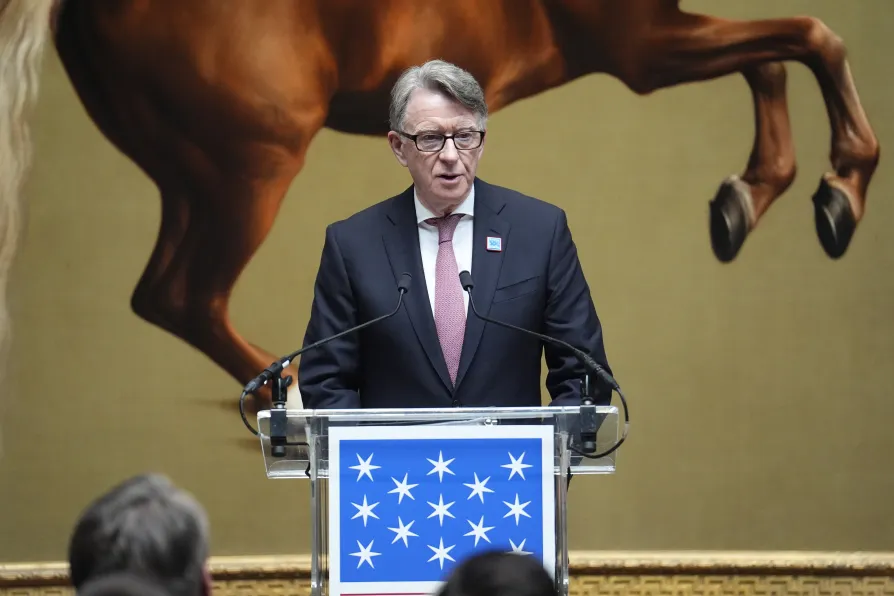
 Then UK Ambassador to the US, Peter Mandelson, speaking during a ceremony at the National Gallery, central London, June 18, 2025
Without evidence or Nato consultations Berlin’s answer to the Leipzig incident is a rupture of relations. SEVIM DAGDELEN examines why
FRANCISCO DOMINGUEZ introduces the background to a conference on defending Latin America’s sovereignty
The glacier collapse in Nepal is yet another warning that a warming planet is making Himalayan disasters more frequent and destructive – but the countries facing the greatest risks are often those least responsible, says LI YANG
Nick Blair is set to benefit from a hugely lucrative contract to ‘virtually’ train the British army for its next war. Like father, like son, writes SOLOMON HUGHES
Even when tragedy strikes, Western media cannot resist the opportunity to turn it into a sordid propaganda opportunity, as the Nepal-China border tragedy shows, writes CARLOS MARTINEZ
Trade unions should be at the heart of the anti-racist push for reparations for the historic legacy and continuing impact of slavery, writes ROGER McKENZIE





THE revelations of recent days have not uncovered anything new about Peter Mandelson; they have simply confirmed what many of us have been warning about for years. His crimes, his networks and the deeply embedded culture of impunity that protected him were all hiding in plain sight.
For too long, a corporate and Labour Party elite has treated accountability as optional and the public as an inconvenience.
This week in Parliament made that clearer than ever. Last-minute amendments, frantic denials, and a Prime Minister visibly rattled at the despatch box all spoke to a political class scrambling to contain a scandal it thought it could hide in plain sight.
Jeremy Corbyn captured the moment when he asked how the public could possibly trust inquiries shaped by individuals inside Mandelson’s “golden circle” of power.
That “golden circle” is not a metaphor. It is a tight-knit network of cronies, political fixers, media gatekeepers and donors who have operated with near-total impunity. And the latest updates show this culture of impunity did not end with Mandelson.
Under Morgan McSweeney’s leadership, Labour Together hired private investigators to dig into journalists and political opponents — a tactic straight out of the News of the World playbook, and a chilling sign of how far these networks will go to silence scrutiny.
Mandelson may no longer be the only practitioner of this style of politics, but — as the latest Epstein files remind us — he has always been at the heart of it.
The question the public is rightly asking is simple: how did he get away with it for so long? Why did those in power, and those in the press, fail to hold him to account?
The answer is equally blunt: the system was designed to protect him.
The latest disclosures, including the secret internal spreadsheet Mandelson was given to influence Labour candidate selections, remove any remaining pretence about what went on behind closed doors.
This was a deliberate, co-ordinated factional operation designed to control the PLP by stealth and patronage. Entire swathes of the PLP are now touched by the stench of his corruption.
If Labour is serious about rebuilding public trust, it must show that no-one — not even a grandee of Mandelson’s stature — sits above accountability. His quiet resignation is nowhere near enough. The fact he was allowed to quietly resign is a disgrace and shows that those in power are still not willing to face up to their own responsibility and complicity. We cannot let Mandelson or those still protecting him get away with it.
The public deserves the truth, and this is precisely why Leveson 2 is needed. Not simply to examine Mandelson himself, but to expose the machinery that enabled him. Our media landscape has become more concentrated, less transparent and more vulnerable to political manipulation than at any time in modern history.
Major conglomerates continue to grow through opaque acquisitions, foreign ownership shapes editorial agendas and local journalism — the backbone of democratic scrutiny — has been hollowed out.
Meanwhile, social media platforms dominated by unaccountable tech giants have distorted how news is created and consumed. The public is bombarded with misinformation and opinions presented as fact, while reputable outlets struggle to survive. Amid all this, Ipso continues to operate as a weak, industry-controlled body that fails even to meet Leveson Part 1’s basic standards for independence.
In recent days, some pundits and commentators have begun a rare moment of self-reflection and performative soul-searching. They now ask how Mandelson was wheeled out and platformed for years as a sage elder statesman when his deeply troubling conduct and connections demanded scrutiny.
They cannot claim ignorance or innocent oversight when the evidence was there for all to see. It was corporate media arrogance — an assumption that the public would not notice, would not question, and would not care. They misjudged the public. Badly.
For my constituents in Liverpool Riverside, media accountability is not an academic debate. Hillsborough remains a living reminder of what happens when powerful media outlets, police forces and political leaders choose collusion over truth.
For 36 years, The S*n has evaded responsibility for its role in that cover-up. To this day, there is no truly independent press regulation capable of preventing such a tragedy from happening again.
The Hillsborough Law — with its legally enforceable duty of candour — will be vital when it finally reaches the statute book. But it cannot achieve its full purpose alone. Leveson 2 must sit alongside it.
Without an inquiry into the relationships between journalists, police and politicians — the very relationships at the heart of the Mandelson scandal — we leave the door wide open for the next institutional failure, the next cover-up, the next immeasurable injustice.
A Metropolitan Police investigation into Mandelson’s alleged misconduct in public office has now been opened, following a government referral. In any healthy democracy, this alone would trigger urgent political action. Instead, the government continues to delay and deflect. But the tide is turning. Support for Leveson 2 has been raised repeatedly in both houses over the past year. Public anger at media ownership and consolidation, political corruption and fake news is growing.
Even journalists bound by the NUJ code of conduct — which upholds truth, integrity and public accountability — acknowledge that their ability to operate ethically is compromised when owners and editors prioritise political patronage over principle. They too have an interest in seeing the system cleaned up, so they can do their jobs and hold power to account.
The purpose of Leveson 2 has always been clear: to examine the relationships and potential corruption between the press, the police and politicians. It was designed to shine a light on the very dynamics now exposed in the Mandelson saga.
We owe it to the victims. We owe it to the public. We owe it to our democracy.
Launching Leveson 2 would complement the passage of the Hillsborough Law, restore a measure of trust and show that no-one — no matter how well connected — is above scrutiny. It would be an immensely popular move with a public that has had enough of corruption conducted in the shadows.
The golden circle of unaccountable power must be broken. The culture of impunity must be dismantled. And Mandelson’s era of shady influence must finally come to an end. Justice demands Leveson 2 — and it demands it now.
Kim Johnson is Labour MP for Liverpool Riverside.
