APURBA CHATTERJEE explains how British artists in India used the “picturesque” to reshape colonial landscapes and celebrate imperial power


 Latest editorial

Folk theatre, Welsh-style
MARK TURNER applauds Michael Sheen’s determination to revive a Welsh National Theatre with Thornton Wilder’s study of love, loss and community
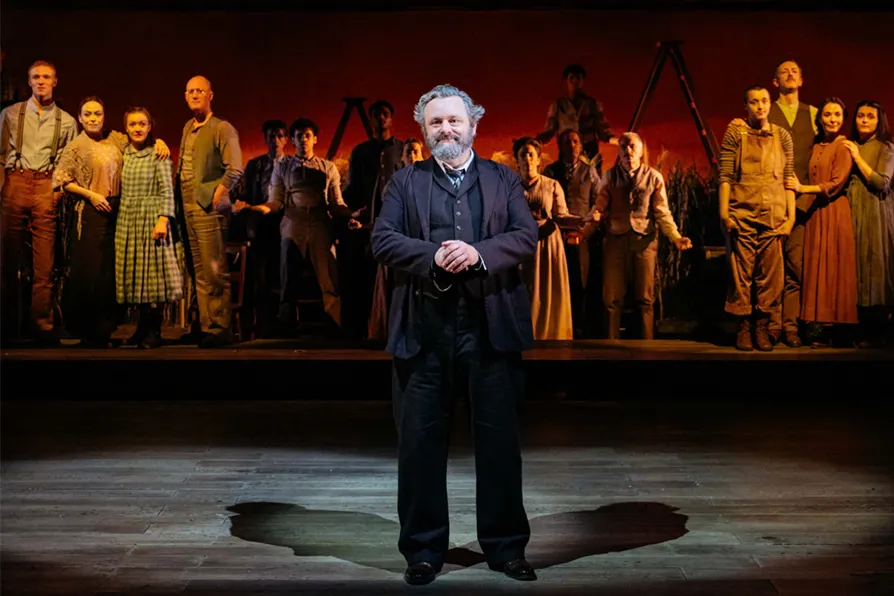 FEELING THE LOVE: Michael Sheen and the cast of Our Town [Pic: Helen Murray]
PAUL DONOVAN welcomes a revival of Reginald Rose’s classic play that reminds us of the fundamental need for trials with juries
SIMON PARSONS applauds an exceptional performance of Wesker’s little-known play, by the same actor for whom it was written 45 years ago
ANDY HEDGECOCK and MARIA DUARTE review Late Fame, The Death of Robin Hood, Leviticus, and Gail Daughtry and the Celebrity Sex Pass
ANGUS REID recommends a uniquely accomplished documentary collage that contemplates our relation to the natural world
GORDON PARSONS enjoys Kant’s ‘mind-boggling’ theory of human reality: that we create the reality we experience





Our Town
Swansea Grand Theatre
★★★★☆
THE last theatrical appearance of Michael Sheen was in the political firework display of Nye, a tour de force performance and personal tribute to the Welsh socialist who created the NHS.
Sheen’s latest project is rather more ambitious — rescuing the culture of working-class Wales. The death by a thousand cuts imposed by Tory austerity eventually meant the National Theatre of Wales could not survive and it closed. In a roar of defiance, Sheen declared that he was not prepared to see the death of such a significant strand of Welsh culture and established the Welsh National Theatre.
The first production of the Welsh National Theatre is Our Town, a little known play from US playwright Thornton Wilder, originally performed in the late 1930s.
Our Town is set in a small town in New York State, where nothing remarkable happens. Life is slow and predictable but comfortably sustained by the warmth of community. It perhaps reflects the Welsh concept of “gwerin” — folk. Is this the connection Sheen makes? It resembles, maybe, the social solidarity of old industrial valleys communities.
This may not be a political production in a direct sense, but it is nonetheless a standard; a stake in the ground that declares the Welsh National Theatre is about us, people, gwerin.
Sheen’s charismatic narrator provides a conduit for the warmth of the audience, to the fine ensemble of ordinary folk on the bare but beautifully drawn town on stage. The actors carry, flip and rotate planks to represent walls and tables, seats and coffins, choreographed with a precise, smooth flow of movement, and accompanied by waves of evocative acoustic guitar.
Movement director Jess Williams and Francesca Goodridge’s idea was for movement to be a central feature, creating a sketch of lives connected in a slow, steady rhythm, inviting the audience to fill in the gaps with their own experiences and emotions.
The cast has some faces familiar from TV dramas set in Wales; Rhodri Meilir, from the film Pride, and The Light in the Hall’s Sian Reece Williams.
In Acts 1 and 2 very little happens but the security and optimism of lives little disturbed by social or economic upheaval. The story is simple and unchallenging, that of a boy and a girl travelling the well worn path from stolen kiss to marriage. Meillir’s Webbe is the kind of folksy, funny, father-in-law who’d “gain a son” with joy.
The familiar device of a marriage reception lifts the auditorium with song and dance before the interval. But the third act opens on a graveyard and the yearnings of the dead. Even boring but contented lives can be wrenched from comforting rhythms by unexpected events. “Not much happens, then you die.” One should appreciate life and loved ones now, because the time we have together is fleeting.
Drama though, requires contradiction and conflict. There are contradictions here but little conflict.
If some may not find the play to their liking, few could fault its execution of the play’s warmth and chill of life and death, such love is there for Sheen and his project.
Nor would I.
On tour in Wales until February 21, then at Rose Theatre, London, until March 28. For tickets and Information see: welshnationaltheatre.com.
