


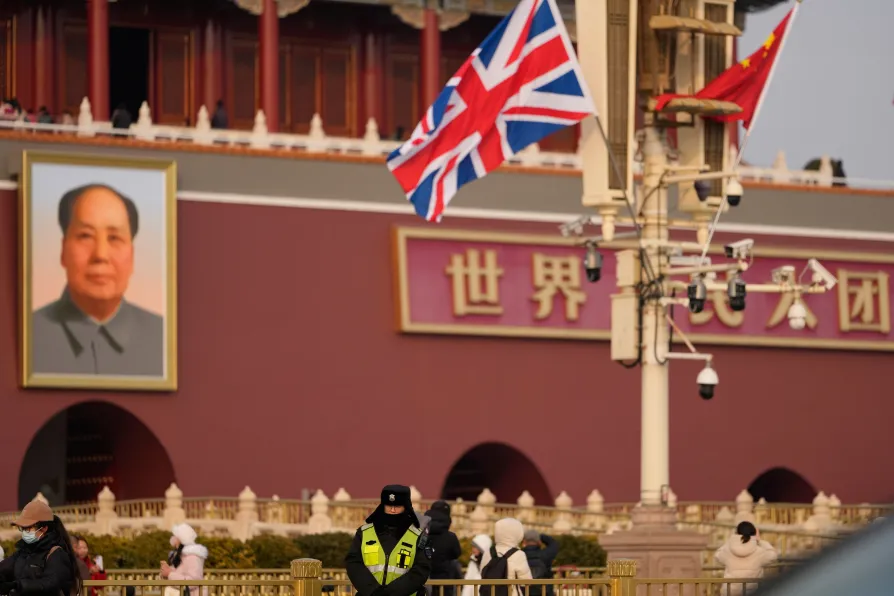
 The British national flag flies next to the Chinese national flag near Mao Zedong's portrait on Tiananmen Gate ahead of the visit of Britain's Prime Minister Keir Starmer in Beijing, China, January 28, 2026





KEIR STARMER’S trip to China has provoked the usual hysteria from Britain’s monopoly media.
He is not the first prime minister to find that any attempt to approach China rationally — as the world’s second-largest economy, a significant trading partner, and the scientific leader in multiple fields, particularly green technology — is portrayed ludicrously as some kind of surrender (or “kowtowing,” to use the still popular stereotyped phrase).
Many of the alleged dangers of working with China flagged in hostile op-eds (and supposedly factual BBC background briefings) are hypocritical or absurd.
Take the accusation that China engages in “intellectual property theft.” This could come from a different era: China is now a scientific and technological powerhouse compared to Britain (to take one measure, in 2024 less than 50,000 patent applications were filed in Britain, compared to almost 1.8 million in China).
We’re also told by the state broadcaster’s security correspondent Frank Gardner that China is after our data.
That’s not something the Beeb tends to raise as a problem in relations with the United States, though we know through whistleblowers like Edward Snowden that GCHQ — caught out harvesting “bulk personal data sets” from millions of people — shared British citizens’ personal data with the US National Security Agency.
A US surveillance firm founded by far-right billionaire Peter Thiel and with close ties to the CIA, Palantir, has not only been handed management of NHS data but has been working with British police forces to compile data on our citizens including with reference to their political opinions and trade union membership.
The threat of digital surveillance and theft of our personal data is real, but it stems primarily from Britain’s toxic relationship with the United States, the unaccountable power of giant US tech firms and secretive but extensive intelligence sharing under the so-called “Five Eyes” arrangement.
That’s significant because the motivation of the China-bashers is not to protect Britain’s sovereignty or independence — let alone its residents — from Beijing, but to maintain our subordination to Washington.
Canadian Prime Minister Mark Carney, in his Davos speech on the end of the illusion of a rules-based world order, spoke of the “strategic partnership” Canada had struck with China as an example of diversifying its international relationships away from over-reliance on the United States.
It was predictably this step that brought threats of tariffs from Donald Trump — and Starmer, on his way to Beijing, was at pains to distance himself from Carney’s approach.
But Trump’s threatened retaliation proves the point. Escalating US aggression comes down ultimately to its rivalry with China, whose companies it has forced out of the Panama Canal, whose “non-hemispheric” influence it hopes to quash by the forced subjugation of Venezuela, Cuba and potentially other Latin American states, and whose trade and investment the US seeks to discourage worldwide with threats and sanctions.
British involvement in the campaign to isolate China economically and encircle it militarily is at the behest of the United States, and asserting our right to engage with China on an independent footing is not just economic common sense but the first step to a truly independent foreign policy.
Such a policy is beyond Starmer’s imaginative reach, but could prove highly popular.
Trump’s outrages mean the downsides of the so-called “special relationship” are more obvious than ever before, while horror at our complicity in the Gaza genocide leads millions to question the alliances taken for granted at Westminster.
For all the years of Establishment propaganda against “enemy” states, people are waking up to the fact that the US alliance is the real problem.
The left has its differences on China, but should be able to agree that the decoupling we need is from Washington. Withdrawal from its cold war against China would be a good first step.
