VIJAY PRASHAD details how US support for Syrian President Ahmad al-Sharaa allowed him to break the resistance of the autonomous Syrian Democratic Forces (SDF)


 Latest editorial

Why is Greenland different from other US targets?
Donald Trump’s bid to seize Greenland has exposed the deep hypocrisy at the heart of Nato, the EU and US foreign policy, writes DIANE ABBOTT MP
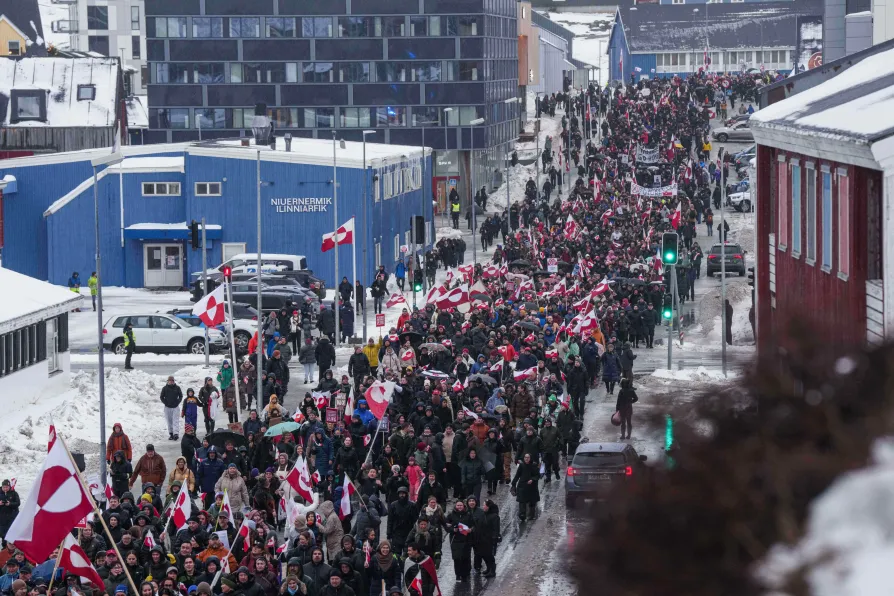 A crowd walks to the US consulate to protest against Trump's policy towards Greenland in Nuuk, Greenland, January 17, 2026

Trump’s ‘Peace Council’ is not a peace project, but a war and colonial council that renews Western colonialism, writes SEVIM DAGDELEN
The US attack on Venezuela raises grave threats to Cuba and the region, writes NATASHA HICKMAN of Cuba Solidarity Campaign
Trump’s vision of ‘might is right’ signals the collapse of the postwar order — and a warning of who may be next, warns BOB ORAM
ROGER McKENZIE pays tribute to a communist, internationalist and organiser, who endures, 50 years after his death, not just as a towering artist but as a master teacher of struggle
Communist Party of India (Marxist) general secretary MA BABY reflects on 2025, tracing how war, imperialism, shrinking democratic spaces and neoliberal restructuring shaped global and Indian politics – pointing towards the urgent task of building a more democratic and just future




IT IS FAIR to say that the institutions and normal processes of the Western alliance have been thrown into turmoil by Donald Trump’s announced intention to seize control of Greenland.
Uproar followed his initial announcements, while relative calm has been restored by his assurance that there will be no armed invasion and there will be no additional sanctions on those countries which have opposed these plans.
The entire episode is far from concluded, and no-one can be quite certain how it will end. None of us has a crystal ball. But even in this intermediary phase of the Greenland crisis it has been highly revealing about both major parties, the US on one hand and non-US Nato members on the other.
Ringing declarations, speeches and even treaties tell us far less about each state’s real foreign policy intentions than what is revealed by how they act in the current instalment of Trump’s foreign adventures.
The first, most striking feature of the crisis is the near-universal and rank hypocrisy of virtually all the main actors. Trump says he needs to seize Greenland because otherwise China or Russia will. But the only actor remotely threatening to annex the territory is Trump himself.
If either China or Russia threatened the same then Trump would undoubtedly designate it as an act of war and Article 5, for the mutual self-defence of all Nato members would certainly be invoked.
Equally certain, both the European Nato members and the EU itself would enthusiastically welcome such a declaration, even though this would be a significant step to global, nuclear war. Sickeningly, EU leaders like Ursula von der Leyen have made ringing declarations about territorial integrity, sovereignty and “the fundamental principles of international law.”
The EU and the European Nato members individually support none of these things when they are riding the coattails of US military aggression against Iran, or Nigeria, or Venezuela. Meanwhile, Chancellor Friedrich Merz, in a fantasy land of his own creation, declares that Germany will defend Greenland against Russia.
In fact, it is impossible to take any of these powers seriously about their claimed principles when they have either condoned, or in some cases participated in the genocide in Gaza. If we are to understand their real policies, we must examine their actions and discount their self-serving rhetoric.
Trump’s demands to seize Greenland have nothing to with defence against attack. Following the 1951 Treaty, the US effectively has unfettered access to military bases on Greenland, and operates a large one, the US Pituffik Space Base, formerly known as Thule Air Base.
The US is the only great power with a military presence on Greenland, while Denmark, a Nato ally, operates two smaller bases.
Any country attacking Greenland would immediately start a shooting war with US military personnel. Therefore, there is no advantage to US adversaries from attempting to seize Greenland; even attempting to do so would be a declaration of war.
In fact, the Trump efforts to annex Greenland are perfectly in line with the global strategy outlined in the US’s recently published national security strategy. This document has previously been discussed in these pages, and the fear is that we will become all too familiar with it over the next period.
In effect, the strategy is to subordinate the whole of the rest of the world in preparation for war with China.
In it, the new “Trump corollary to the Monroe Doctrine” excludes other powers from what Trump clearly believes is the US’s backyard, and this seems to apply to Greenland as much as the whole of Latin America.
In conjunction with this aggressive expansionism is the stated intention to reduce whole continents to the role of the suppliers of raw materials to the US, as required. This is Trump’s vision for both Latin America and Africa.
But there may also be a direct military rationale to Trump’s Arctic land grab, beyond what is currently possible under the 1951 Treaty. Trump has previously spoken about a “golden dome” for the US, like Israel’s iron dome, which allows the respective country to attack others with relative immunity from aerial attack.
In the case of the US, Trump’s golden dome would protect the US from attack, or counter-attack from any adversary. The effect would be, if technically possible, for a golden dome to encourage US nuclear first-strike capacities against its enemies.
The positioning and movement of the missiles forming part of the dome cannot be shared with anyone, not even a friendly Greenland government.
The European powers are largely silent on this, preferring instead to focus on the damage to their own prestige from being forced to hand over Greenland. But this motivation is widely reported in the US press and now, recently, in The Times.
Because it relates to the US golden dome and first-strike capabilities, in this very important sense, opposition to Trump’s seizure of Greenland is in all our interests.
However hypocritical and feeble EU opposition to Trump will be, at least there is token opposition. In Britain, Keir Starmer’s subservience is portrayed as strategy, paralysis is deemed to be statecraft.
While the EU said it was preparing counter-tariffs on the US, Starmer simply accepted the imposition without any response. David Lammy makes himself ridiculous by claiming that this passivity changed Trump’s mind on the use of armed force and on tariffs.
In reality, the change of heart probably came from cooler heads in the US administration, who might reasonably argue that Europe will not present any serious obstacles to achieving Trump’s aims by peaceful, bullying means.
But it should be clear that the entirely submissive posture that the British government has adopted to Trump over the last year has proven to be a spectacular failure.
Brazil, China and the EU have all at different times won some respite from Trump’s attacks by pushing back. Starmer has achieved nothing, except the earliest tariffs of any “ally.”
British influence counts to close to zero in the world with this approach.
Looking ahead, it seems as if the entire global South is going to be treated like Venezuela, Nigeria and Iran, with the ultimate example of how far Trump will go in trampling on another country being Palestine.
The non-US Nato countries are going to be treated like Greenland and Denmark, while the US openly and explicitly lobbies for new governments of the hard right.
Yet Trump is already massively unpopular in Europe and will become more so. Therefore what the population requires is political forces that express that viewpoint.
Diane Abbott is Labour member of Parliament for Hackney North and Stoke Newington.
