
The US administration is endangering lives by reversing environmental protection laws, CHAUNCEY K ROBINSON argues

The chemistry of war
The long-term effects of chemical weapons such as Agent Orange mean that the impact of war lasts well beyond a ceasefire
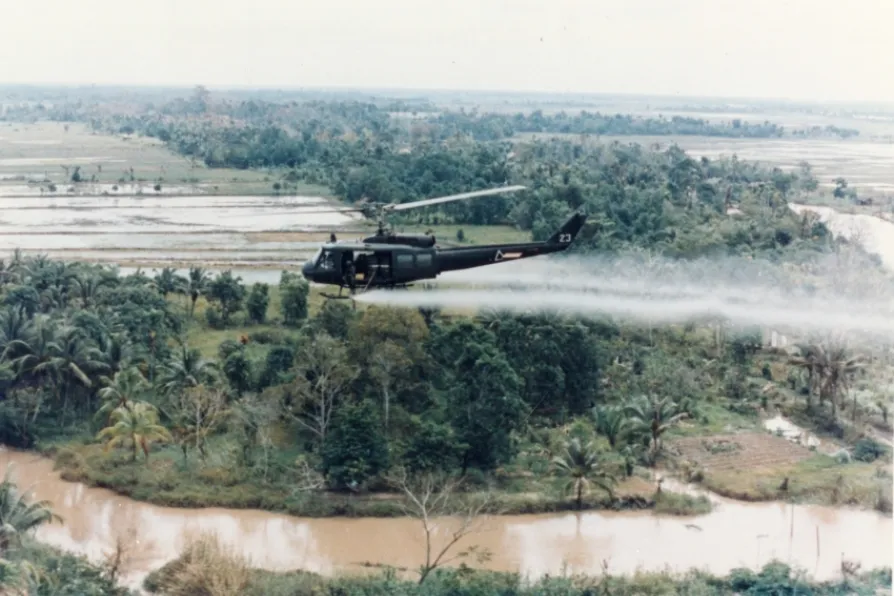
 A US military helicopter spraying Agent Orange during the Vietnam War
It’s time to stop retreating and go on the offensive to promote working-class interests, argues DOUG NICHOLLS
Marco Rubio wants to defeat socialism in Nicaragua, not restore ‘democracy,’ writes JOHN PERRY
Believe it or not, there was a time when the US government built beautiful homes for working‑class Americans to deal with a housing shortage, writes ERAN BEN-JOSEPH
DIANE ABBOTT provides an analysis of the reasons for EU and British voters’ dramatic swing to the right
Train drivers’ union Aslef general secretary DAVE CALFE speaks to Ben Chacko about his hopes that Burnham’s devolution agenda will include the importance of the railway





ACCORDING to official estimates from the BMJ, the US war on Vietnam killed over 3 million Vietnamese people, two thirds of them civilians.
Events like the My Lai massacre, where hundreds of unarmed Vietnamese civilians were slaughtered by US soldiers, exemplify the US’s wider military strategy. Nick Turse, the author of Kill Anything That Moves, investigated the intentional, widespread and systematic killings of civilians, describing them as stemming “from deliberate policies that were dictated at the highest levels of the US military.” These policies prioritised body count; the title of Turse’s book refers to official orders given to US soldiers.
As well as these horrifying massacres, the US military is also notorious for its deployment of “herbicidal warfare” in Vietnam. Between 1961 and 1971, an estimated 74 million litres of toxic chemicals were sprayed over the dense forests and mangrove swamps of South Vietnam.
The aim was to destroy the crops that supplied food for the Vietnamese guerilla fighters and make it more difficult for them to use foliage for cover during the fighting. The most infamous of these herbicides was “Agent Orange,” so-called because the barrels were sprayed with orange paint. It was a blend of two commercially available herbicides, 2,4-dichlorophenoxyacetic acid and 2,4,5-trichlorophenoxyacetic acid (2,4,5-T). Over 3 million hectares of farmland and forest and 20,000 villages were affected.
The chemical 2,4,5-T in Agent Orange is a type of chemical called a dioxin. Dioxins are a group of compounds that vary widely in their toxicity. 2,4,5-T is one of the most toxic mostly because it’s a potent carcinogen. The Vietnamese population have been absorbing this dioxin through the skin, breathing it in through contaminated dust or air, and consuming it via contaminated crops and livestock. It is widely established that this dioxin is directly linked to several health conditions: various cancers, type two diabetes, Parkinson’s disease, and ischemic heart disease. Official figures from the Vietnamese government estimate that over 400,000 Vietnamese people died due to Agent Orange exposure.
The more chlorine atoms a dioxin contains, the more toxic it is, and the more stable it is. 2,4,5-T contains a lot of chlorine and is not a short-lived chemical.
It can survive up to three years in soil that is exposed to sunlight, and over 100 years if leached into river or pond sediment, vastly increasing the possibility that animals or fish can be contaminated by it. Similarly, it can lodge itself in the human body, attached to fats in the breast or other fatty tissue. Thus, breastfeeding babies could be exposed, if their parent was exposed to dioxin.
A 2012 study led by Nishijio and Tai into the impact of exposure to dioxin through breastfeeding found “a considerable impact of perinatal dioxin exposure on infant growth,” leading to slower physical growth and lagging neurodevelopment.
The team, and other researchers, have followed this up with several more epidemiological studies investigating the impact of the compound on children and adults exposed to historical and ongoing dioxin contamination in Vietnam. These studies point to multigenerational impacts of dioxin through birth defects in Vietnam.
The environmental impacts of the poison are also long-lasting. The destruction of forests meant the loss of habitats for many animals, leading to a sharp decrease in biodiversity.
The regions most heavily affected by herbicidal warfare have still not recovered, 50 years after the end of the war. Dioxin levels in Vietnam’s soil, sediment and water are still high, affecting regrowth and also causing soil erosion. Invasive, aggressive species such as bamboo and cogon grass have invaded defoliated regions, slowing the recovery of primary forest.
The nine chemical companies that supplied Agent Orange to the US government included Monsanto (acquired by Bayer in 2018). In 1984 they and other companies paid an out-of-court settlement to US soldiers who’d fought in Vietnam. But these companies have continued to fight international attempts by Vietnamese victims to claim compensation. In 2005 a US court rejected a case brought by Vietnamese victims, and only last year the Paris Court of Appeal rejected another appeal case on the basis that the companies had immunity because they were working for a sovereign government.
The use of chemicals as a weapon of war continues to this day. Although white phosphorus is not technically considered a “chemical weapon” by international law, it relies on a chemical reaction whereby phosphorus contained within artillery shells or bombs ignites when it is exposed to oxygen.
The reaction creates intense heat, in excess of 815°C. Once ignited, it is very difficult to extinguish, and the burns it causes can penetrate through bone. The smoke issued from burning phosphorus is also harmful to the eyes and respiratory tract, causing long-term adverse health effects including blindness, renal failure and central nervous system damage. The denial of the definition of white phosphorous as a chemical weapon by international law is entirely spurious. It is based on the fact that although it is toxic, and its most deadly characteristics are produced by its chemistry, in most cases it is the burning that kills people.
The Israeli occupation army’s use of white phosphorus in Palestine and Lebanon is yet another instance of Israel’s flagrant disregard for international humanitarian law, which states that parties within a conflict must take all feasible precautions to avoid civilian injury and loss of life. The use of white phosphorus in densely populated areas such as Gaza is a war crime.
Israel has been using white phosphorus for decades: in late 2008 and early 2009, approximately 200 white phosphorus munitions were fired into populated areas of Gaza.
These caused multiple civilian casualties and damaged civilian infrastructure such as a school, a market, a humanitarian aid warehouse, and a hospital. All of these structures have been targets in the most recent assault in the genocide against Palestinians, and the use of white phosphorus has been documented by Amnesty International.
Investigation of the projectile shells deployed in October 2023 by the Amnesty International team found that the shells have visible US Department of Defense Identification Codes for white-phosphorus-based ammunition (which we discussed at https://morningstaronline.co.uk/article/smokescreens-science-and-technology).
This indicates that the contractors producing these munitions are likely to be based within the US. According to the Corruption Tracker project, three companies produce the majority of the world’s white phosphorus: one of them is Bayer-Monsanto.
