MARY DAVIS says the centrality of the Jewish community and the Communist Party to anti-fascism in the 1930s is too often overlooked on the left


Endgame: escalation and negotiations
While Trump negotiates peace with Moscow, Kiev and Brussels continue to pour fuel on the fire. Nato is preparing a big strike – and calling it defence, argues SEVIM DAGDELEN
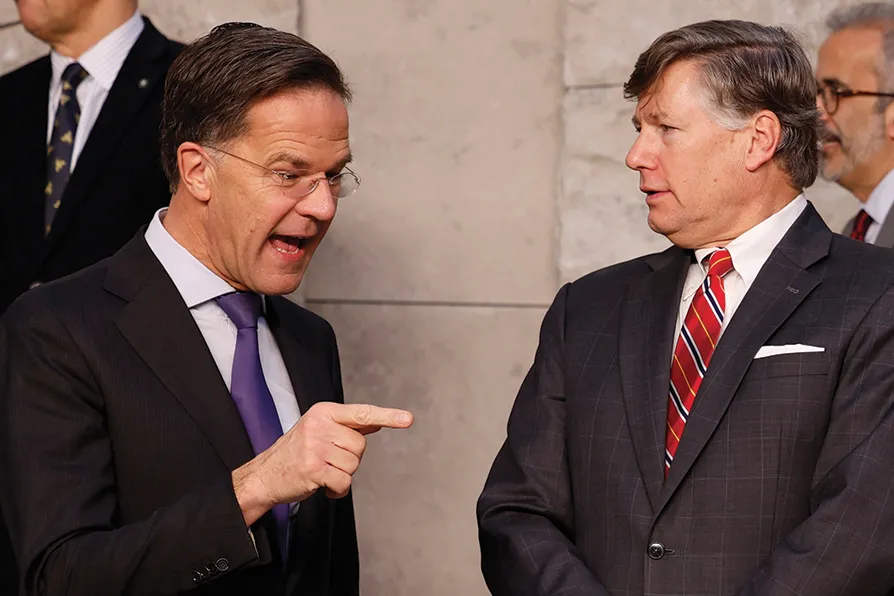
 NEARLY APOPLECTIC: Nato Secretary General Mark Rutte, left, corners US Deputy Secretary of State Christopher Landau at Nato HQ in Brussels on Wednesday
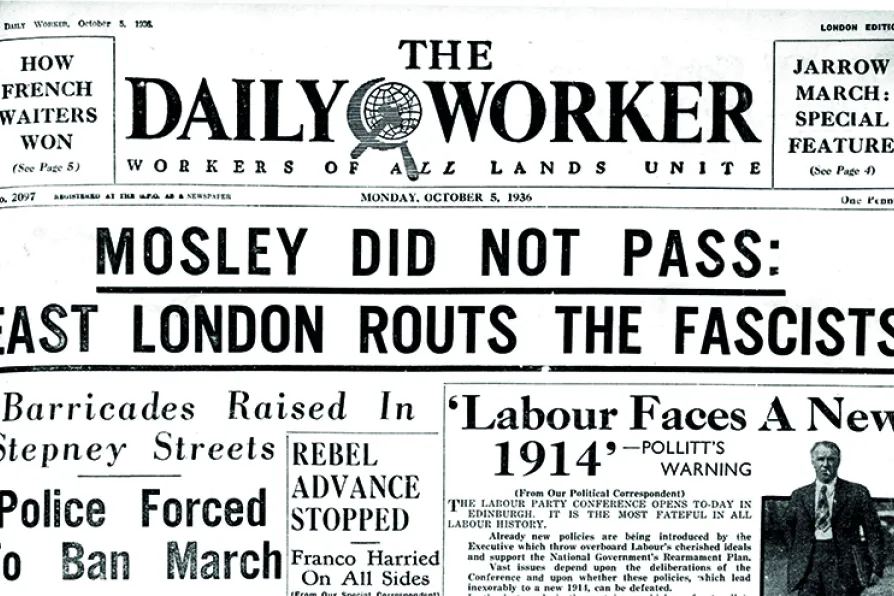
A 1936 confrontation with Mosley’s BUF became part of a wider international struggle, with local activists later joining the fight against fascism in the Spanish civil war. TONY FOX tells the story ahead of a 90th anniversary commemoration event
GEORGE WHITE explains why Unite’s Lancashire area activists committee believes co-ordinated recruitment in an area defined by particular kinds of employment and linked by a major transport artery could provide a model for organising the unorganised
Voters have delivered a stay of execution for Labour and exposed limits to Reform’s advance. But will Burnham offer a political alternative rather than just a different face at the top, asks ANDREW MURRAY
Calls for a Universal Basic Income are a red herring, argues the Full Marx editorial team — socialists should fight for Universal Basic Services
SEVIM DAGDELEN warns that Germany’s military resurgence and revival of old hostilities towards Russia have dangerous implications for Europe and beyond





WHILE talks about ending the Ukraine war are taking place in Moscow, both the Kiev regime and the top echelons of Nato and the EU are pushing for total escalation in a last-ditch attempt to “win” the war after all.
Ukraine has opened a new phase of the conflict with terrorist attacks on Russian oil tankers off the Turkish coast in the Black Sea and on a tanker carrying Russian oil off the coast of Senegal.
The attacks on Russian oil terminals on November 30 speak an equally clear language. The dream of finally ruining Russia economically has evidently not yet been abandoned.
Incidentally, it is scarcely conceivable that these Ukrainian attacks using underwater drones could have been carried out without the active assistance of Nato member states.
Faced with the precarious military situation following the fall of the small town of Pokrovsk, the Ukrainian leadership and its backers in Nato are banking on expanding the combat zone.
Washington calls the shots – Europe pays and marches
While the Trump administration conducts peace talks on the Ukraine war, President Zelensky is touring Europe to secure further arms aid.
Ukraine’s military spending is exploding: already in the first quarter of 2025 it reached $20.8 billion (£15.6bn – 75 per cent of the entire budget), according to the Kiev Post.
In Brussels, EU defence ministers announced new arms plans: up to €40bn (£36bn) for weapons to Ukraine in 2025, including two million artillery shells. The main beneficiary: the US arms industry. Nato’s new war mechanism Prioritised Ukraine Requirements List (PURL) ensures that Europe pays, the US delivers – and cashes in.
The Netherlands recently pledged €250 million (£220m) for US weapons via PURL (eg air defence systems and F-16 ammunition).
The Merz government is planning a record €11.5bn (£10.1bn) in “gifts” of weapons in the coming year, paid for by German taxpayers. An estimated 10–15 percent of that is likely to disappear straight into corruption networks and be converted into precious metals.
Once again, it would be a mistake to construct a fundamental contradiction between the US and its European vassals.
By ostentatiously displaying disagreements with the Europeans – including US Secretary of State Marco Rubio’s conspicuous absence from the foreign ministers’ meeting on December 3 – Washington is merely trying to bolster the credibility of its negotiating efforts vis-a-vis Moscow.
The US’s strategic goal remains to pry Russia away from its alliance with China or at least to neutralise it to some extent, so that all forces can be concentrated against Beijing.
At the same time, Ukraine is to be given time – just as after the Minsk 1 and Minsk 2 agreements – to expand and massively rearm its military capabilities. For that, however, compliant actors are needed in Kiev, who are to be kept in line by the sudden “discovery” of golden toilets and massive corruption in President Zelensky’s entourage.
‘Pre-emptive strike’ Against Russia
In parallel, Nato is preparing an attack on Russia that it intends to present as defence. This can be seen, on the one hand, in the secret planning itself – such as the Germany Operational Plan – and, on the other, in the rhetoric of the responsible Nato generals.
Anyone with even a passing knowledge of Nato’s history knows that nothing – absolutely nothing – has ever happened or happens in this organisation without the approval of the US.
Even the recurring talk of a Nato that has supposedly already died a thousand (brain) deaths must be understood as a purely functional smokescreen for its own aggressiveness and as a fresh justification for even more rearmament.
The chairman of the Nato Military Committee, Italian Admiral Giuseppe Cavo Dragone, told the Financial Times that a more aggressive Nato response to the war in Ukraine is in the offing. One possible measure, he said, could be a “pre-emptive strike” against Russia – provided it is framed as a “defensive measure.”
This explicit Nato announcement that it is prepared to wage a preventive war against Russia acquires an even sharper edge against the backdrop of Russian history. After all, both Napoleon’s alleged defence of France in Moscow and Nazi Germany’s alleged defence of Europe before Moscow used the justification of prevention for their respective invasions.
Kaja Kallas’s Orwell show
And where there is darkness, the prince of darkness must not be missing. As if she wanted to blot out her own sinister intentions, the EU’s leading “historian,” Kaja Kallas – EU High Representative for Foreign Affairs in her spare time – distinguished herself with the bold claim that in the last 100 years Russia has attacked other countries 19 times, while no country has ever attacked Russia.
Kallas is in charge of the ideological component of warmongering against Russia. War is peace, attack is defence – that is her Orwellian message.
In pursuing this goal, the EU and Nato are risking nothing less than a third world war in order to make Kallas’s dream of destroying Russia a reality.
