WILL STONE samples the 20th anniversary atmosphere of this eclectic end-of-season indie festival


 Latest editorial
Whose progress is it anyway?
HENRY BELL is sceptical of the notion that ‘progress’ is an ideology that the ruling class uses exclusively to camouflage appropriation
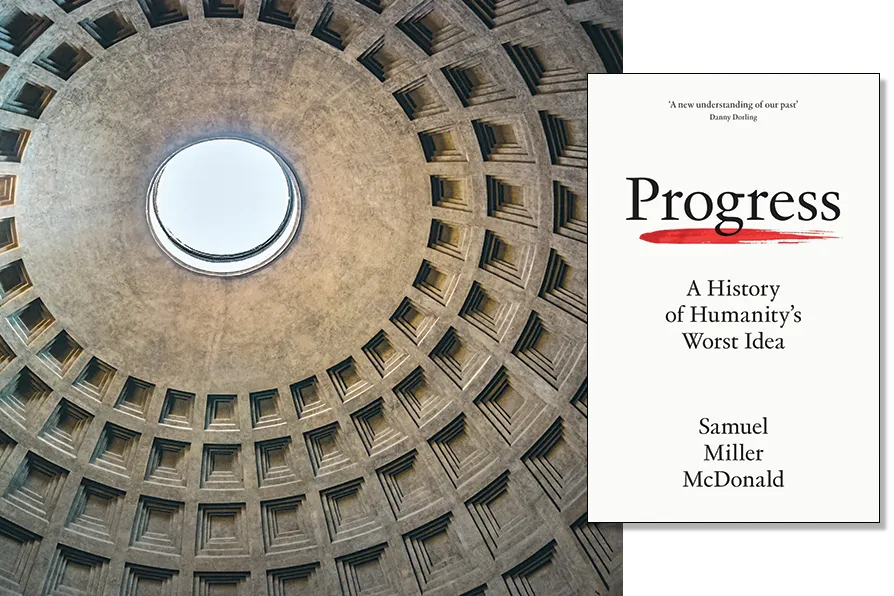 BUILDING PROGRESS: The Pantheon with its legendary dome was built exactly 1,900 years ago. The material used was Roman 'concrete' pozzolan (unreinforced). The dome, at 43 meters (142 feet), is the largest of its kind in the world [Pic: Gary Ullah/CC]

Comics are not just superheroes and spandex – it can be public art, telling public stories, suggests HARRIET EARLE
The bard serenades the Diggers of Wigan and their festive followers
ALEXEI SAYLE speaks to Angus Reid about a lifetime of protest, how to hone political art – and what to do now
ANDY HEDGECOCK, JAMES WALSH, LEO BOIX and MARIA DUARTE review Just An Illusion, Everybody Digs Bill Evans, Blue Film, Oasis: Don’t Look Back in Anger, and Runner
MARIA DUARTE recommends a nerve-wracking reconstruction of the 72 hours before the Normandy landings





Progress: A History of Humanity’s Worst Idea
Samuel Miller McDonald, William Collins, £10.99
IN his impressive and uncompromising takedown of that bedrock of capitalist ideology, progress, Samuel Miller McDonald argues that almost any view of progress can immediately be altered by a change of frame, and every claim of progress is really a fiction dependent on externalities, altered timelines or bias from the viewer. He argues that centuries of propaganda about “civilisation” and “development” in fact represent the very forces that are marching us backwards (or rather, marching us nowhere).
It is not mysterious that such a book would find both publisher and audience in this particular moment. By almost every measure the idea of progress that held good for much of the 19th and 20th centuries has begun to break down in the 21st century.
As Miller-McDonald writes: “Democracy is declining, economic inequality is increasing poverty and slums are a growing feature of urban life, global life expectancy is falling, maternal mortality is 300 per cent higher for millennials than it was for their parents, new infectious diseases are rapidly increasing.” Add to this the fact that we are standing at a precipice — the current fossil-capitalism that is defended by the progress narrative may in fact wipe us out altogether — and it is no wonder that a doom-laden survey like this should land.
The central thrust of the book is that we have been had. Progress itself is an illusion designed to protect the worst actors in our society. We are not experiencing a surprise decline, but rather the fictions that sheltered us from reality are fading. The forces that ameliorated the worst excesses of so-called linear progress (be they religious, communistic or indigenous) are all but defeated. A tipping point has arrived at which the profit motive and the myth of civilisation has begun not just to immiserate most life on Earth, but now in fact all life on Earth must suffer.
Miller McDonald argues that many fictions and manipulations have allowed us to arrive at this necro-capitalist moment but that none is more pervasive or pernicious than the myth of progress. He traces it back through industrialisation, reformation, caliphates and vikings, attempting to skewer the origins of “progress” itself.
Such panoramic histories will inevitably be shallower in part, and certainly the overall polemic here suffers from over-reach at times. So focused is it on its mission to denude progress that its claims against bias and restricted frames become accusations in the mirror. Scientific advancements are dismissed as inevitable, religious and social paroxysms are omitted when they do not fit the narrative, and progressive revolutionary politics is chided as part of the problem.
To some extent the millennia of evidence that the book assembles has the opposite effect from that which has been set out. We can’t help but observe that things have changed! Are we supposed to accept that progress is a myth or that progress is real but also really bad? The question slowly becomes not whether we are making progress, but rather where is that progress directed? Who is defining the progress and what are they hiding?
Automation, the automobile, AI — vast destructive forces that lessen life — are also true miracles of accumulation and labour reduction. Perhaps we might agree that great progress has been made by the ruling class in the last 50 years — at a cost to all of us. But what would happen were the exploited to seize that power and reorient progress away from the strictly parasitic and extractive lens that Miller McDonald consistently applies to it?
To some degree humanity and history are cyclical and progressive. The destruction of progress is a noble aim in this book, but perhaps a more dialectic view would ask how progression and regression nevertheless might move us onwards. Apocalyptic prophecies inevitably spread because of their urgency, but this does not make them intrinsically any truer than their opposites.
In his final pages, Miller McDonald offers a vision of a more mutual, consensual, content and sustainable world. This can’t help but feel like progress.
