New releases by Interpol, Phoebe Bridgers, Lambchop


 Latest editorial

Visions of the urban fox
JOHN GREEN is intrigued by the ethereal, ghostly quality of images of a London unobscured by the bustle of humanity
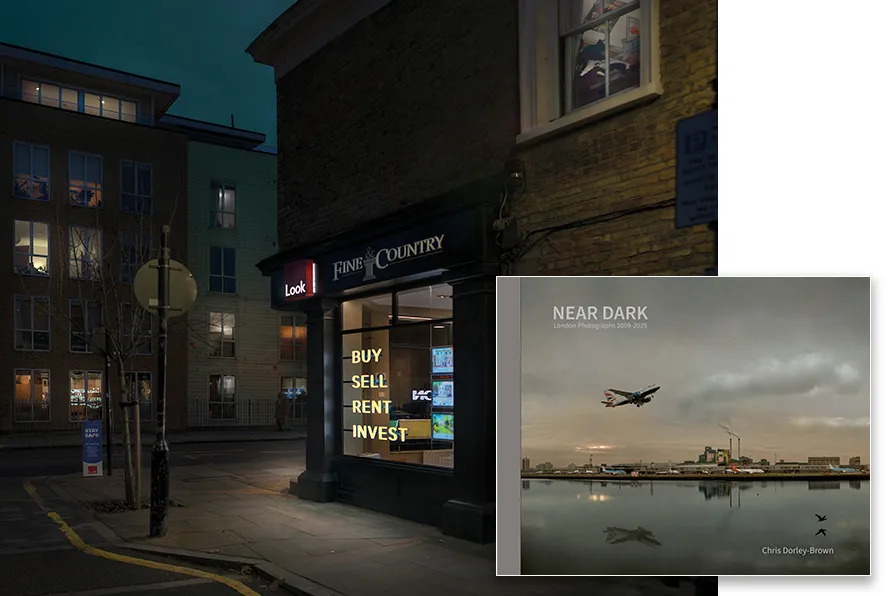 SPECTRAL: Bow, 2022 [Pic: © Chris Dorley-Brown]
ANGUS REID urges us to understand the persecution of Jason Arday from a political and historical perspective, and to see the victim in human terms
Re-releases of the classics Gypsy Rhumba and Buena Vista Social Club, and a stunning album by Palestinian artist Faris Ishaq
Nothing, says ANDY HEDGECOCK, can rescue this undistinguished amalgam of ponderous melodrama and shallow philosophical speculation
JAMIE BRITTON invites readers to visit 3,500 locals as part of a marathon artistic pub crawl
JOHN GREEN welcomes a valuable and incisive analysis of a world become hyperpolitical but without the mass movement institutions to represent it





Near Dark
Chris Dorley-Brown, Dewi Lewis, £40
PHOTOGRAPHED in London, in Near Dark, Dorely-Brown ventures into rarely seen territory. London is as alluring as ever, but almost everyone is taking shelter, keeping out of sight.
Dorely-Brown’s images have an ethereal, ghostly quality about them; he has captured those precious moments between the snuffing out of the light and the descent of darkness. Buildings are sometimes wreathed in mist and you half expect a character out of Dickens to sidle around the corner, or they feel abandoned as if everyone is in hiding.
His photos explore decaying modernism, post-industrial landscapes, council estates in a state of apparent sleep and serenity, where monumental London landmarks are wreathed in a painterly haze. His images are shot in super high resolution.
On first impression, you might react to this collection of photographs by saying: why should I be interested in images that contain hardly any people? But reading between the lines there is, of course, the photographer himself at work, and the empty urban vistas of buildings, roads and pavements themselves have been designed and built by human beings who are, in this displaced way, present too.
He certainly has that instinct for sniffing out the iconic in hidden corners of the capital city, rather like a fox on the prowl. He teaches you to see London in a demonstrably new light. Our eyes are freed to take in the intersecting lines, planes and shapes, unobscured by the bustle of humanity.
The Palladian curve of Regent Street is visited by the apparition of an unlit Christmas Angel, suspended from the sky; Spitalfields is depicted as a scruffy graffitied wall in the foreground and a diaphanous cluster of high-rise blocks, like a modern Stonehenge, on the skyline.
Blackfriars is seen as a series of vertical columns made up of street lamps, signs and surveillance cameras, with the Shard in the distance, pricking the louring cloud. His images sear themselves into your memory and have a brittle, crystalline sculptural quality about them.
The images have been made over the last 10 years during which London has experienced both Olympic euphoria and the pandemic and chaotic government policies. The emphasis is on mood and an attitude amassed over 40 years of picturing London.
Dorley-Brown set up his Hackney based darkroom off Mare Street in 1984, concentrating on documenting East London. In a series of residencies and commissions focussing on social housing, workplaces, hospitals and architecture, he has established a substantial archive of images that are re-purposed and re-contextualised for distribution via web, film, exhibition and publication.
Project partners have included the BBC, Museum of London, Homerton Hospital, the Wellcome Collection and various London Borough archives. He often works with re-energising existing archival material as part of creating new works.
For more information see: modrex.com
