GEOFF BOTTOMS applauds a world-class production King Lear that pits late feudalism against a rising bourgeoisie


 Latest editorial

The Story: what the newsroom does to the truth
MARY CONWAY keeps up with the sheer pace of a drama about the terrible gap between sanitised reporting and real-life turmoil of race and gender
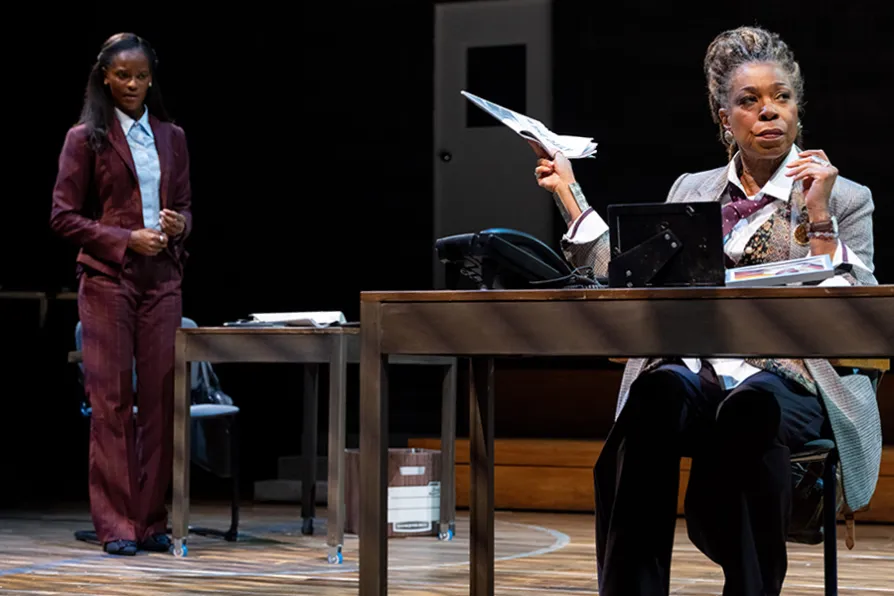 POWERFUL PURPOSE: Letitia Wright (Yvonne) and Lorraine Toussaint (Pat) in The Story [Pic: Feruza Afewerki]
New releases from Brian Fallon, Antony Szmierek and Hollow Hand
APURBA CHATTERJEE explains how British artists in India used the “picturesque” to reshape colonial landscapes and celebrate imperial power
PAUL DONOVAN welcomes a revival of Reginald Rose’s classic play that reminds us of the fundamental need for trials with juries
SIMON PARSONS applauds an exceptional performance of Wesker’s little-known play, by the same actor for whom it was written 45 years ago





The Story
National Theatre, London
★★★★☆
TRACEY SCOTT WILSON’s The Story, written in 2003, centres on a buzzing newsroom somewhere in the United States, where the interest of the moment is the murder, in a predominantly black neighbourhood, of a white male teacher. That he was shot by an unidentified hooded figure in front of his pregnant white wife seems to suggest a simple gripping whodunit.
But there is more at stake here and we are full attention as a fierce investigation into the truth takes shape.
Star actor Letitia Wright plays Yvonne, an ambitious young black journalist determined to get to the top. Her assignment to the Vanguard wing of the newspaper irks her. It’s a section confined to headline stories about black people, whereas she wants to work on the central News Desk proper where the real power sits. That she’s sleeping with the white, clean-cut Editor (Wilf Scolding) is a benefit not lost on her as she carves out her ascent to greatness.
Meanwhile, her take on the current murder story is very much more about self-aggrandisement, lies and unsupported evidence than it is about establishing facts.
The editor of the Vanguard section, Pat — played with powerful purpose by the acclaimed Lorraine Toussaint — conversely represents a long-term, tried-and-tested black activist, whose mission in the job is to serve the black community and fight their corner. While Pat’s aim clashes with Yvonne’s, Neil — another black reporter sidelined to the Vanguard and played with fitting earnestness by Ashley Thomas — wants primarily to distil the truth.
Chaos ensues when the journalists’ varied motives find expression through the multiple potential contexts that emerge for the murder of the white teacher. Even as no killer is identified, the potential stories are endless. And the play transforms from a clear search for truth about one incident, to an in-depth study of news and false reporting in the context of black lives. It explores white supremacy, male dominance, and seriously authentic detail from within a black community.
The play is, indeed, packed with insights; its fast, almost gabbled dialogue not only creating distinctive style but throwing out ideas and information at breakneck speed. And, in Clint Dyer’s frenetic direction, the scenes flash from one to another at different points on the stage, forcing us to keep up or literally lose the plot.
The pacing is stimulating at first but inhibiting of character study, and even when slowed slightly in the second half, it’s wearing over a whole show. The impression is altogether dense, sprawling and frantic.
Anna Fleischle’s set, though, makes good use of the expansive Olivier stage to create a community sports centre within which defined areas accommodate a variety of scenes and settings. And the gospel-style singing of Abide With Me contrasts well with the fast-pace dialogue.
Set way back before social media hijacked news reporting, the play seems even more relevant for our current post-truth generation. It blows apart any belief we might have in the integrity of the press and brings to the fore the still massive battles of race and gender.
The ultimate truth that emerges is of the terrible gap between sanitised reporting and real-life turmoil at ground level.
If only the play were less weighed down with complex detail and let the audience breathe, this could be a landmark piece. It certainly captures a definitive aspect of our era.
Runs until October 24. Box office: (020) 3989-5455, nationaltheatre.org.uk.

Similar stories

MARY CONWAY admires a brave and topical study of Armageddon that is, unfortunately, unable to come to a conclusion

SIMON PARSONS applauds the timely revival of a play about solidarity and betrayal within Britain’s Pakistani community
MARY CONWAY becomes impatient with the intellectual self-indulgence of Tom Stoppard in a production that is, nevertheless, total class
MAYER WAKEFIELD is gripped by a production dives rapidly from champagne-quaffing slick to fraying motormouth