

 Latest editorial

Argentina’s World Cup campaign reignited a long-running sovereignty dispute and exposed the contradictions of Javier Milei’s government, writes BERT SCHOUWENBURG
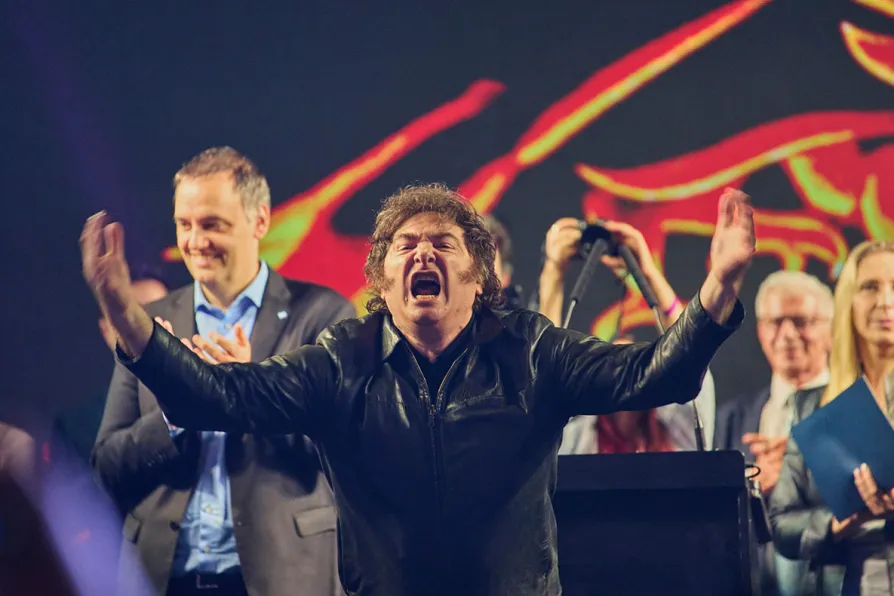 Argentina's President Javier Milei greets supporters during the closing campaign rally for Manuel Adorni, a contender in the upcoming elections for the Buenos Aires city legislature, in Buenos Aires, Argentina, May 14, 2025

JAMES NALTON explains how this historic Lancashire clash has become a fixture of the Championship season





IN BRITAIN, anti-Argentine sentiment is never far from the surface, and so it proved during the football World Cup in the United States. Argentina lost the final to a superior Spanish team and at the end of the game, some of their players pushed their opponents to the ground and were extremely aggressive. English TV pundits categorised the Argentinians’ actions as being typically “disgraceful” or “unacceptable” and while there can be no excuse for their behaviour, we now know that they took offence to Spanish verbal provocations.
What really upset the right-wing press and politicians came after the semi-final when Argentina beat England, the country that introduced football to South America in the 19th century. Following their 2-1 victory, Argentinian players paraded a large homemade banner proclaiming “Las Malvinas son Argentinas” (The Falklands are Argentinian), prompting calls for them to be banned from playing in the final. Keir Starmer became the latest Prime Minister to reiterate that the islands are British, saying that “The World Cup might not be ours, but the Falklands definitely are. Our position is unchanged, and our commitment to the Falklanders is unwavering.”
Like his predecessors, Starmer is either ignorant of the facts or chooses to ignore them. Britain seized the archipelago in 1833 after previously recognising that it belonged to Argentina following their independence from Spain. Anyone who has any doubts about the legitimacy of Argentina’s claim should read the masterful presentation delivered by their ambassador to the United Nations, Jose Maria Ruda, at the Special Committee on Decolonisation in 1964.
In 1965, UN resolution 2065 recognised the existence of disputed sovereignty over the Malvinas/Falklands and urged both governments to renew negotiations in order to arrive at a solution as quickly as possible.
The resolution has been largely ignored by successive British governments. In recent years, Britain has tried to justify the continued occupation of the islands by referring to a 2013 referendum in which the 1,500 inhabitants voted to remain under London’s rule. In fact, according to international law, the self-determination principle does not apply because the territory has been sparsely populated by nationals of the colonial power, ie Britain, after forcefully evicting the original inhabitants and never allowing them to return. It should also be noted that the principle of self-determination is based upon UN resolution 1514, whose main aim is to end colonialism in all its forms.
Before the Argentina-England game, the republic’s President Javier Milei drew considerable criticism after endorsing a Fifa directive preventing fans entering the stadium with flags, shirts, placards or any other type of poster that made reference to the Malvinas because it would be considered “political content.” Moreover, in contrast to the indifference or lack of understanding of most English people, the quest for regaining the islands from British imperialism is fundamental to who the Argentinians are and most will have a firm understanding of the historical context, especially after the 1982 war.
Interviewed on television, the security minister Alejandra Monteoliva stated that the Malvinas were indeed Argentinian but that they would be regained by diplomatic means with what she described as intelligent action, so she supported the Fifa ban. By way of contrast, Milei’s vice-president Victoria Villarruel, with whom he has had a long-standing feud, supported the players’ demonstration and referred to the English as “usurping pirates.”
Milei has been ambivalent about the Malvinas question since coming to power in December 2023 and the footballers’ gesture clearly made him uncomfortable. In April of last year, he was ridiculed after saying that the islanders would want to become Argentinian citizens after he had “made the country great again.” And in December, he appeared to question Argentina’s right to the islands by saying that they would only be recuperated when the inhabitants wanted it themselves.
His political opponents were not slow to capitalise on his discomfort. Jorge Taiana, who was foreign minister under the more progressive Kirchner administrations in the early part of the century, said that the national football team had ended three years of what he described as “de-malvinisation” and put the fate of the islands firmly back on the international agenda.
Not long after the World Cup, Milei came under further criticism for waiting 10 days before raising a complaint with the British ambassador after a British warship passed through Argentinian territorial waters without prior notice.
Previously, he failed to act when, without consultation, the colonial administration announced the approval of the Sea Lion project, a joint venture between Britain’s Rockhopper Exploration and Israel’s Navitas to drill for oil 200 kilometres north of Puerto Argentino (Port Stanley). The Israeli company is taking the 65 per cent stake in the project previously owned by Harbour Energy, a firm listed on the London Stock Exchange, thus making a mockery of the Labour government’s supposed commitment to scaling down fossil fuel exploration, not to mention collusion with Israel’s genocidal regime.
In 2015, during the presidency of Cristina Fernandez, a similar incursion in the Falklands basin was met with a legal claim demanding a U$156.4 million fine and the seizure of boats, platforms and equipment, which resulted in the withdrawal of the companies involved. However, the sanctions were never applied after the successor government of the corrupt Mauricio Macri signed the Foradori-Duncan agreement that effectively shut down any discussions on sovereignty. According to Duncan, his counterpart Carlos Fordari was drunk when the deal was agreed, though the latter has always denied it.
During the World Cup, Milei’s government introduced an extraordinary Bill in parliament that would allow any foreign individual, company or state to purchase territory in Argentina without restriction. Milei has already granted foreign mining concerns unprecedented access and financial incentives for the exploitation of his country’s natural resources and there is no shortage of landowners who would jump at the chance of cashing in were the Bill to become law.
In some quarters there are suspicions that he wants to sell large tracts of Patagonia to Israeli interests. Whether there is any truth in this is a moot point, but to his detractors it only serves to demonstrate that their president, who has a portrait of Margaret Thatcher in his office, cares little for Argentina’s territorial integrity, be it on the mainland or in the South Atlantic.
Argentina’s exploits in the World Cup prompted a wave of negative comments on social media, despite the incredible and largely good-humoured support of their followers. Milei’s response was to sign an emergency decree on Thursday empowering the government to deny entry to or expel foreigners accused of inciting hatred against Argentines, a move his critics viewed as another example of his government’s increasingly confrontational approach to national identity.
One of the more ridiculous comments, and without any sense of irony given the history of his country, came from US film producer and actor Samuel L Jackson, who said that Argentina was the most racist country in the world because there were no black players in their squad, completely ignoring the fact that only 0.066% of Argentines identify as being of African descent.
However, more than 451,000 adverse comments came as result of Milei’s identification with Israel. Just before the competition started, Israeli ministers Smotrich and Ben-Givir, both of whom are wanted by the international criminal courts for crimes against humanity, were pictured with the Argentinian ambassador holding an Argentinian football shirt. In the UN, only the US, Israel and Argentina voted against a resolution stating that slavery was the gravest crime against humanity and in 2024 Argentina was the only country to vote against a resolution to eliminate and prevent violence against women.
Even allowing for the divide between rich and poor, it is scarcely credible that in an open and largely tolerant country, a right-wing extremist like Milei could be elected president and the prospect of him being re-elected next year does not bear thinking about. But if there is one thing that unites Argentinians, it is their passion for football and the national team’s impromptu display of support for the claim to the Malvinas has done nothing for his already tarnished reputation.

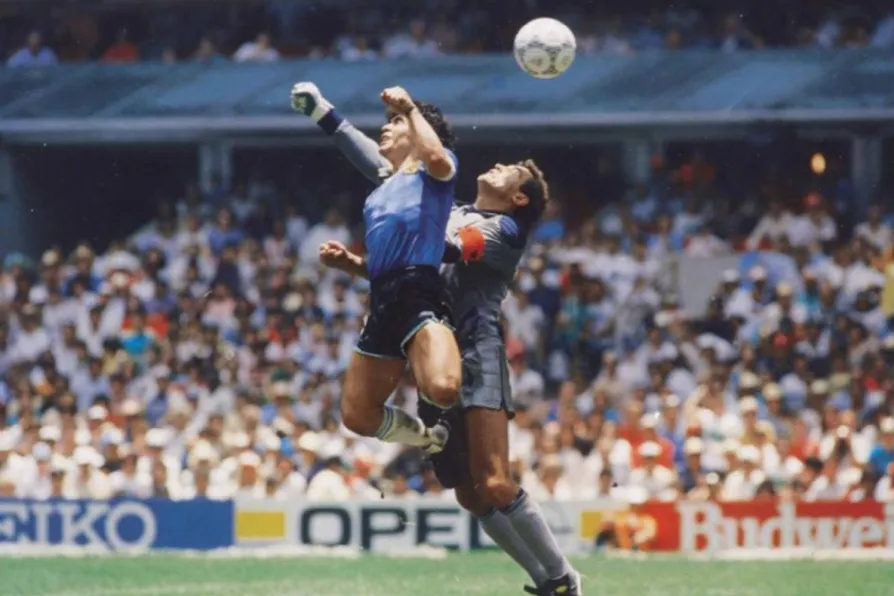
ASIF BURHAN explores why England v Argentina remains football’s most politically and culturally charged fixture in his new book
Football may not solve the working class’s problems, but it does matter — and politicians know it, writes BERT SHOUWENBURG